
Specifying a wooden playground is a 10–15 year commitment. Facility teams must weigh budget, durability and safety while comparing timber, steel and PE board quotes that rarely use the same criteria.
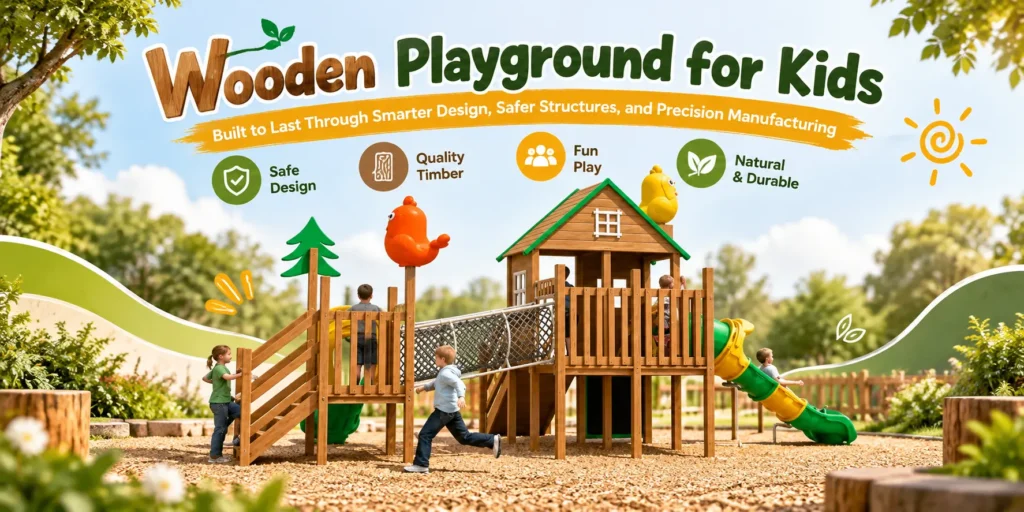
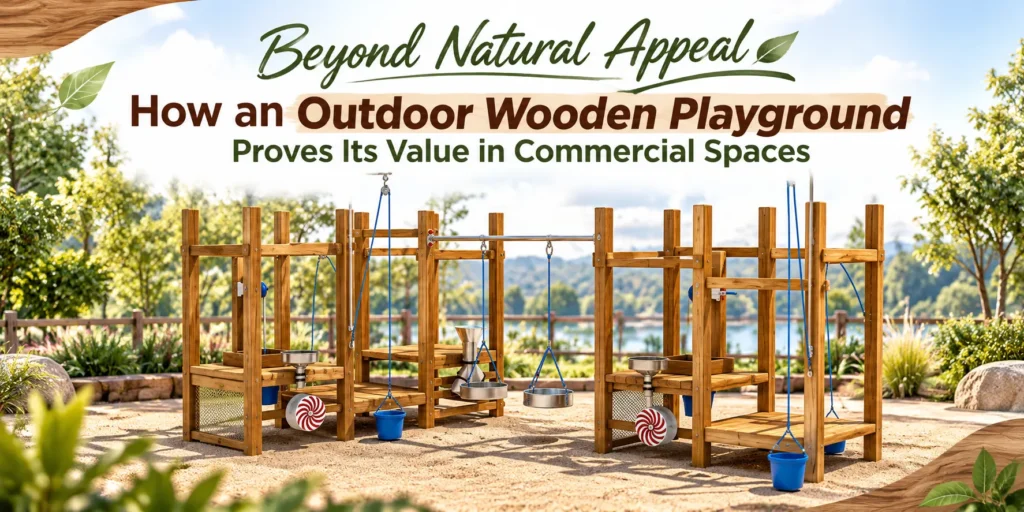
A wooden playground is a play structure built from timber components, including posts, decks, cladding and access features, supplied as preconfigured playsets, custom designs or modular indoor systems for commercial use.
The sections below cover materials, durability trade-offs and procurement checks.
Wooden Playground Materials and Product Categories for Commercial Projects
Supplier pages group timber play equipment by species, configuration and setting. Cedar and redwood dominate outdoor ranges because both resist rot without chemical treatment. Redwood is denser and holds shape through wet-dry cycles; cedar is lighter, so freight per unit is lower.
- Cedar — natural decay resistance, lightest of the three, weathers to a grey finish.
- Redwood — tighter grain, better dimensional stability, highest cost per linear metre.
- Treated pine or natural wood — lowest upfront price, but timber typically needs re-oiling every 12–24 months.
Three product categories map to commercial buyers: preconfigured outdoor playsets for rapid install, custom designs for fixed footprints and colour requests, and indoor wooden play sets for weather-independent venues. Each option carries a different maintenance and lifecycle profile, which matters when you weigh timber against steel and PE board.
Wooden vs. Steel and PE Board Playground Structures: Durability and Lifecycle Trade-offs
Timber, powder-coated steel and PE board differ less in whether they work than in how often you touch them. Treated timber frames typically need re-sealing every 12–24 months. Powder-coated steel needs occasional rust touch-ups where coatings chip. PE board panels are washed rather than refinished, though they fade under strong UV.
That pattern shapes playground lifecycle cost. Timber’s lower upfront price is offset by recurring labour and inspection time, so playground maintenance cost can pass the original purchase over a decade. Steel holds shape across long spans and busy swing bays; PE board suits low-level clamber units and damp sites where rot is the main risk.
| Material | Durability | Maintenance | Best fit |
|---|---|---|---|
| Treated timber | Strong when sealed; ground-contact posts rot first | Re-seal every 12–24 months; check fixings | Sheltered parks, natural-look playscapes |
| Powder-coated steel | High structural strength; chips expose rust | Touch up chips every 3–5 years | Swing bays, high-traffic zones |
| PE board | Rot- and splinter-resistant; fades in UV | Wash down; swap single panels | Damp climates, low-level clamber units |
Match material to site conditions and staffing, not headline price. Indoor venues meet the same trade-off with different constraints: no rain, no UV, tighter footprints.
Indoor and Modular Wooden Playground Systems for Malls, Schools, and Family Venues
Indoor wooden systems suit sites where load-bearing floors, ceiling heights and fire routes already limit what you can install. Natural-wood frames bolt into modular bays, so a 20 m² corner can start small and gain a tower, bridge or gymnastic bar later without rebuilding the base. Most configurations share the same bolt-and-bracket joint, which keeps spare parts and staff training consistent across a portfolio.
Common modular configurations:
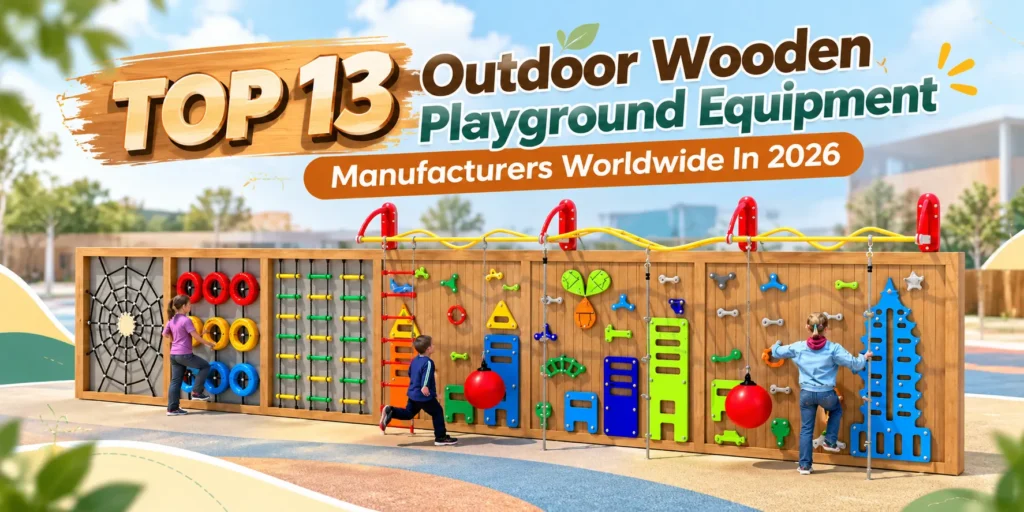
- Climbing cubes with gymnastic rings, bars and rope ladders at 1.2–2.4 m heights.
- Wall-fixed balance beams, ladders and finger-traverse panels for narrow corridors.
- Soft-fall timber decks with ramps, tunnels and slide exits.
- Add-on swing, net and ball-pit modules joined by the same fixings.
Mall installations
Plan for sightlines, queue space and cleaning access. Zoned bays of 15–30 m² let you rotate modules between atria and keep footfall moving past retail frontage.
School and nursery fit-outs
Climbing and gymnastic elements map to physical development goals. Wall-fixed frames free floor space, and a documented playground safety inspection checklist keeps termly checks quick.
Family entertainment venues
Toddler and junior zones expand on separate decks so age groups stay apart. Ring seating around the frame so carers keep visual contact, then review commercial playground ROI once attendance data settles.
Before committing budget, work through cost, safety and legacy equipment checks.
Cost, Safety, and Legacy Equipment Checks Before Buying a Wooden Playground
Retail wooden playsets often sit between £800 and £4,000, while self-build kits cut the headline price and move labour, groundworks and surfacing onto your own team. For commercial buyers, phase the spend and track playground investment value as cost per use: a £30,000 structure used by 200 children a day returns roughly £0.50 per visit within a year.
- Budget: compare quotes on identical footprint, surfacing and installation scope.
- DIY or trade: self-build suits small sites; busy venues need installation included.
- Legacy equipment: confirm whether older treated timber is restricted locally before extending an existing site.
- Holistic approach: assess the whole play area, not just the new unit.
- Inspection: log wear points, fixings and timber checks at set intervals.
A playground supplier review should confirm these points in writing. Procurement teams should settle phased delivery, cost per use and inspection ownership before signing.
About JQ Playground – commercialplaygroundreview.com
JQ Playground (Wenzhou Jiqi Amusement Equipment Co., Ltd.) is a children’s playground equipment manufacturer founded in 1993. The company provides design, customization, large-scale manufacturing, sales, installation guidance, and after-sales support for outdoor playgrounds, indoor playgrounds, soft play, water playgrounds, PE board playgrounds, kindergarten furniture, outdoor fitness equipment, pet playgrounds, and playground facilities. Approved company facts include 180+ employees, a large Wenzhou production base, 20+ production lines, 55 production machines, ISO/BSCI/EN1176/EN71/ASTM/CPC/CPSIC certification references, 100+ patents, free design support, OEM/ODM capability, trial installation before shipping, export experience, and one-year quality warranty.