A timber play unit can look right in a render and still fail on site when post sizes, fixings or fall zones are left until installation. That omission can delay handover by weeks and add inspection costs. Early specification checks prevent it.
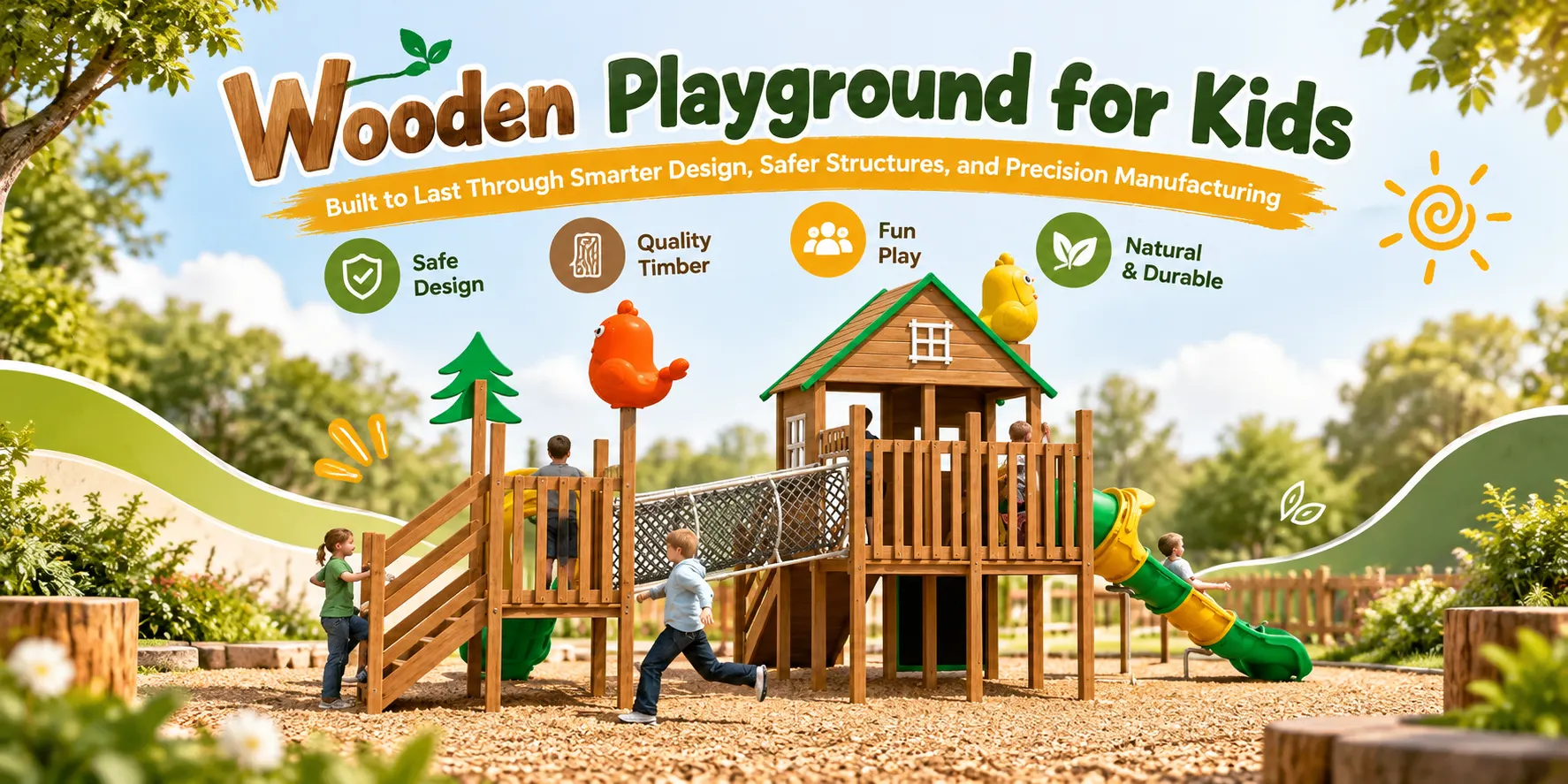
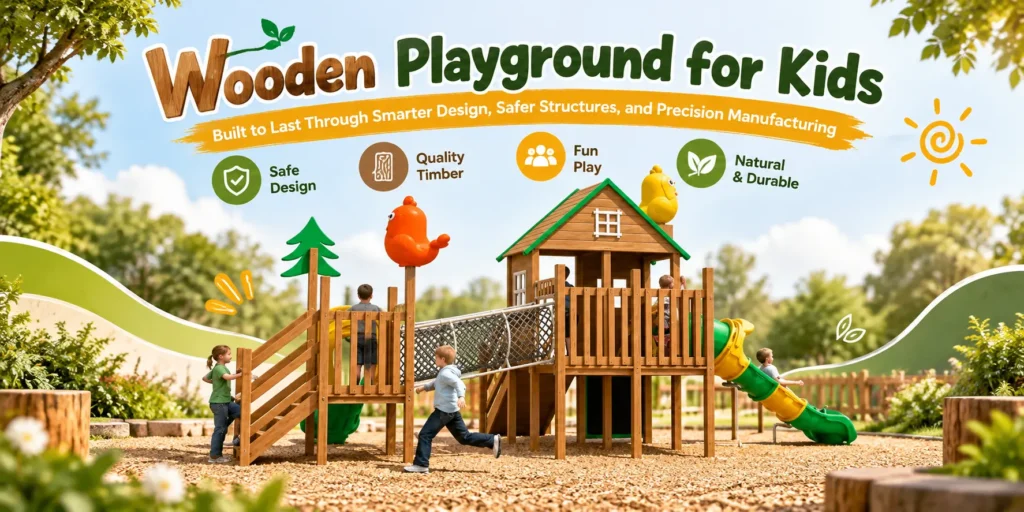
A wooden playground for kids is a play structure built mainly from timber posts, beams and panels for climbing, sliding, swinging and imaginative play. Buyers review it by age group, post dimensions, fixing method, fall height, surface clearance and compliance evidence. Timber species, treatment, hardware grade and modular layout affect durability and inspection frequency.
The next section explains how the structure works and what to verify before approval.
How Wooden Playground For Kids Work
Wooden playground for kids work by turning a timber frame into a load path: posts carry vertical weight, braces resist sway, and every fixing ties the deck or platform back to that frame.
- Site and layout check. Confirm ground conditions, fall height and useable zone before fixing module sizes.
- Frame assembly. Posts are set, levelled and braced so the structure stays square under swing or climb loads.
- Deck and access fit. Platforms, ladders and guardrails are matched to the intended age band.
- Surface and fixing review. Check footings, bolt covers and surfacing depth against the declared fall height.
- Repeatability test. Confirm the same parts, drill points and hardware recur across batches.
For commercial playground buying criteria, ask for the load and age-band assumptions behind each step.
Component Roles
Posts and beams carry load; diagonal braces control movement; deck boards and guardrails manage fall risk; galvanised or coated fixings hold the joints. Timber species, section size and preservative treatment decide how long those roles hold. A common buyer warning: a design drawing without fixing schedules or treatment class leaves installation quality unpredictable.
Next, compare the product categories that match your site brief.
Shop by Category
Buyers shortlist wooden playground for kids by matching the play pattern to the site, not by choosing the largest set. Use this category comparison before you send an RFQ.
| Category | Best for | Check before RFQ |
|---|---|---|
| Play tower with slide | Compact gardens and fenced zones | Platform height, guardrail gaps, slide run-off |
| Swing set | Shared, repeat-use play | Frame bracing, anchor type, beam span |
| Climbing frame or trail | Active routes and older children | Grip diameter, fall height, fixing points |
| Sandpit or activity panel | Low-level sensory play | Drainage, edge seating, panel fixings |
| Modular add-ons | Phased builds | Connector compatibility, spare parts |
- Timber species, profile, treatment data and expected playground lifecycle cost.
- Post size, platform height and ground fixing method.
- Bolt grade, coating, cap details and access to replacement parts.
- Fall zone, guardrail spacing and pedestrian traffic routes.
Use the site’s daily use pattern to narrow the shortlist before the application review.
Typical Applications for Wooden Playground For Kids
Site type sets the specification before catalogue photos do. Match each scenario to components, batch demand and proof.
- Schools and community trusts: lower platforms, ramps and enclosed decks suit supervised groups. Confirm guardrail heights, bolt connector fit and a playground safety inspection checklist covering anchor torque, splinter risk and fall zones.
- Commercial parks and malls: 8–12 activity points handle higher footfall. Ask for timber moisture readings, hardware batch codes and a replacement-part list; a commercial playground ROI model based on dwell time helps justify the layout.
- Hospitality and investors: compact tower-and-slide sets with replaceable panels work well. Request sample joints, finish swatches and packing lists matched to phased delivery.
Those checks turn a generic wooden playground for kids brief into a buildable specification for custom manufacturing and OEM cooperation.
Custom Wooden Playground For Kids Manufacturing and OEM Cooperation
Custom wooden playground for kids manufacturing and OEM cooperation runs through five stages: drawings or samples, sample confirmation, packaging, batch inspection and shipment. Pair every buyer input with a manufacturer output, so a playground supplier review compares documents rather than promises.
| Stage | Your input | Manufacturer output |
|---|---|---|
| Drawings or samples | Dimensioned sketch, footprint, play events, timber section, fixing details | Feasibility note and itemised quote |
| Sample confirmation | Approved finish, colour and hardware set | Pre-production sample plus agreed specification sheet |
| Packaging | Carton marks, flat-pack protection and label data | Packing plan and one pack sample |
| Batch inspection | Checkpoints, sampling level and photo evidence | One signed inspection record per batch |
| Shipment | Delivery window and loading sequence | Loading list and dispatch confirmation |
The inspection record should list timber grade, sanding standard, fastener count and hardware coating. That evidence supports playground investment value at handover and gives the next supplier comparison a fair basis.
Top 10 Wooden Playground For Kids Manufacturers and Supplier Fit
After inspection checks, build a wooden playground for kids shortlist by scale, safety paperwork and spare-part support, not catalogue size. Use commercial play area evaluation to compare timber treatment, hardware coating and spares lead times.
| Supplier type | Pros | Cons | Best fit |
|---|---|---|---|
| Integrated manufacturers | Towers, slides, swings from one line | Higher minimums; slow changes | Large parks, schools |
| Modular kit suppliers | Fast layout changes; repeatable packs | Less bespoke shaping | Community, mall areas |
| Custom joinery workshops | Flexible sizes; small batches | Variable paperwork; slow scale-up | Bespoke hotel, retail features |
| Import and trading suppliers | Wide price bands; mixed sourcing | Longer samples; spare-part risk | Budget rollouts with clear specs |
Score playground durability review evidence 1–5:
– Written treatment class, fastener coating and sanding standard.
– One sample per profile against the drawing set and packed dimensions.
– A spare-part list covering swings, slides, fasteners and at least two replacement cycles.
– At least three like-for-like quotes tied to the same drawing set.
These scores set the specification.
About JQ Playground – commercialplaygroundreview.com
JQ Playground (Wenzhou Jiqi Amusement Equipment Co., Ltd.) is a children’s playground equipment manufacturer founded in 1993. The company provides design, customization, large-scale manufacturing, sales, installation guidance, and after-sales support for outdoor playgrounds, indoor playgrounds, soft play, water playgrounds, PE board playgrounds, kindergarten furniture, outdoor fitness equipment, pet playgrounds, and playground facilities. Approved company facts include 180+ employees, a large Wenzhou production base, 20+ production lines, 55 production machines, ISO/BSCI/EN1176/EN71/ASTM/CPC/CPSIC certification references, 100+ patents, free design support, OEM/ODM capability, trial installation before shipping, export experience, and one-year quality warranty.