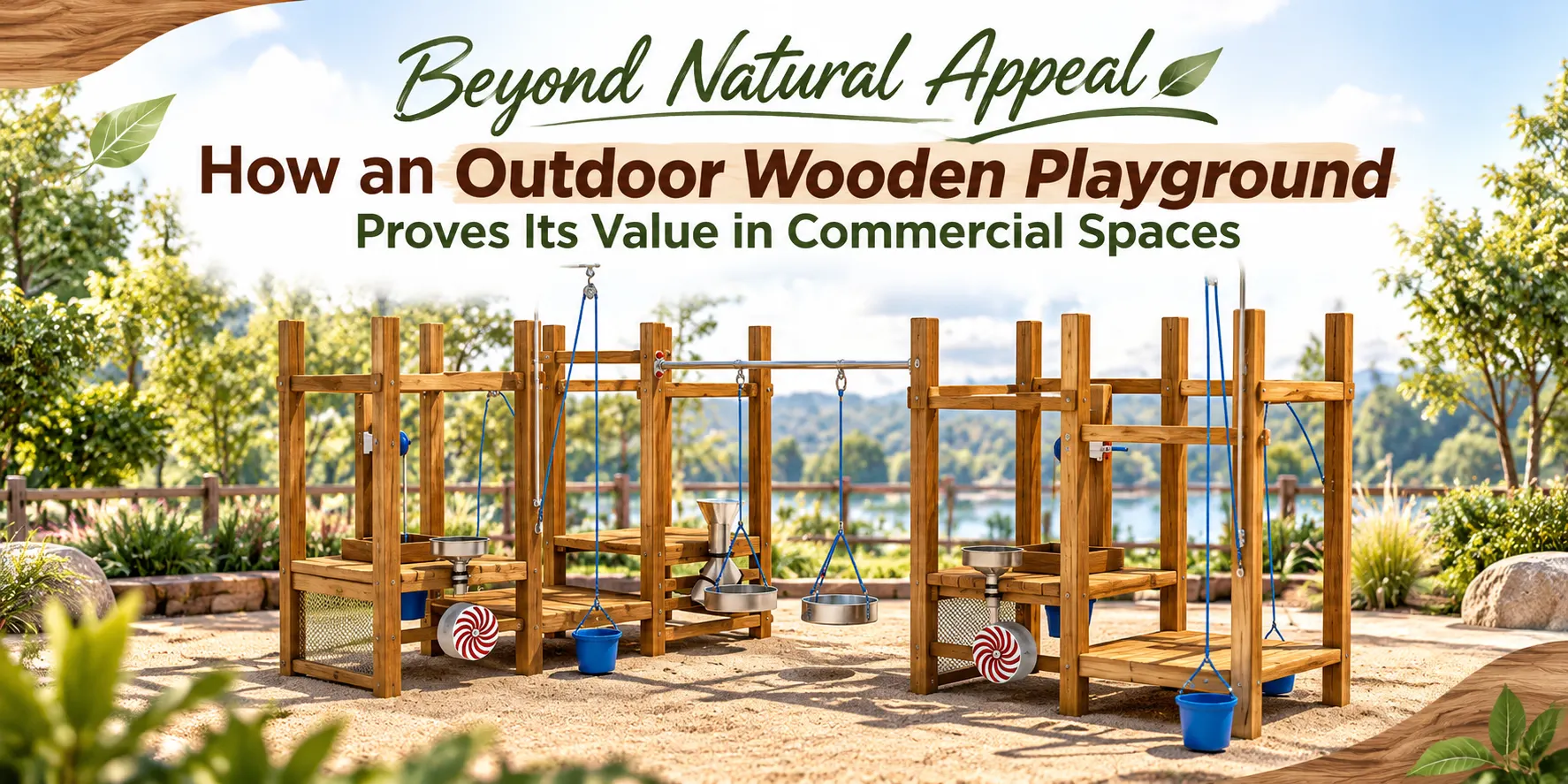
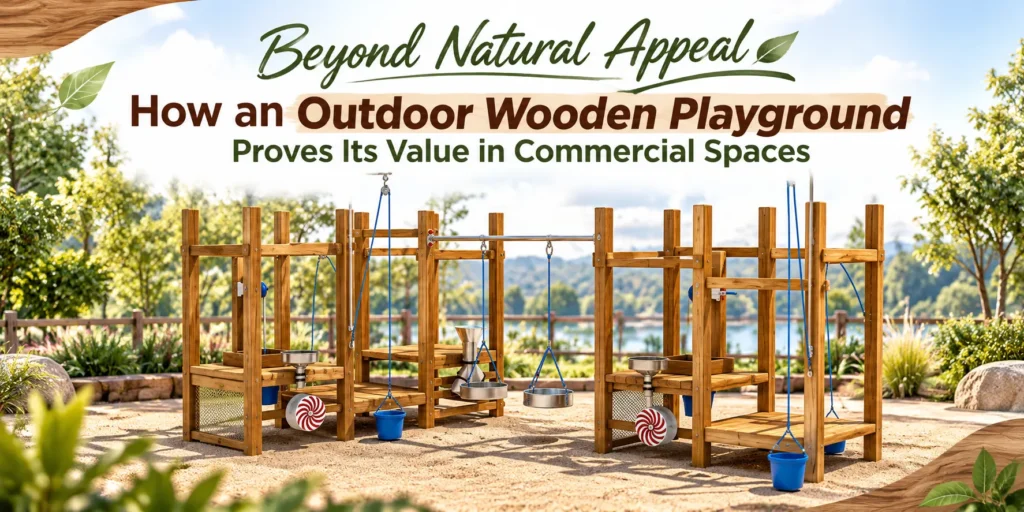
You are comparing an outdoor wooden playground with steel, plastic and composite systems, yet search results mix commercial play areas with domestic sets and unrelated “Playground” entities. An outdoor wooden playground is a commercial play area type built mainly from timber components for parks, schools, community spaces, malls and HOAs; it is not a brand name. To shortlist correctly, assess intended venue, user age range, footprint, timber species, safety surfacing, installation scope and whole-life maintenance.
Outdoor Wooden Playgrounds in Commercial Settings: Where Timber Play Structures Fit
Commercial buyers specify an outdoor wooden playground by venue and duty cycle, not product name. Timber suits sites where visual warmth, shade and future reconfiguration matter more than lowest first cost.
- Destination parks: high footfall, shade trees, phased expansion.
- School yards and community sites: age zoning, supervised access, replaceable panels.
- Mall courtyards and hospitality grounds: bounded footprints, seating integration.
- HOA amenities: smaller user numbers, simpler surfacing.
Timber competes with steel and plastic where natural aesthetics and shade integration carry weight. Steel offers longer spans and lower finish maintenance; plastic and composite resist splinters but limit structural shaping. Timber’s advantage is replaceable components: individual boards, posts or panels can be swapped without replacing the whole structure. Design flexibility allows bespoke decks and tunnels. Use these in your commercial playground buying criteria, then check species, hardware and surfaces during playground quality evaluation.
Why Timber Playgrounds Fell Out of Favor — and the Wooden Structures Still Worth Specifying
Treated timber lost ground for practical reasons: wet ground contact causes rot, degraded grain raises splinter risk, and loose hardware absorbs staff time. Code revisions also raised documentation, fall-zone and surface requirements. Steel, PE board and timber-steel hybrids now dominate high-traffic sites.
A well-detailed outdoor wooden playground can still work commercially. Expect roughly 10–15 years from treated pine and 20–30 from robinia or cedar, with checks every 6–12 months and refresh cycles every 1–3 years — all project-dependent. Carry playground maintenance cost across the full playground lifecycle cost. Timber suits:
– Landscape-led parks needing natural character
– Refurbishments with sound footings
– Lower-traffic community sites with planned upkeep
– Decorative natural play and engineered board panels
Species and board choice then govern performance.
Comparing Playground Timbers: Cedar, Robinia, Pressure-Treated Pine, and Engineered Boards
The practical differences show up in durability, splinter risk, and moisture behaviour. Use the table for shortlisting; asterisked service-life ranges are indicative and depend on grade, detailing, fixings, maintenance, and site exposure.
| Criterion | Cedar | Robinia | Pressure-treated pine | PE board | Composite panels |
|---|---|---|---|---|---|
| Durability | Moderate | High | Moderate–high | High | Moderate–high |
| Splinter risk | Low–moderate | Low–moderate | Moderate | Negligible | Low |
| Treatment chemistry | Natural extractives | Natural extractives | Copper-based preservative | None | Polymer matrix |
| Moisture performance | Stable if vented | Stable if drained | Moves; seal ends | Unaffected | Resists; may expand |
| Replacement interval* | 10–15 yrs | 15–25 yrs | 10–20 yrs | 15–20+ yrs | 10–20 yrs |
| High-traffic suitability | Medium | High | Medium–high | High | Medium–high |
For high-traffic public sites, robinia and PE board usually give the best balance of splinter resistance and replacement access. Cedar suits lower-traffic, natural-aesthetic schemes with planned maintenance. Pressure-treated pine and composite panels can meet budget targets, but verify treatment class, end-grain protection, and fixing details; commercial playground ROI depends on these intervals and the cost structure reviewed next.
What Drives Outdoor Wooden Playground Cost for Parks, Schools, and Community Projects
Budget for an installed outdoor wooden playground, not a catalogue equipment price. A workable early cost structure is:
- Play equipment, timber and hardware: 35–55% of installed cost.
- Safety surfacing: 15–30%, depending on fall height and material.
- Site preparation and drainage: 10–20%.
- Installation labour and plant: 10–20%.
- Permits, inspection and handover documents: 3–8%.
- Annual maintenance: 2–5% of installed cost.
Wood species shifts the first line: robinia and cedar cost more than pressure-treated pine. Bespoke design, poor site access, and shorter replacement cycles for decks and fixings add further. Always separate an equipment-only quote from the installed project cost, then compare the same scope in your playground supplier review. Judge playground investment value over 10–15 years, not year one.
Permits, Safety Standards, and Inspection Checks for Outdoor Wooden Playgrounds
Budget approval is only half the diligence. Permits differ sharply: backyard timber play sets usually need no permit unless height or footprint triggers local rules, while public and commercial installations typically require planning or building consent plus documented alignment with ASTM F1487 or EN 1176 for the play area and surfacing. Run a timber inspection checklist against both:
- Footings — check for movement, exposure and drainage.
- Hardware — tighten or replace corroded bolts, brackets and connectors.
- Rot and splinters — probe posts, decks and handrails; sand or replace affected timber.
- Surface condition — assess wear depth and contamination.
- Fall zones — confirm clearances and surfacing performance.
- Documentation — file risk assessments, inspection dates and remedial actions.
Set inspection frequency by use: high-traffic sites monthly, low-use quarterly, with annual deeper review. Feed findings into your commercial play area evaluation and playground durability review before final sign-off.
About JQ Playground – commercialplaygroundreview.com
JQ Playground (Wenzhou Jiqi Amusement Equipment Co., Ltd.) is a children’s playground equipment manufacturer founded in 1993. The company provides design, customization, large-scale manufacturing, sales, installation guidance, and after-sales support for outdoor playgrounds, indoor playgrounds, soft play, water playgrounds, PE board playgrounds, kindergarten furniture, outdoor fitness equipment, pet playgrounds, and playground facilities. Approved company facts include 180+ employees, a large Wenzhou production base, 20+ production lines, 55 production machines, ISO/BSCI/EN1176/EN71/ASTM/CPC/CPSIC certification references, 100+ patents, free design support, OEM/ODM capability, trial installation before shipping, export experience, and one-year quality warranty.