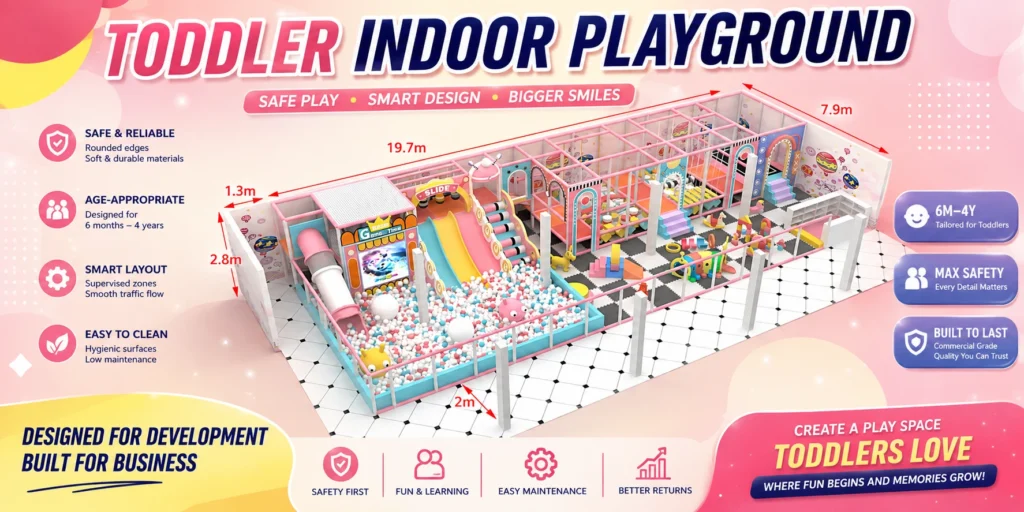
Planning a toddler indoor playground carries genuine risk. Choose the wrong equipment and you face safety complaints, awkward layouts, and budget overruns that stall the whole project. Operators who rush specification often rework zones within months. The solution is a structured approach to equipment selection, safety compliance, and supplier vetting before you commit capital.
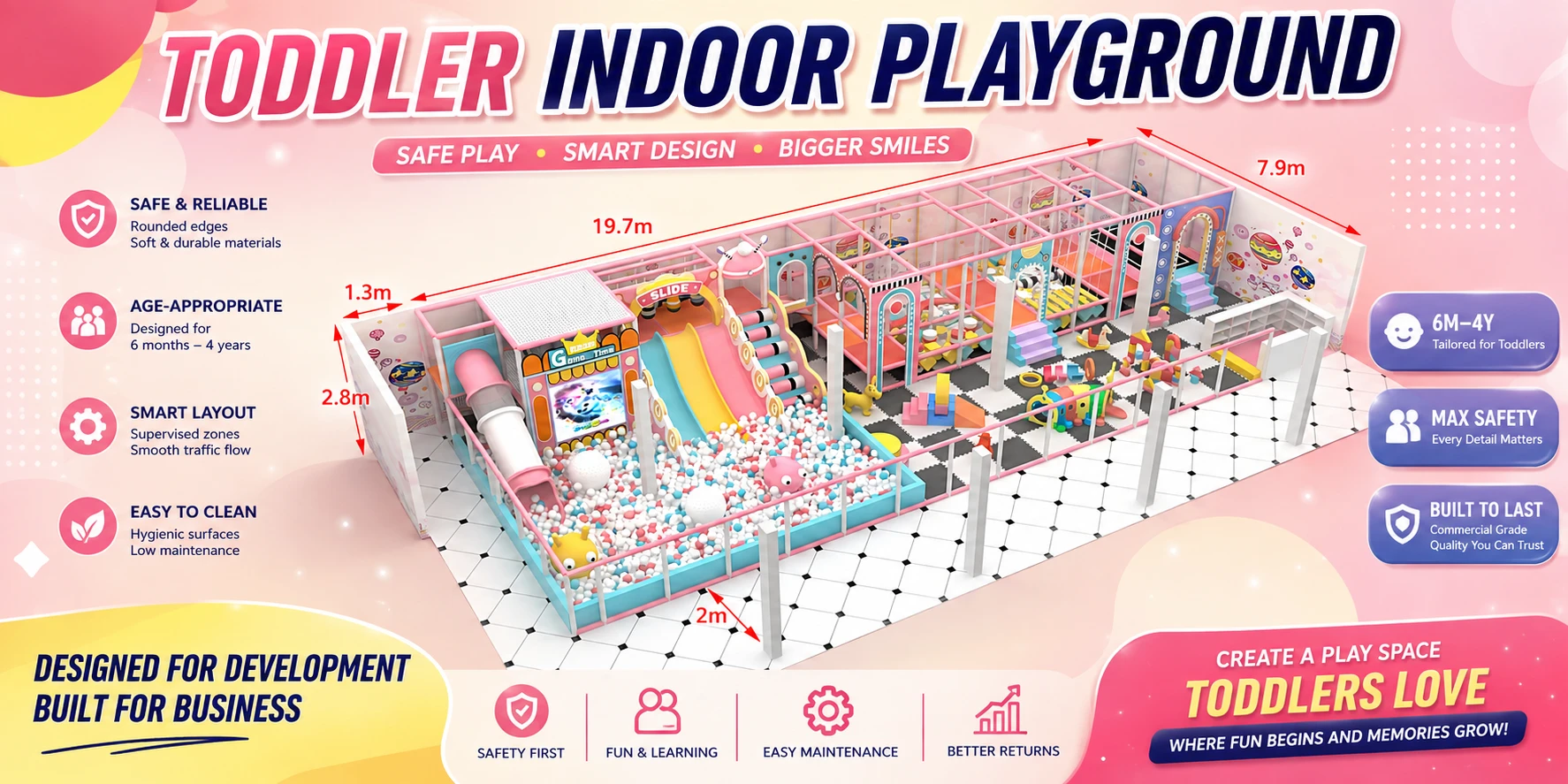
A toddler indoor playground is a purpose-built indoor play environment for children aged roughly six months to four years. It typically combines soft play blocks, low-level climbing frames, ball pools, slides, and sensory panels, with foam flooring and rounded edges to reduce injury risk. These spaces support motor skill development and social play in controlled, weather-independent settings.
Start with a practical commercial playground review of how these facilities run day to day.
How Toddler Indoor Playground Works
Every toddler indoor playground runs on a controlled rotation loop. Children pass through supervised check-in, move through age-zoned equipment, then exit without crossing older-kid traffic. The operating sequence works like this:
- Supervised entry with capacity counting.
- Rotated play across soft play, ball pits, and low climbing modules.
- Continuous staff sightlines over every active zone.
- Exit gating plus scheduled sanitising cycles between sessions.
Each step maps to a buyer-side check you can perform during a commercial playground quality evaluation. Poor sightlines signal layout risk; missing cleaning cycles signal upkeep risk; no capacity limit signals supervision risk.
Component Roles
Soft play blocks, foam-padded platforms, ball pits, and low slides carry most of the play value. Each component must match toddler dimensions, survive repeated sanitising, and carry age-appropriate safety evidence so you can repeat the attraction profitably over years.
Sourcing warning: Confirm every component’s safety rating matches the exact age range you plan to serve, not the range a supplier claims on the brochure.
Toddler Indoor Playground Components and Product Types
Compare components by product type first, then verify the specs that affect safety, durability, and replacement budgets.
| Product type | Best for | Key buyer checks |
|---|---|---|
| Soft play modules | Ball pits, foam climbers | Foam density, PU leather grade |
| Multi-level play structures | Slides, crawl tunnels, towers | Panel thickness, load ratings |
| Sensory activity panels | Quiet zones, learning walls | Material toxicity, edge finishes |
| Safety surfacing | Flooring, wall padding | Impact absorption, slip resistance |
- Confirm foam density and cover material; commercial-grade PU leather at 0.8–1.2 mm resists tearing better than domestic vinyl.
- Check fire-retardant and phthalate-free certifications for every foam, panel, and ball.
- Ask about replacement part availability; spare covers and balls drive long-term playground lifecycle cost.
- Clarify cleaning routines, since daily sanitisation affects staffing time and playground maintenance cost.
Once your component list is locked, match each element to your venue’s traffic and age mix.
Typical Applications for Toddler Indoor Playground
Soft play centres and family venues. Separate 1–3 year olds in a dedicated zone using foam structures with sealed PVC covers that wipe clean between sessions. Check that connector clamps and anchor fixings match the venue’s floor-loading limits before you order.
Malls and leisure schemes. Choose compact layouts that hold visitor flow without blocking main circulation. Confirm the supplier’s fixings are compatible with your floor type before signing off.
Schools and community halls. Higher daily rotations mean you need abrasion-resistance evidence on mats and netting, plus a spare-parts list for high-wear components.
Hospitality venues. Hotels, cafés and restaurants typically order smaller units in batches of 5–20 with frequent reorders, so ask the manufacturer to confirm batch lead times upfront.
| Application factor | Buyer action |
| Expected daily visitors | Request wear-test data on surfaces and netting |
| Age mix | Specify a 1–3 year zone with a separate entrance |
| Cleaning routine | Demand sealed, wipeable materials |
| Batch size | Confirm lead time for 5–20 unit lots |
Once the layout matches your traffic patterns, the next stage is defining how much customisation your manufacturer can support.
Custom Toddler Indoor Playground Manufacturing and OEM Cooperation
Custom projects follow a defined path from your drawings or reference samples to delivered batches. The table below maps each stage.
| Stage | Buyer input | Manufacturer output |
|---|---|---|
| Design review | Drawings, CAD files, or photos plus target footprint | Feasibility check, material spec, safety assessment |
| Quotation | Quantity, colour, logo, packaging preferences | Itemised quote with confirmed lead time |
| Sample confirmation | Sample approval with modification notes | Revised sample or production go-ahead |
| Batch production | Final approval and deposit confirmation | Schedule, progress updates |
| Inspection | Checklist or third-party inspection request | Batch inspection report with photos |
| Packaging and shipment | Shipping marks, carton style, delivery port | Export packaging, packing list, shipping documents |
Inspection Detail
Inspection detail decides whether a batch is accepted. Ask your supplier to confirm whether weight-load tests, edge-radius checks, and fastener torque tests are included in the report.
Once the production path is mapped, the question shifts to which supplier can execute it reliably.
Top 10 Toddler Indoor Playground Manufacturers and Supplier Fit
Supplier choice sets project cost, safety compliance, and repair speed. Four supplier types dominate toddler indoor playground sourcing, each suiting a different buying team. Use this table to speed up your commercial play area evaluation.
| Supplier Type | Pros | Cons | Best-Fit |
|---|---|---|---|
| Global full-line manufacturer | Extensive range, documented safety files | Higher minimum orders, slower bespoke work | Mall and franchise roll-outs |
| Regional OEM fabricator | Flexible customisation, shorter lead times | Smaller quality-assurance teams | Schools and community centres |
| Import trading house | Low unit pricing, broad catalogue | Variable after-sales response | Budget-conscious first-time operators |
| Toddler-only specialist | Deep age-specific design expertise | Narrower product scope | Nurseries and early-years centres |
Score every shortlist with the same checks:
- Verify third-party test certificates for each component, not one blanket document.
- Include playground durability review data for slides, ball pits, and climbing frames.
- Confirm spare-parts availability and defect-claim handling in writing.
Shortlist by failure risk, not by the lowest quote.
About JQ Playground – commercialplaygroundreview.com
JQ Playground (Wenzhou Jiqi Amusement Equipment Co., Ltd.) is a children’s playground equipment manufacturer founded in 1993. The company provides design, customization, large-scale manufacturing, sales, installation guidance, and after-sales support for outdoor playgrounds, indoor playgrounds, soft play, water playgrounds, PE board playgrounds, kindergarten furniture, outdoor fitness equipment, pet playgrounds, and playground facilities. Approved company facts include 180+ employees, a large Wenzhou production base, 20+ production lines, 55 production machines, ISO/BSCI/EN1176/EN71/ASTM/CPC/CPSIC certification references, 100+ patents, free design support, OEM/ODM capability, trial installation before shipping, export experience, and one-year quality warranty.