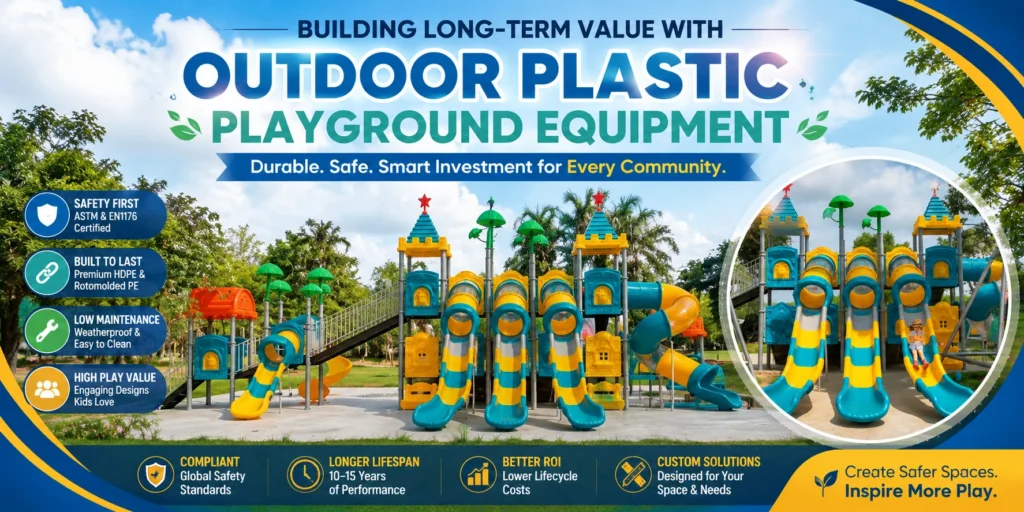
Finding playground equipment that withstands public use, meets safety standards, and fits your budget can feel like a gamble. You need structures that last years in all weather without constant repairs. Making the wrong choice means higher lifecycle costs and unhappy users.
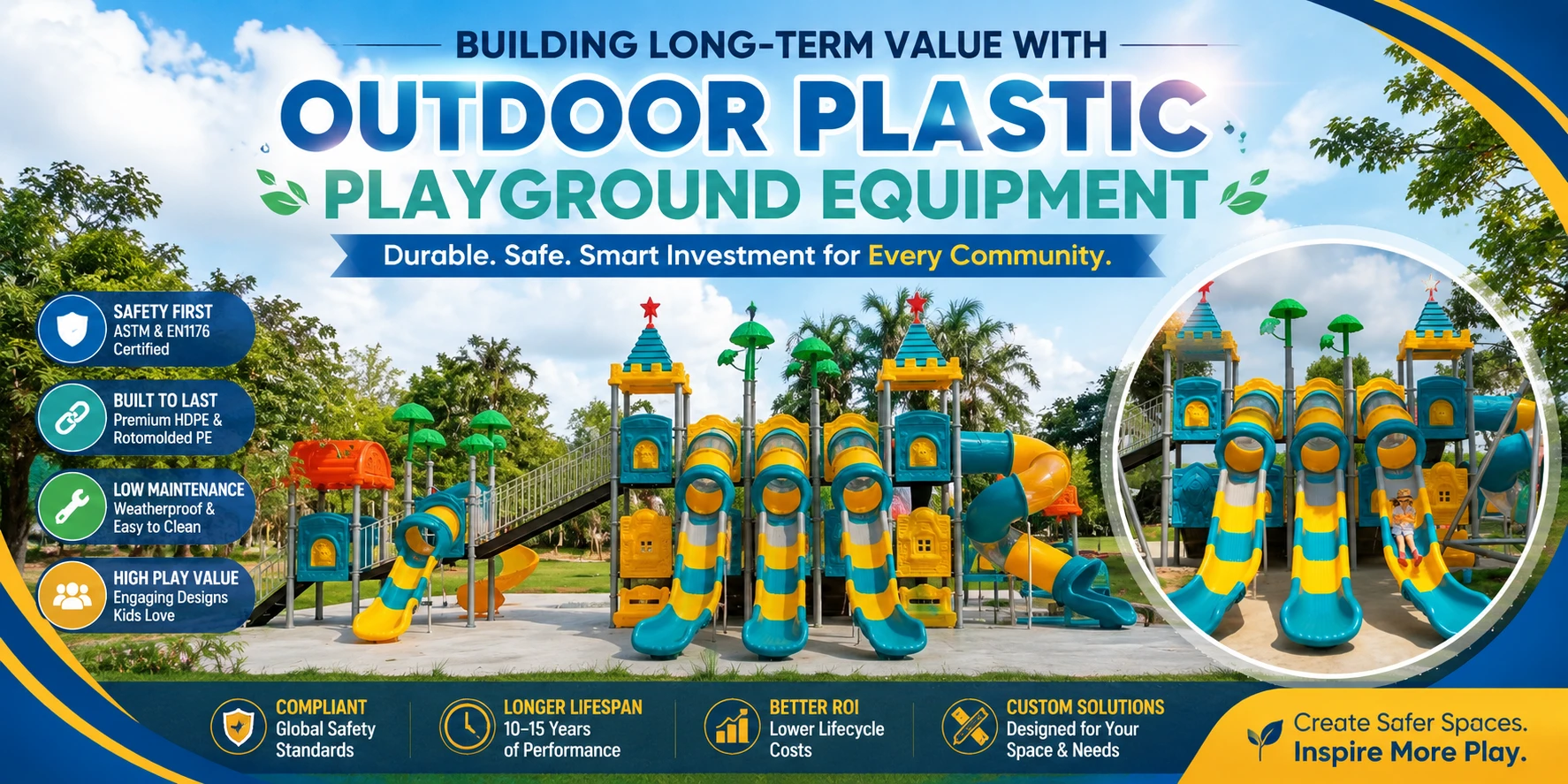
Outdoor plastic playground equipment refers to play structures and components made from engineered plastics such as HDPE and rotomolded polyethylene. These materials are designed specifically for public parks, schools, and commercial spaces, offering durability and low maintenance.
This guide covers material comparisons, safety standards, manufacturer selection, and procurement best practices to streamline your purchasing decision. Whether you’re conducting a commercial playground review or a full commercial playground equipment review, the following sections provide the evidence-based criteria you need.
Key Plastic Materials: PE Board, HDPE, and Rotomolded
The three plastics dominating commercial playgrounds are polyethylene (PE) board, high-density polyethylene (HDPE) sheet, and rotomoulded polyethylene. Each material offers distinct trade-offs in durability, UV resistance, maintenance, cost, and application fit. The table below summarises the key differences to support your commercial playground buying criteria.
| Material | Durability | UV Resistance | Maintenance | Cost | Typical Applications |
|---|---|---|---|---|---|
| PE Board | Moderate; prone to scratching under heavy use | Low; fades within 2–3 years without additives | Requires periodic cleaning and UV protectant | Low | Budget community play sets, indoor–outdoor transitional zones |
| HDPE | High; impact resistance per ASTM D256, resists cracking | Good; 5–10 year UV-stabilised warranty common | Low; washes clean with soap and water | Moderate | Themed play panels, signs, roofs, slides, and climbing holds |
| Rotomoulded PE | Very high; uniform wall thickness, resists vandalism | Excellent; UV package can exceed 10 years | Minimal; colour is moulded through, not coated | High | High-traffic structures, multi-user units, water play components |
Project-scale guidance. Rotomoulded panels suit busy public parks and school yards where impact and graffiti are daily risks. HDPE works well for custom-themed installations – you can laser-cut shapes and add bright colours without delamination. PE board fits tight-budget community playgrounds where replacement frequency is acceptable. All three materials must comply with ASTM F1487 or EN 1176 fall-height and entrapment criteria, which we cover in the next section on safety certifications.
Safety Certifications Every Commercial Buyer Should Know
ASTM F1487 (USA) and EN 1176 (Europe) are the two dominant safety standards for commercial playground equipment. Both specify minimum requirements for impact zones, entrapment prevention, sharp edges, and structural stability. Compliance is non-negotiable if you expect insurance coverage and regulatory approval. Never accept a manufacturer’s claim of “meets standards” without third-party evidence.
Key safety features these standards address:
– Impact attenuation – the surfacing and equipment must limit peak deceleration to below 200 g’s under a fall from the maximum platform height. Tested with a headform drop test.
– Entrapment hazards – no openings between 89 mm and 230 mm (EN 1176) that could trap a child’s head or torso. Also check shear and crush points.
– Sharp edges, corners, and protrusions – all plastic edges must be radiused or rolled. Fasteners must be recessed or capped.
– Anchoring and stability – equipment must resist overturning under a lateral load of at least 1.5 times the applied load, with permanent anchoring to concrete footings or ground anchors.
Third-party certification bodies like TÜV, ASTM itself (via accredited labs), and Intertek verify compliance. A certificate from an ISO 17025-accredited lab carries real weight.
Checklist for reviewing manufacturer compliance documentation:
– Do they provide a current Certificate of Compliance from an accredited lab?
– Does the certificate reference the correct standard (ASTM F1487 or EN 1176) and the specific model number?
– Are installation and anchoring instructions included that match the site’s soil and wind conditions?
– Have they supplied post-installation inspection reports (e.g., fall-height tape, entrapment gauge results)?
– Is there a maintenance schedule that covers periodic checks of impact attenuation and hardware tightness? Skipping these steps inflates your playground maintenance cost and shortens your playground lifecycle cost.
Evaluating Manufacturers for Commercial-Grade Equipment
A supplier’s track record tells you more than glossy brochures. For a project that must last 10–15 years, you need concrete evidence of capability. Use these criteria to separate qualified manufacturers from those selling on promises alone.
- Years in business and project portfolio – Look for at least five years of operational history with a portfolio matching your site type (school, public park, housing development). Ask for photos of installations from similar climates and usage levels.
- Customisation capabilities – Can they produce custom colours, themed panels (e.g., castle, pirate ship), or integrate your brand logo? Verify whether they own in-house moulding or outsource, which affects lead time and consistency.
- Warranty terms – Expect 10–15 years on HDPE panels and rotomolded components, 5 years on hardware and moving parts, and 1–2 years on UV stability. A manufacturer that offers less may be cutting corners on material quality.
- Post-installation support – Does the supplier provide a written maintenance schedule, spare parts availability for 10+ years, and on-site inspection training? Request their playground safety inspection checklist as a sign of commitment to long-term safety.
- Reference sites and sample policy – Visit a completed project that is at least three years old. Look for fading, warping, or loose hardware. Also request a physical material sample – most reputable suppliers provide small HDPE colour swatches and rotomolded test pieces.
Red flags to watch for. Vague certifications (e.g., “third-party tested” without naming the body), unwillingness to share customer references, and warranty clauses that exclude “normal wear” or UV degradation. Avoid suppliers who cannot supply a physical sample or a site visit within 30 minutes’ drive of your location.
The right manufacturer directly affects your commercial playground ROI – fewer replacements, lower maintenance costs, and higher utilisation. Once you have shortlisted candidates, move to the procurement stage to lock in price, timeline, and delivery terms.
A Practical Procurement Guide for Outdoor Playground Equipment
Writing a clear specification is the foundation of a successful RFQ for outdoor plastic playground equipment. Include the exact quantity of units, material type (HDPE, rotomolded), colour options, site dimensions, and intended age range. Specify delivery timelines — typically 8-12 weeks for custom orders — and whether installation is required. A structured RFQ avoids costly change orders later.
Warranty terms vary by manufacturer and material. Standard HDPE coverage runs 5-10 years against fading and 10-15 years against structural defects. Rotomolded parts often carry 10-year coverage for breakage and UV degradation. Always request the full warranty document; some policies exclude fade after year five.
Lifecycle cost analysis goes beyond the purchase price. A £12,000 HDPE structure may cost £500 per year in maintenance, with a replacement interval of 12-15 years. A £20,000 rotomolded unit might cost £300 annually and last 18-22 years. Over two decades, the more expensive option saves £3,000-5,000 in total ownership cost.
For a structured procurement process, follow five steps: (1) write a detailed specification, (2) send RFQs to at least three suppliers, (3) compare warranty terms, (4) request lifecycle cost projections for year 5, 10, and 15, and (5) confirm delivery lead times and installation support before signing.
| Material | Typical Warranty | Coverage Details |
|---|---|---|
| HDPE | 5-10 years | Fade, structural defects |
| Rotomolded PE | 10-15 years | Breakage, UV degradation |
| PE Board | 3-5 years | Delamination, colour fastness |
A thorough RFQ process and clear warranty terms directly improve playground investment value — you avoid hidden costs and secure a structure that performs for its full lifespan. Including a playground supplier review at the procurement stage validates whether quoted terms match real-world delivery.
When evaluating suppliers, consider manufacturers with proven experience and comprehensive support. For example, JQ Playground, established in 1993, offers over three decades of expertise in outdoor plastic playground equipment. With 180+ skilled workers, a 60,000 sqm production base, 20+ production lines, and certifications including ASTM and EN1176, they provide free CAD-based design support and trial installation before shipping. Such capabilities can significantly streamline your project and ensure quality.
About JQ Playground – commercialplaygroundreview.com
JQ Playground (Wenzhou Jiqi Amusement Equipment Co., Ltd.) is a children’s playground equipment manufacturer founded in 1993. The company provides design, customization, large-scale manufacturing, sales, installation guidance, and after-sales support for outdoor playgrounds, indoor playgrounds, soft play, water playgrounds, PE board playgrounds, kindergarten furniture, outdoor fitness equipment, pet playgrounds, and playground facilities. Approved company facts include 180+ employees, a large Wenzhou production base, 20+ production lines, 55 production machines, ISO/BSCI/EN1176/EN71/ASTM/CPC/CPSIC certification references, 100+ patents, free design support, OEM/ODM capability, trial installation before shipping, export experience, and one-year quality warranty.