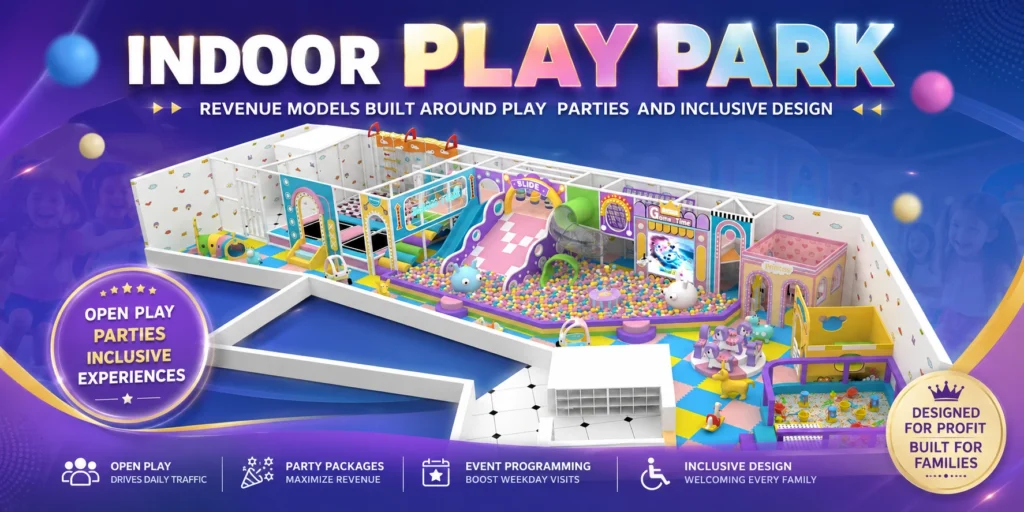
Indoor play parks have grown into a standalone commercial category. Search results for “indoor play park” return a familiar mix: venue pages promoting their own attractions, plus local roundups comparing options within one metro. For operators and investors, that pattern signals both opportunity and competition.
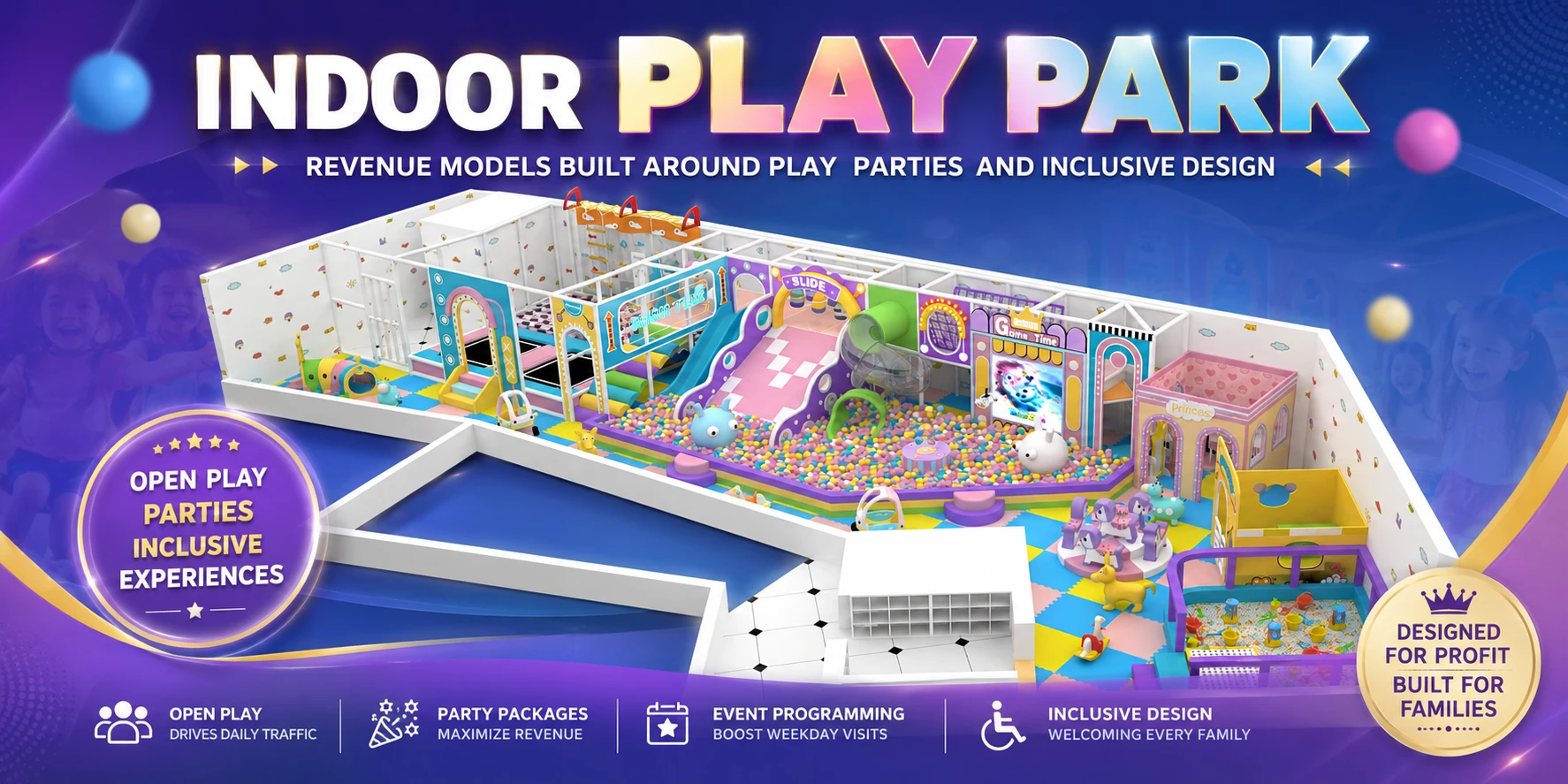
An indoor play park is a climate-controlled family entertainment venue combining open-play areas, party services and structured attractions under one roof.
Before committing to a site or equipment package, you need market benchmarks, service pillars and equipment choices grounded in what successful venues actually offer.
Indoor Play Park Market Overview: Flagship Venues and Location Patterns
The top-ranking venues for “indoor play park” cluster around the New York metro area, giving you a dense, competitive reference market for layout and service planning. Four results dominate the SERP: Complete Playground, Flying Apple, Kids Town, and a Brooklyn magazine roundup. Their claims mark the range you should benchmark:
- Complete Playground positions itself as a non-profit inclusive family centre, with sensory-friendly hours and central Brooklyn access.
- Flying Apple claims to be the largest indoor playground in the region, pairing open play with party-focused programming.
- Kids Town operates as a commercial party centre, emphasising celebrations and group bookings.
- The Brooklyn roundup cross-lists venues, confirming that location and transit access drive search visibility.
The mix of non-profit and commercial operators matters for your feasibility study. A non-profit model signals grant funding and community support, while commercial venues rely on ticket and party revenue. That split affects pricing, staffing levels, and the service pillars you must plan first.
Core Service Pillars: Open Play, Parties, and Event Programming
Once the operator model is fixed, the service pillars decide your floor plan, staffing, and revenue mix. The highest-ranking venue pages repeat a four-part structure. Flying Apple’s site is built on Open Play, PLAY. PARTY. CELEBRATE., PLAN YOUR VISIT, and upcoming events; Complete Playground routes visitors through a dedicated party reservation flow.
- Open play is the volume driver. Admission tickets smooth daily cash flow, but they also dictate supervision ratios, cleaning cycles, and wear on climbing structures and ball pits.
- Parties are the margin driver. Fixed-package bookings bring lump-sum revenue and predictable headcounts, so allocate a dedicated party room with its own entrance and storage.
- Event programming fills weekday gaps. Storytime, seasonal celebrations, and sensory-friendly hours build return visits between weekend peaks.
- Plan-your-visit content — hours, admission, FAQs — cuts call volume and sets capacity expectations before customers arrive.
Admission Pricing and Facility Size Benchmarks for Planners
Before committing to a layout, compare admission and scale signals from featured venues. Open-play entry typically runs £8-£16 per child, with sibling discounts lowering effective rates. Party packages — the main revenue lever — price at £15-£25 per child for two hours including a host, food, and room hire.
| Facility type | Price signal | Scale signal |
|---|---|---|
| Neighbourhood play café | £6-£10 per child open play | 3,000-8,000 sq ft; 50-80 capacity |
| Mid-size indoor play park | £10-£16 per child; parties from £350 | 10,000-25,000 sq ft; 150-250 capacity |
| Flagship family entertainment centre | £14-£20 day pass; £40-£60 monthly | 30,000-50,000 sq ft; 300-500 capacity |
Use these figures to shape your projections:
- Price entry 10-15% below the flagship rate for family-heavy catchments, then recover margin through party upsells.
- Reserve 25-30% of floor area for party rooms, queueing, and check-in; capacity benchmarks assume that buffer.
- Test your break-even ticket price against commercial playground ROI before fixing square footage.
Attraction Mix and Zone Design: From Slides to Sensory-Friendly Hours
An indoor play park’s attraction mix splits into high-energy zones and calm, inclusive areas. Equipment lists across ranked venues follow a consistent pattern:
- Multi-level slides and tube slides for older children
- Ball pits and foam-block pits sized for toddler safety
- Climbing structures, tunnels, and scramble nets
- Sensory-friendly hours with dimmed lighting and lower music
- Inclusive equipment such as wide ramps and accessible platforms
Balance is the zoning principle. Complete Playground’s sensory-friendly hours signal an emerging standard rather than an optional extra. Locate quiet rooms away from slide exits and party rooms, with acoustic buffering between zones. Pair every high-energy structure with a low-stimulation fallback so families can alternate. That mix shapes equipment selection: specify noise-damping panels and soft-impact flooring early in the layout.
About JQ Playground – commercialplaygroundreview.com
JQ Playground (Wenzhou Jiqi Amusement Equipment Co., Ltd.) is a children’s playground equipment manufacturer founded in 1993. The company provides design, customization, large-scale manufacturing, sales, installation guidance, and after-sales support for outdoor playgrounds, indoor playgrounds, soft play, water playgrounds, PE board playgrounds, kindergarten furniture, outdoor fitness equipment, pet playgrounds, and playground facilities. Approved company facts include 180+ employees, a large Wenzhou production base, 20+ production lines, 55 production machines, ISO/BSCI/EN1176/EN71/ASTM/CPC/CPSIC certification references, 100+ patents, free design support, OEM/ODM capability, trial installation before shipping, export experience, and one-year quality warranty.