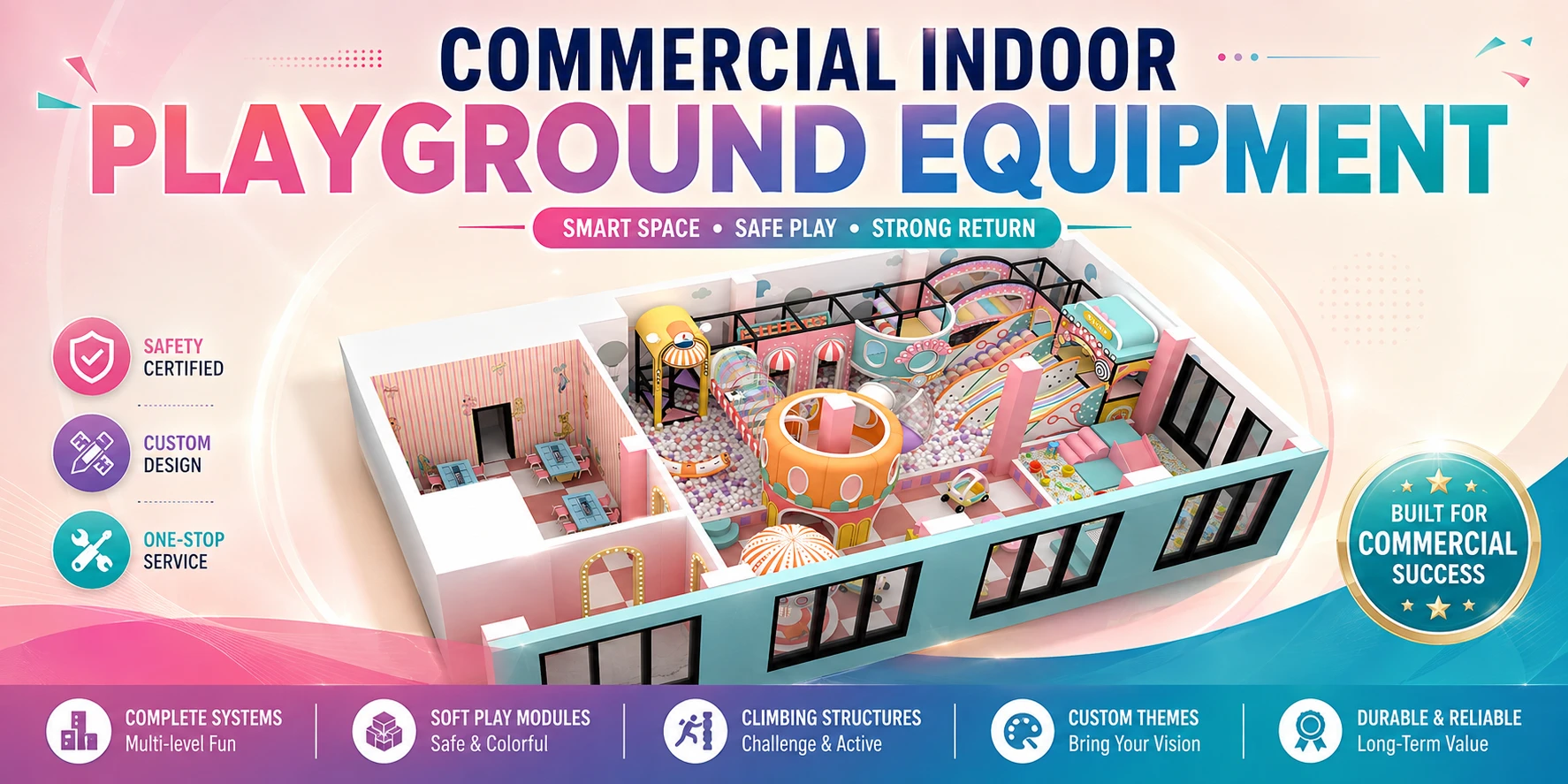
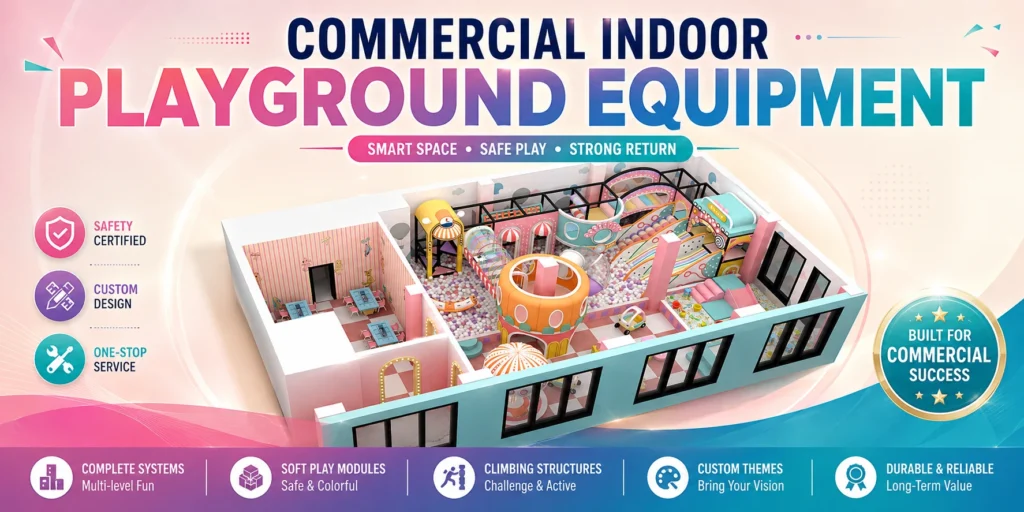
Before you commit budget to a new indoor play area, the range of available systems can complicate the decision. You need a clear overview of product categories, cost drivers, safety requirements, and customisation services to shortlist the right supplier. Commercial indoor playground equipment refers to heavy-duty, code-compliant play structures, soft play modules, and custom-themed systems designed for high-traffic indoor venues such as malls, schools, and family entertainment centres.
This commercial playground equipment review covers the four key buying considerations: product categories, cost drivers, safety compliance, and custom design.
Commercial Indoor Playground Equipment: Product Categories and System Configurations
Structure your commercial playground buying criteria around four equipment categories, each suited to different spaces and age groups.
- Complete playground systems: multi-level units with slides, tubes and platforms; Go Play Systems lists 6 ft H x 20 ft W x 24 ft examples plus replacement parts.
- Soft play modules: foam shapes and obstacles for toddlers and low-impact zones.
- Climbing structures: netted or rigid towers that challenge older children.
- Custom-themed playsets: concept-driven designs for malls and entertainment centres.
System configurations vary by venue type and age group. Compact mall layouts need high play rotation in limited square footage, while schools and community centres favour open layouts for younger children. CedarWorks builds 2&Over commercial sets with hardwood frames and kid-friendly materials; Dreamland publishes best-selling products and case studies to support your comparison.
Key Cost Drivers That Affect Commercial Indoor Playground Pricing
Commercial indoor playground equipment pricing is rarely a flat per-square-metre rate. Five variables shape most quotes:
- Floor area and ceiling height. Larger footprints and taller structures increase material volume, engineering input, and installation time.
- Equipment type. Soft play modules typically cost less than rigid playsystems with load-bearing frames and moving components.
- Custom theming. Branded or sculpted features add design and fabrication labour.
- Safety surfacing and fall protection. Impact-absorbing mats or poured rubber add significant cost.
- Labour and maintenance. Installation complexity and ongoing playground maintenance cost affect total ownership.
Prices vary widely by configuration and site conditions, so Dreamland publishes an estimated cost analysis page to guide initial budgeting. Before committing, request a detailed quote that itemises equipment, shipping, and installation separately — then compare your safety compliance checklist against the specification.
Safety Standards and Compliance Checklist for Indoor Playground Procurement
Safety evidence sits at the top of any procurement file. Treat this as your playground safety inspection checklist:
- Verify ASTM F1487 (US) or EN1176 (Europe) certification for every structure.
- Confirm non-toxic, kid-friendly finishes on all materials — including paints, seals, and adhesives.
- Check fall surfacing depth and clearance zones against the manufacturer’s drop-height ratings.
- Request inspection certificates, maintenance logs, and installation documentation before delivery.
CedarWorks publishes its safety standards for commercial indoor playsets, while Dreamland maintains a dedicated compliance section — both are useful reference points during shortlisting. Also factor in ADA accessibility routes and local building codes, which sit alongside third-party certifications.
How to Approach Custom Indoor Playground Design and Installation
A custom commercial indoor playground equipment project works best when handled as a single, accountable process. Start with a site assessment and space planning, measuring footprint, ceiling height, and entry routes. Then select a theme and brief the designer on custom sizes, integrated branding, and age-group requirements. Move to engineering and prototyping, where structural loads and safety clearances are validated before production. Fabrication and quality control follow, with materials checked against your specification. Finally, arrange professional installation and post-install support, including inspections and spare parts.
Leading suppliers position themselves as “one experienced partner — from the first sketch to years of support,” and many offer coordinated solutions for malls, schools, and community centres. During your playground supplier review, weigh that end-to-end service against playground investment value — ask for a timeline, itemised costs, and a named installation team before signing.
About JQ Playground – commercialplaygroundreview.com
JQ Playground (Wenzhou Jiqi Amusement Equipment Co., Ltd.) is a children’s playground equipment manufacturer founded in 1993. The company provides design, customization, large-scale manufacturing, sales, installation guidance, and after-sales support for outdoor playgrounds, indoor playgrounds, soft play, water playgrounds, PE board playgrounds, kindergarten furniture, outdoor fitness equipment, pet playgrounds, and playground facilities. Approved company facts include 180+ employees, a large Wenzhou production base, 20+ production lines, 55 production machines, ISO/BSCI/EN1176/EN71/ASTM/CPC/CPSIC certification references, 100+ patents, free design support, OEM/ODM capability, trial installation before shipping, export experience, and one-year quality warranty.