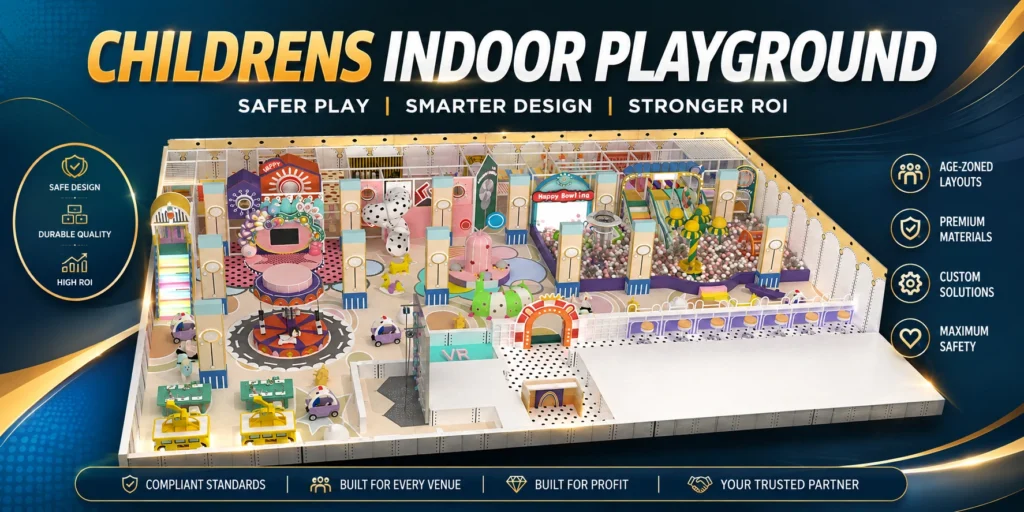
Buying a childrens indoor playground is high-stakes. Wrong equipment, flooring, or age zoning means safety failures and wasted budget. This guide shows how indoor play facilities work and which checks matter before you source.
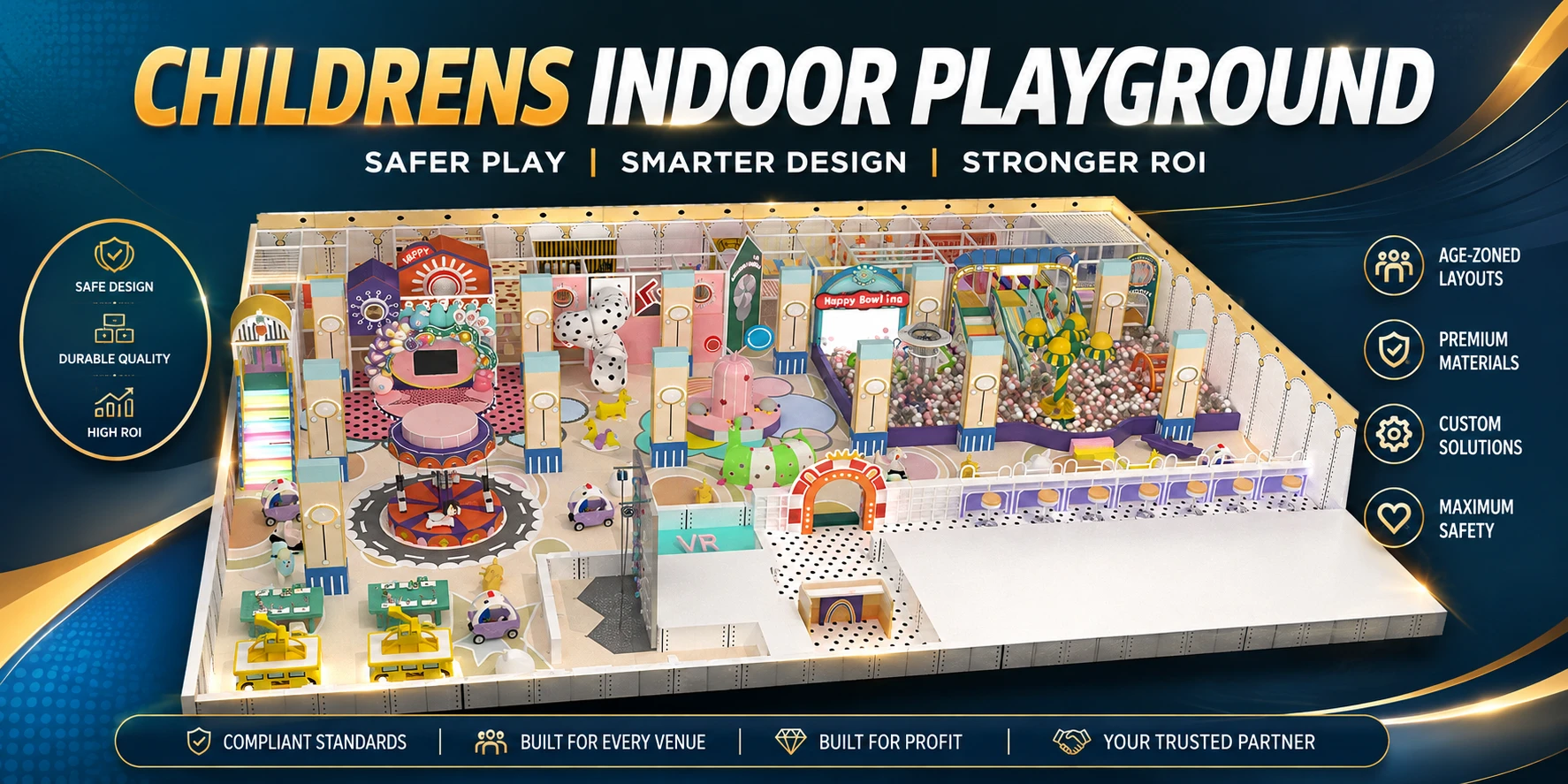
A childrens indoor playground is a purpose-built indoor facility for children from toddler age to around 12 years, typically featuring slides, climbing structures, ball pits, soft play blocks, and themed zones. Operators add age-separated sections, impact-absorbing flooring, and safety netting to meet local standards and insurance requirements.
Next, we trace how a childrens indoor playground operates step by step.
How Childrens Indoor Playground Works
A childrens indoor playground runs on a simple circulation loop: entry, play, supervision, exit. The sequence determines both safety and repeat visits.
- Entry control — a staffed gate or wristband system caps capacity and separates under-5s from older climbers.
- Play circuit — netted towers, slides, ball pits and soft obstacles form a one-way loop, limiting crowding.
- Supervision zones — sightlines from seating allow parents and staff to watch every platform and tunnel.
- Exit and hygiene — sock-only areas, hand sanitiser points and daily mat cleaning cut slip and infection risk.
Component Roles
Every part has a clear job: foam absorbs falls, netting contains climbers, and modular panels let you reconfigure zones as visitor numbers change.
Buyer warning: insist on playground quality evaluation evidence — load-test and material certificates — before signing. Quotes without them usually hide retrofit costs later.
Which components suit your footfall and budget is the comparison we make next.
Childrens Indoor Playground Components and Product Types
Match the component family to your footfall, age range and budget before sending an RFQ. These five categories cover most commercial installations.
| Product type | Best for | Buyer demand |
|---|---|---|
| Frame-based play structures | Multi-level climbing, nets, slides | High footfall, ages 4-12 |
| Soft play modules | Toddler safe zones and crèches | Under-5s, parent-heavy venues |
| Trampolines and jump zones | Energy-led repeat visits | Party and admission models |
| Ball pits and foam pits | Sensory and social play | Compact spaces, younger children |
| Interactive themed panels | Light, sound and branding | Museums, family centres, mixed ages |
Compare these specification details on the supplier drawing:
- Foam and cover: closed-cell foam over a plywood or steel core, finished in cleanable PVC leather.
- Safety geometry: rounded edges, correct fall-surface depth and gap checks at every junction.
- Service access: removable panels and replaceable parts help control playground maintenance cost.
- Site limits: unit footprint, clearance zone and ceiling height for each structure.
These checks narrow the component shortlist; the venue type then decides which combination fits, as the next section explains.
Typical Applications for Childrens Indoor Playground
The venue type sets the application, and each application changes the component mix, batch size and quality evidence you should request.
Retail and shopping centres — high-footfall malls need compact, durable layouts with easy-clean soft play surfaces. Tie component spend to commercial playground ROI, and ask for abrasion-resistance data on slides and ball-pit panels.
Education and community — schools and community hubs favour modular structures that adapt to different age bands, with clear sightlines for supervision. Request accessibility compliance evidence during the design review.
Hospitality and tourism — hotels, resorts and trampoline parks require high-capacity frames and climbing elements rated for continuous use. Confirm peak-load ratings and spare-part lead times before ordering.
| Venue factor | What to request |
|---|---|
| High daily footfall | Wear-test reports and spare-part stock levels |
| Mixed-age visitors | Zoned layouts with separate entry controls |
| Restricted ceiling height | Height-specific engineering drawings |
With the venue profile settled, the next stage is deciding which elements need bespoke production.
Once the bespoke list is set, the OEM sequence runs in six stages. Each one converts a buyer decision into a verifiable factory output, so you can track progress without chasing phone calls.
| Stage | Buyer input | Manufacturer output |
|---|---|---|
| Drawings or samples | 2D/3D drawings, photos or a reference unit | Feasibility review and itemised quote |
| Quote confirmation | Target quantity, colour, logo and material spec | Final pricing, lead time and payment terms |
| Sample confirmation | Written approval or a revision list | Corrected sample and photo evidence |
| Packaging | Carton style, labelling and shipping marks | Packing specification and unit counts |
| Batch inspection | Inspection date or third-party agent mandate | Dimensional report, photos and test records |
| Shipment | Incoterm, port and delivery window | Packing list, tracking and customs paperwork |
Inspection detail
A playground supplier review should confirm who signs off each gate. Inspections typically cover dimensions against drawings, foam density, load-bearing platforms and gap clearances to the relevant safety standard. These gates also reveal how a manufacturer handles scale, which matters when you shortlist suppliers.
Top 10 Childrens Indoor Playground Manufacturers and Supplier Fit
A childrens indoor playground project has no universal “top 10”; your fit depends on project type, budget and safety evidence. The credible supplier groups divide into four categories, so match these before chasing names. Use this matrix to shortlist by need.
| Supplier type | Pros | Cons | Best fit |
|---|---|---|---|
| Full-service commercial manufacturer | Design-to-install project management; EN 1176 certificates and full documentation | Higher price; longer delivery windows | Councils, schools and large centres needing turnkey delivery |
| Modular soft play specialist | Quick install; easy reconfiguration; vibrant colour options | Not built for heavy climbing loads | Malls, cafés and smaller indoor play areas |
| Import distributor | Low unit cost; broad catalogue; fast sample turnaround | Shipping delays; inconsistent warranty cover | Price-sensitive operators with flexible timelines |
| Bespoke OEM fabricator | Full customisation; direct factory pricing | You supply detailed drawings; QC falls to you | Themed or branded builds with unique footprints |
Score every candidate on the same checks:
- Ask for test reports and safety certificates before you request pricing.
- Inspect a physical sample against your footfall and age range.
- Compare lead times, inspection gates and packaging, not just the unit price.
- Confirm installation support and spare-parts availability.
Sourcing principle: a proper playground durability review needs the manufacturer’s own load and impact data — ask for it before you compare quotes.
About JQ Playground – commercialplaygroundreview.com
JQ Playground (Wenzhou Jiqi Amusement Equipment Co., Ltd.) is a children’s playground equipment manufacturer founded in 1993. The company provides design, customization, large-scale manufacturing, sales, installation guidance, and after-sales support for outdoor playgrounds, indoor playgrounds, soft play, water playgrounds, PE board playgrounds, kindergarten furniture, outdoor fitness equipment, pet playgrounds, and playground facilities. Approved company facts include 180+ employees, a large Wenzhou production base, 20+ production lines, 55 production machines, ISO/BSCI/EN1176/EN71/ASTM/CPC/CPSIC certification references, 100+ patents, free design support, OEM/ODM capability, trial installation before shipping, export experience, and one-year quality warranty.