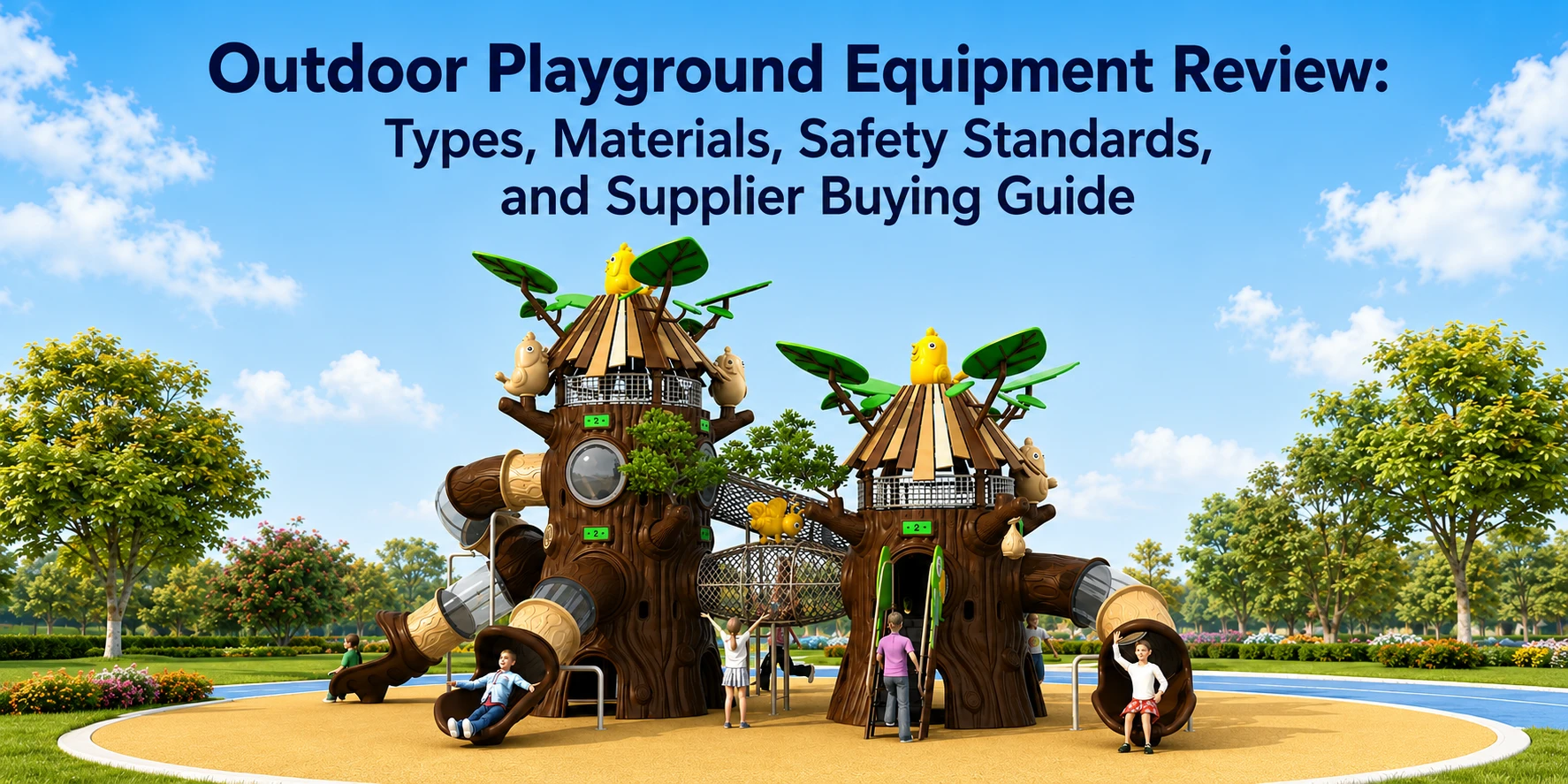
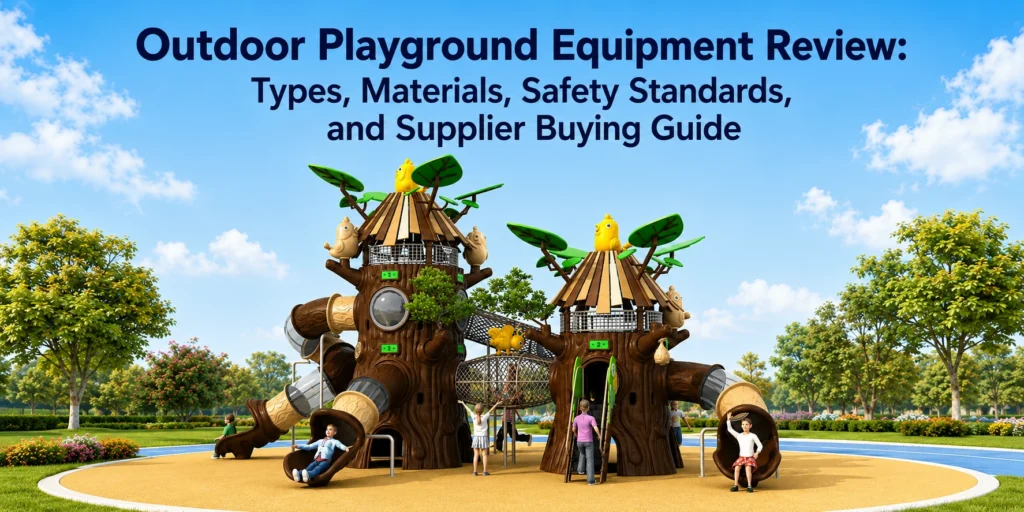
Outdoor playground equipment for commercial projects includes swings, slides, climbers, and fitness stations built for high-traffic public spaces. These installations typically serve 50 to several hundred users daily across parks, school grounds, shopping centres, and community hubs.
Outdoor playground equipment refers to play structures and safety surfacing designed to provide recreational and developmental benefits in commercial settings. This category covers modular multi-activity units, standalone pieces, and inclusive fitness zones, each specified for different user ages and capacities.
For procurement teams, a thorough commercial playground review means evaluating types, materials, and compliance requirements. Understanding these factors directly affects your investment’s safety record, durability, and total cost over a 10- to 15-year lifecycle.
Types of Outdoor Playground Equipment for Different Commercial Venues
Your equipment selection hinges on the venue’s primary users and daily traffic patterns. Modular play systems dominate school applications. These integrated structures combine slides, climbing nets, and interactive panels with age-differentiated zones for children aged 2–5 and 5–12, supporting developmental milestones like balance and social cooperation. A school-grade system typically includes educational elements such as abacus boards or sand play areas.
For community parks, standalone swings and slides remain the most cost-effective choice. Commercial-grade units use galvanised steel frames and rotationally moulded polyethylene decks to withstand year-round weather with minimal maintenance. A typical park installs four-bay swing sets and a 2.4m slide tower, both designed for rapid inspection and part replacement.
Public fitness parks demand a different category: outdoor fitness stations. These include pull-up bars, seated leg presses, and air walkers, constructed from powder-coated aluminium to resist corrosion without concrete foundations. A standard six-station layout serves cardio and strength training for adults and seniors.
Inclusive play equipment guarantees ADA compliance through ramps, transfer platforms, and ground-level sensory panels. Models with 100% rubber surfacing ensure wheelchair access and meet fall-height ratings of up to 3m.
| Venue | Primary Equipment | Key Features | Maintenance Priority |
|---|---|---|---|
| Schools | Modular play systems | Age zones, educational panels | Quarterly bolt checks |
| Parks | Standalone swings, slides | Galvanised steel, low upkeep | Semi-annual structural |
| Malls | Indoor-outdoor inclusive units | ADA ramps, soft surfacing | Monthly cleaning |
When you conduct a playground quality evaluation for these settings, consider how each type aligns with your site’s expected user age groups, usage frequency, and safety surfacing needs — core factors in any commercial playground buying criteria.
Material and Construction Specifications That Determine Durability
Your playground’s lifespan — and its total cost of ownership — hinges on three factors: the raw material, the fabrication method, and the protective finish. Commercial-grade equipment uses galvanised steel frames for rust resistance, polyethylene panels for UV stability and colour retention, and aluminium components where weight or corrosion is a concern. The safety surfacing (rubber tiles, poured-in-place, or engineered wood fibre) must match the equipment’s fall height rating.
Material attributes for spec review:
- Galvanised steel frames – hot-dip galvanised after welding to cover cut edges and welds. Commercial-grade thickness: 2.5–3.0 mm (14–12 gauge). Expect a 15-year warranty against rust perforation.
- Polyethylene panels – rotationally moulded, UV-stabilised HDPE. Thickness: 12–15 mm. Colour retention warranties of 10+ years are common.
- Aluminium components – extruded 6061-T6 alloy, powder-coated or anodised. Lightweight, corrosion-free in coastal or wet climates, but less impact-resistant than steel. Suitable for handrails and roof supports.
- Safety surfacing – poured-in-place rubber can be custom coloured; rubber tiles give modular replacement; engineered wood fibre is cheapest but requires annual top-ups. Depth: minimum 150 mm for most commercial fall heights under 3 m.
Preferred material combinations for high-traffic sites:
- Steel frame + HDPE panels + poured-in-place rubber surfacing.
- Steel frame + aluminium roof + rubber tiles (for easy spot repair).
- All-aluminium structure with wood fibre surfacing (budget-sensitive inland projects).
Choosing these combinations upfront reduces both playground maintenance cost and overall playground lifecycle cost by minimising corrosion and panel replacement over a 10–15 year window.
Mandatory Safety Standards and Certification Process for Commercial Playgrounds
Every commercial playground must comply with a specific safety framework. Three major standards dominate procurement decisions: ASTM F1487 (US), EN 1176 (EU and many other countries), and CSA Z614 (Canada). Choosing the right standard for your location is the first step in procurement.
Compliance centres on three critical areas. Fall height limits dictate the required surfacing depth — EN 1176 caps free fall height at 2.5 m for most equipment, while ASTM F1487 uses maximum critical fall height determined by each product’s test report. Entanglement risks are reduced by restricting protrusions and gaps; for example, ASTM prohibits openings between 89 mm and 229 mm that could trap a child’s head. Spacing requirements prevent limb entrapment in moving parts — rotating swings need at least 500 mm clearance from adjacent structures.
To verify compliance before purchase, follow these steps:
- Request the manufacturer’s certification certificate citing the exact standard and test date.
- Check that the third-party test lab holds ISO 17025 accreditation for playground equipment.
- Measure the installed surfacing depth against the equipment’s critical fall height — rubber tiles typically require 25–50 mm depth depending on the product.
Use this playground safety inspection checklist during your project:
- Surfacing depth matches the critical fall height report.
- No exposed bolts, S‑hooks, or shearing points.
- Guardrails on platforms above 600 mm height (minimum 380 mm high per EN 1176).
- Swing spacing: minimum 500 mm between seats and no fewer than 750 mm from frame posts.
- All gaps between 89 mm and 229 mm are eliminated (ASTM requirement).
- Certification documents are current and match the installed product.
Meeting these standards protects users and improves your commercial playground ROI by reducing liability claims and extending structure life.
Procurement Criteria: Total Cost of Ownership and Vendor Evaluation
A low upfront price can hide a much higher total cost over a playground’s 10- to 15-year service life. Procurement teams must look beyond the equipment invoice to installation, shipping, site preparation, annual maintenance, and warranty coverage.
Installation typically adds 15–25% to the project cost. Site preparation — grading, drainage, safety surfacing — can double that figure for unprepared ground. Annual maintenance includes inspections (every 6–12 months per EN 1176), fastener tightening, worn part replacement, and coating touch-ups. Premium systems with hot-dip galvanised steel frames and UV-stable polyethylene panels need fewer repairs: budget alternatives often require coating reapplication every 2–3 years, adding £500–£1,500 per year for a medium park.
Warranty terms vary widely. Structural warranties run 5–15 years; protective coating warranties last 1–5 years.
Example scenario: A 10-play-event budget system at £12,000 with £4,000 installation and £800/year maintenance totals £24,000 over 10 years. A premium system at £22,000 with £3,500 installation and £300/year maintenance totals £28,500 — a difference of only 19% over a decade, with fewer safety interruptions and higher residual value.
Vendor evaluation should include:
- References from three recent commercial installations of similar size.
- Project portfolio showing compliance with your venue type (school, park, mall).
- Customisation capability — colour, layout, inclusive features.
- Post-installation support — operator training, inspection schedules, spare parts lead times.
When evaluating suppliers, consider manufacturers with extensive experience and proven export capacity. For example, JQ Playground (Wenzhou Jiqi Amusement Equipment Co., Ltd.), founded in 1993, operates a 60,000 sqm production base with over 180 skilled workers and 20+ production lines. They offer free CAD-based design support, trial installation before shipping, and a one-year warranty on all products. Their certifications include EN1176, ASTM, and CPC, ensuring compliance with major global standards. Such capabilities can reduce procurement risk and simplify project coordination.
| Cost Factor | Budget System | Premium System |
|---|---|---|
| Initial equipment | £12,000 | £22,000 |
| Installation & site prep | £4,000 | £3,500 |
| Annual maintenance | £800 | £300 |
| Warranty (structure) | 5 years | 12 years |
| Warranty (coating) | 1 year | 5 years |
| 10-year total (approx.) | £24,000 | £28,500 |
Performing a thorough playground supplier review using this checklist ensures your next investment delivers real playground investment value — not just the lowest tender.
About JQ Playground – commercialplaygroundreview.com
JQ Playground (Wenzhou Jiqi Amusement Equipment Co., Ltd.) is a children’s playground equipment manufacturer founded in 1993. The company provides design, customization, large-scale manufacturing, sales, installation guidance, and after-sales support for outdoor playgrounds, indoor playgrounds, soft play, water playgrounds, PE board playgrounds, kindergarten furniture, outdoor fitness equipment, pet playgrounds, and playground facilities. Approved company facts include 180+ employees, a large Wenzhou production base, 20+ production lines, 55 production machines, ISO/BSCI/EN1176/EN71/ASTM/CPC/CPSIC certification references, 100+ patents, free design support, OEM/ODM capability, trial installation before shipping, export experience, and one-year quality warranty.