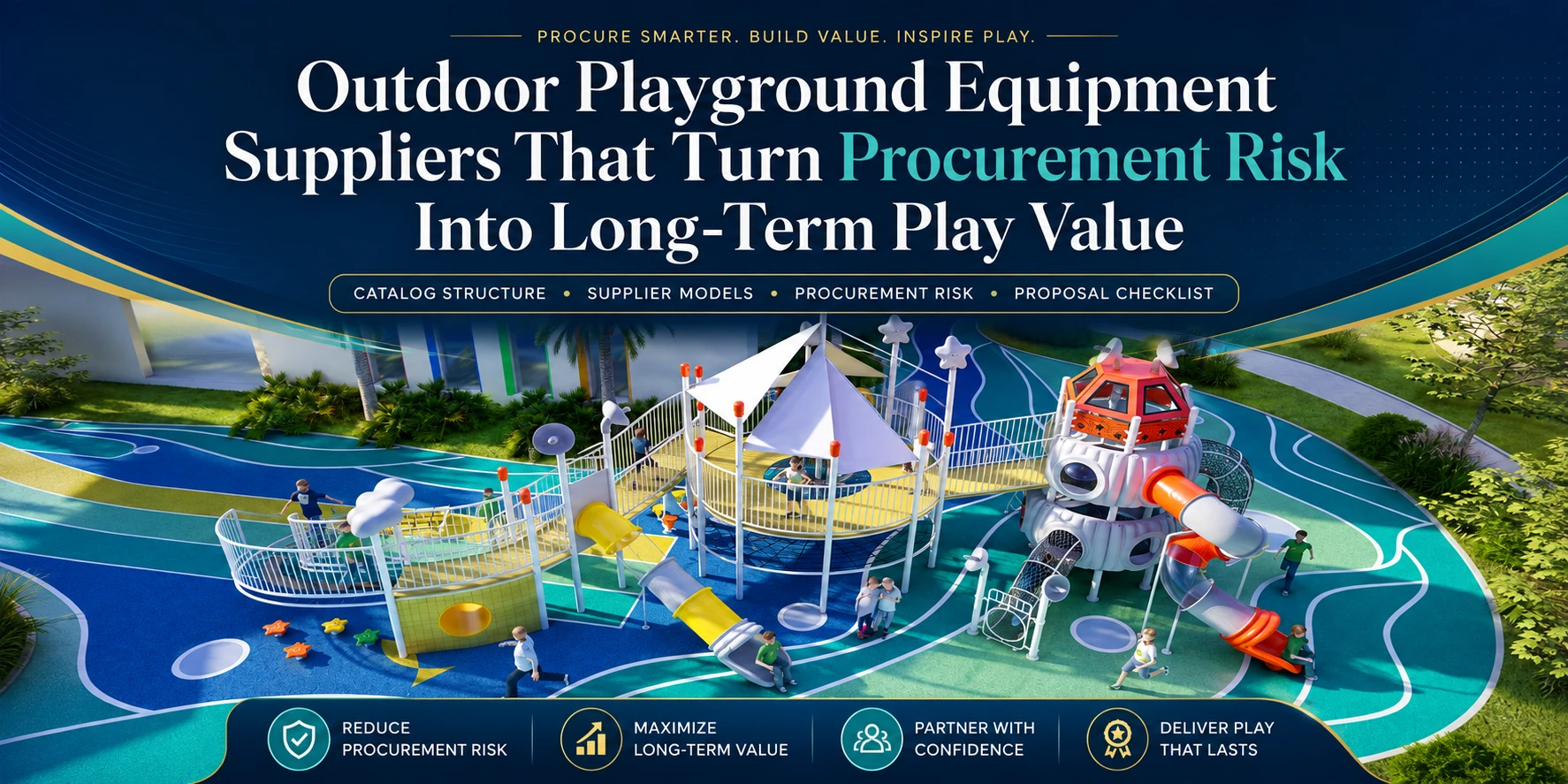
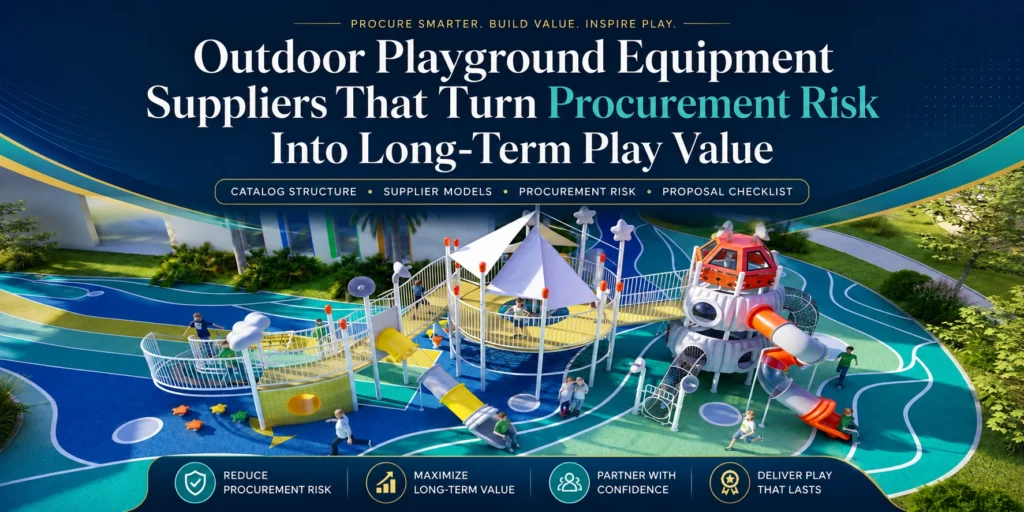
Choosing an outdoor playground equipment supplier is a high-stakes decision. Your choice shapes safety outcomes, project timelines, and the long-term play value of a public asset. One mis-specified component can delay installation for months.
Outdoor playground equipment suppliers are manufacturers, distributors, or turnkey providers that supply play structures, surfacing, shade, and site amenities for parks, schools, malls, and community spaces.
Some sell direct; others operate through dealer networks. The sections ahead examine catalogue organisation, supplier models, and the buying criteria that separate commercial-grade vendors from consumer sellers. Use them to structure your next tender.
How Outdoor Playground Equipment Suppliers Organize Their Product Lines
Most commercial suppliers categorise their catalogues in the same four ways, so learning the pattern speeds up shortlisting.
- By age group. Toddler (2–5), primary (5–12) and teen (12+) ranges appear first. Little Tikes, Landscape Structures and Playworld all sort products this way, often under a “Commercial Playgrounds by Age” heading.
- By style. Nature-inspired, modern and themed collections help match site character, not just equipment function.
- By product line. Playsystems, freestanding units, swings and climbers map to “Products by Category” sections.
- By market. School, park, HOA and faith-based segments sit separately, so procurement teams can compare like-for-like options.
This structure makes commercial playground buying criteria easier to apply during playground quality evaluation. If a supplier lacks age-based filtering, expect more manual sorting. Whether you buy factory-direct or through a dealer changes that workflow — the next section weighs both supplier models.
Manufacturer vs. Distributor: Choosing the Right Supplier Model for Playground Projects
Start with the model that matches your in-house capacity. Buying direct from a manufacturer suits teams that can manage site prep, installation and project sequencing themselves. A distributor or dealer adds coordination, design support and installation crews, which helps when your team is stretched. Both are legitimate outdoor playground equipment suppliers; the difference is where the responsibility sits.
- Manufacturer-direct: Lower unit pricing on large orders, faster lead times for custom designs, and direct warranty handling. You own logistics, surfacing coordination and contractor scheduling.
- Distributor or dealer: One contact across multiple brands, design help, installation services and simplified warranty claims. Expect a markup and longer timelines for special-order items.
Before committing, confirm who owns warranty claims and repair call-outs. Unclear responsibility inflates playground lifecycle cost, so write it into the contract. The next test is whether the supplier can genuinely reduce procurement risk.
Key Supplier Capabilities That Reduce Procurement Risk
Commercial-grade suppliers distinguish themselves from residential sellers through verifiable capabilities. When vetting candidates, look for these markers:
- Safety certification. Structures should meet ASTM F1487, CPSC, CSA, or EN1176 depending on your market. Ask which standard applies and request the certificates.
- Material specifications. Galvanised steel cores and UV-stabilised plastic resist corrosion and fading. Confirm coating thickness and stabiliser levels in writing.
- Independent testing. Third-party labs verify impact attenuation and structural integrity. Supplier-conducted tests are not enough.
- Design and consultation services. Many suppliers help translate site constraints into compliant layouts, saving redesign costs later.
- Funding assistance and installation support. Some suppliers provide grant guidance, site surveys, or trained installation crews, reducing hidden project costs.
Before sending an RFQ, verify third-party test reports and contact two or three references with projects similar to yours. A supplier’s safety record matters more than its catalogue size.
What Should a Playground Equipment Supplier Proposal Include?
Strong proposals from outdoor playground equipment suppliers answer ten questions before you compare prices. Use this checklist:
- Site dimensions and layout — does the design fit your measured space with required fall zones?
- Age-range requirements — equipment matched to 2-5, 5-12, or 12+ users?
- ADA/inclusion compliance — accessible routes, transfer points, and inclusive play features?
- Surfacing specifications — material type, depth, and critical fall height ratings?
- Shade options — integrated canopies or standalone shade structures?
- Spare parts availability — do they stock parts beyond the warranty period?
- Installation plan — crew credentials, timeline, and site preparation responsibilities?
- Maintenance schedule — routine inspection points and service intervals?
- Budget breakdown — equipment, surfacing, delivery, installation, and contingency costs?
- Quoting format — suppliers like Pro Playgrounds offer ‘Build a Quote or Buy Now’; others provide custom drawings.
When shortlisting, match supplier core strength to your primary need. A school project demands age-group depth; a public park may value shade and inclusion expertise. Keep your playground supplier review centred on the checklist, not the brochure. That safeguards playground investment value.
About JQ Playground – commercialplaygroundreview.com
JQ Playground (Wenzhou Jiqi Amusement Equipment Co., Ltd.) is a children’s playground equipment manufacturer founded in 1993. The company provides design, customization, large-scale manufacturing, sales, installation guidance, and after-sales support for outdoor playgrounds, indoor playgrounds, soft play, water playgrounds, PE board playgrounds, kindergarten furniture, outdoor fitness equipment, pet playgrounds, and playground facilities. Approved company facts include 180+ employees, a large Wenzhou production base, 20+ production lines, 55 production machines, ISO/BSCI/EN1176/EN71/ASTM/CPC/CPSIC certification references, 100+ patents, free design support, OEM/ODM capability, trial installation before shipping, export experience, and one-year quality warranty.