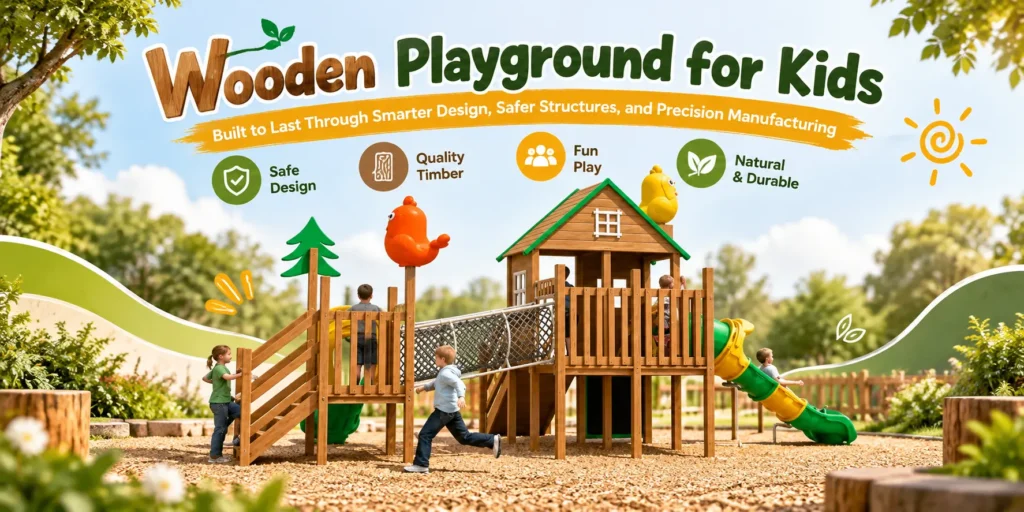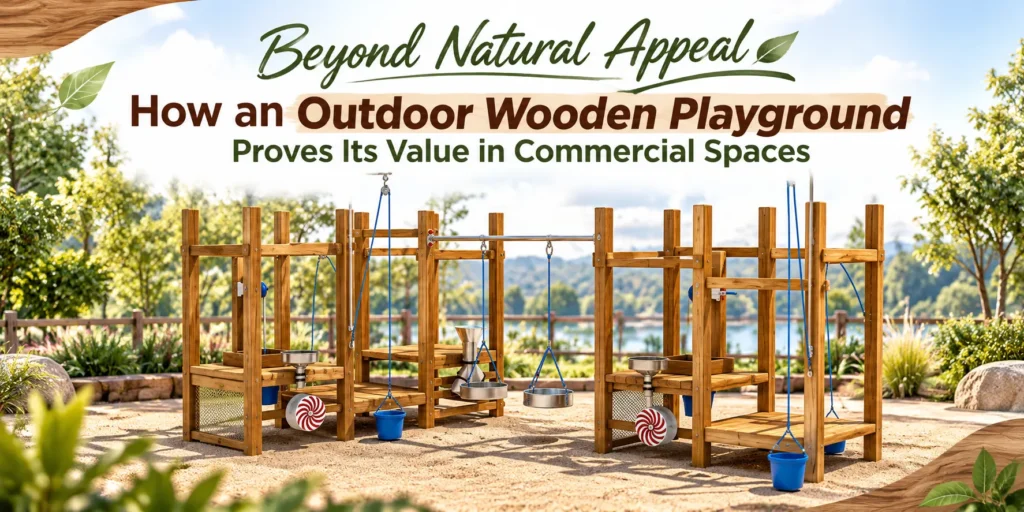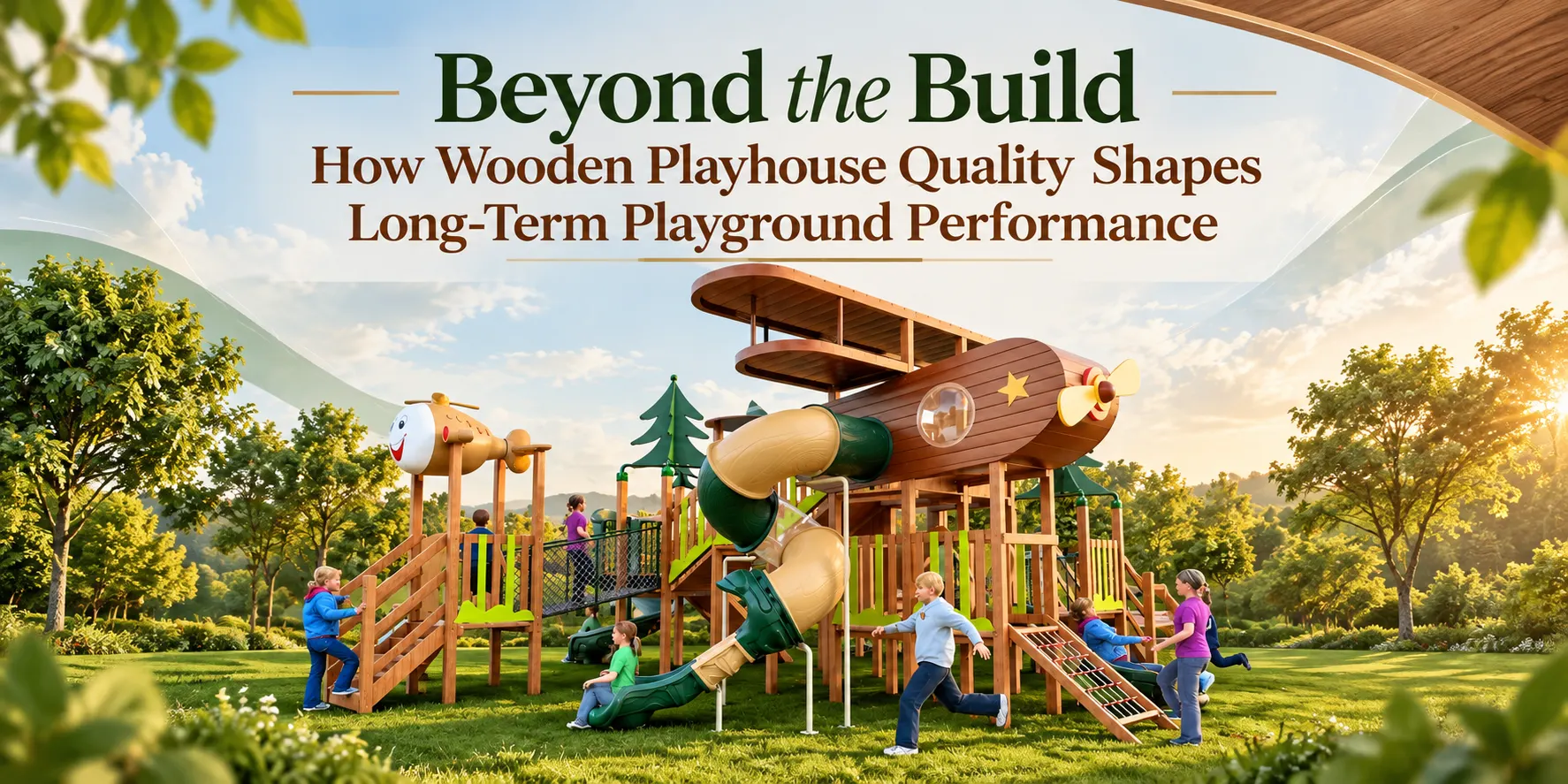
Buying a wooden playhouse for a park, school or mall means one bad spec can sit in public view for a decade. Thin panels split, untreated pine rots, and soft fixings loosen within two seasons. Replacing a unit mid-season costs more than the unit itself. You can avoid that by checking timber grade, panel thickness, treatment method and load-rated fittings before comparing quotes. The sections ahead show how these units are built, what to specify, and how to shortlist suppliers.
A wooden playhouse is a small outdoor play structure built from timber panels, posts and roof sections, assembled on site or delivered pre-built, and used in gardens, schools and commercial play areas for role-play, climbing and shelter. Standard builds use treated softwood such as pine or spruce, weather-resistant roof coverings, and galvanised or stainless fixings. Commercial wooden playhouses are specified by footprint, platform height, panel thickness, timber treatment class and safety clearance, and are usually bought in batches with matching colour and hardware for consistency across a site.
Next: how wooden playhouses are built, step by step, and what your commercial playground review should check.
How Wooden Playhouse Works
A wooden playhouse works as a load path: ground anchor, base frame, wall panels, roof. Each step affects stability, so check the sequence against your commercial playground buying criteria.
- Anchoring and levelling. Posts sit on concrete pads or ground screws; 5 mm out of level pushes load onto one corner.
- Frame and panel fixing. Treated studs carry the roof while 12–18 mm cladding absorbs impact between them.
- Roof sealing. Felt or shingle with drip edges keeps rain off end grain, where rot starts first.
- Finishing. Countersunk screws and rounded edges cut snag and splinter risk.
Component roles
Posts take vertical load, rails resist racking, panels brace the frame, fixings tie the set together. Confirm which element does what before approving a sample, and repeat the checks on every batch.
Match anchor type to the surface — turf, rubber safety surfacing or concrete — before releasing a batch.
Wooden Playhouse Components and Product Types
Anchors aside, finished stock splits into four product families. Compare them before you price a project.
| Product type | Typical build | Common buyers |
|---|---|---|
| Tower and slide unit | 90–120 mm posts, platform around 1.2 m | Parks, schools |
| Elevated clubhouse | Enclosed panel walls, gable roof | Malls, community sites |
| Ground-level play set | Low deck, sandpit, mud kitchen | Nurseries, gardens |
| Flat-pack modular kit | Loose panels plus hardware | Resellers, installers |
Specification details worth confirming:
- Timber species and post thickness, since both shape playground lifecycle cost
- Flat-pack panels or pre-assembled frames — this changes freight and site labour
- Roof type, window glazing and hardware finish
- Fixing pack completeness, including bolt and bracket counts per unit
- Pre-drilled holes and cut-list accuracy for repeatable assembly
- Fall-height and surface clearance data issued per configuration
Which family fits depends on the site, so match the configuration to the setting before shortlisting suppliers.
Typical Applications for Wooden Playhouse
Different settings need different configurations. Match product choice, hardware fit, order volume and evidence to the site before shortlisting.
- Parks and public schemes: open-access units need weather-treated panels, anti-trap fixings and documented ground anchoring. Request a playground safety inspection checklist covering post embedment, edge radius and gap widths.
- Schools and nurseries: age bands such as 2–5 or 5–12 set deck height and rail spacing; low platforms with enclosed sides cut supervision load, and demand is often one unit per class group.
- Malls, resorts and residential developers: themed finishes, tower combinations and phased deliveries dominate. High footfall justifies testing commercial playground ROI against replacement cycles.
| Application factor | Buyer action |
|---|---|
| Ground surface | Confirm anchor kit for concrete, grass or rubber |
| Age band | Verify deck height and guard-rail gaps |
| Phase volume | Split orders so replacement parts stay consistent |
Once the application set is defined, the next step is converting drawings and samples into a custom build and OEM programme.
Custom Wooden Playhouse Manufacturing and OEM Cooperation
A custom wooden playhouse programme starts from what you already hold: a dimensioned drawing, a sketch, or a physical sample. The supplier then confirms timber section, panel sizes, fixings and finish before quoting. The table below maps each hand-off, so nothing is assumed at either end.
| Stage | Buyer input | Manufacturer output |
|---|---|---|
| Drawings or sample | Dimensioned drawing, sample unit, colour and logo files | Feasibility notes, material and hardware proposal |
| Quotation | Target quantity, delivery window, packaging preference | Itemised quote with lead time and set-up costs |
| Sample confirmation | Approved sample sign-off, requested changes | Pre-production sample plus agreed specification sheet |
| Packaging | Retail or bulk carton preference, label artwork | Carton drawings, pallet plan, packing method |
| Batch inspection | Inspection level, checkpoints (fixings, edges, coating) | Report with photos before goods are packed |
| Shipment | Shipping mode, documents, booking date | Loading plan, container photos, shipping documents |
Inspection Detail Before Shipment
Checkpoints usually cover fixing torque, sanded edges, coating thickness and panel moisture content. Ask for photo evidence per carton and a written pass/fail record, not a verbal summary. Reading each quote against these outputs shortens a playground supplier review, and it is where genuine supplier fit is settled.
Top 10 Wooden Playhouse Manufacturers and Supplier Fit
Once inspection evidence is agreed, the deciding filter is build method. Top-ten shortlists usually sit inside five supply models, each winning on a different brief.
| Supplier type | Pros | Cons | Best fit |
|---|---|---|---|
| Integrated playground manufacturers | EN 1176 paperwork, spares, install crews | Higher unit price, longer slots | Schools, councils, parks |
| Timber joinery workshops | Bespoke towers, non-standard sizes | Limited coating and lab records | Hotels, bespoke estates |
| Flat-pack importers | Low cost, fast dispatch | Thin sections, generic hardware | Retail resale, seasonal stock |
| OEM/ODM contract factories | Your drawings, logo, packaging | Minimum volumes per SKU | Brands, distributors |
| Regional distributors | Small drop sizes, local delivery | Mark-up, little design change | Repair orders |
For commercial play area evaluation, a playground durability review should score:
- Pressure-treated hardwood with a stated moisture limit
- Fixings, brackets and roofing named per component
- Sample panel and batch photos before bulk release
- Written pass/fail record per carton
Match the supplier to the order you will repeat, not the one you place this week.
About JQ Playground – commercialplaygroundreview.com
JQ Playground (Wenzhou Jiqi Amusement Equipment Co., Ltd.) is a children’s playground equipment manufacturer founded in 1993. The company provides design, customization, large-scale manufacturing, sales, installation guidance, and after-sales support for outdoor playgrounds, indoor playgrounds, soft play, water playgrounds, PE board playgrounds, kindergarten furniture, outdoor fitness equipment, pet playgrounds, and playground facilities. Approved company facts include 180+ employees, a large Wenzhou production base, 20+ production lines, 55 production machines, ISO/BSCI/EN1176/EN71/ASTM/CPC/CPSIC certification references, 100+ patents, free design support, OEM/ODM capability, trial installation before shipping, export experience, and one-year quality warranty.