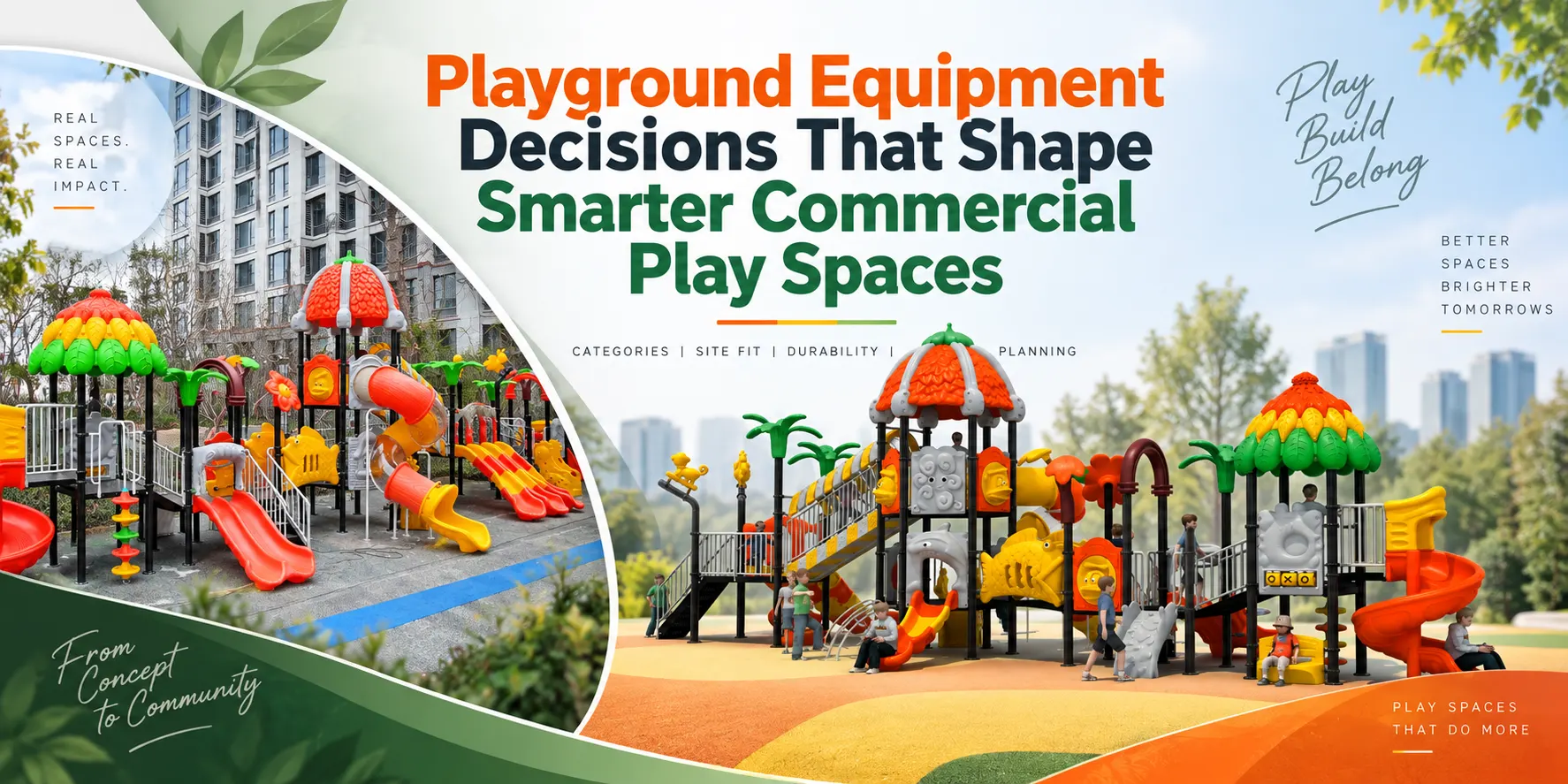
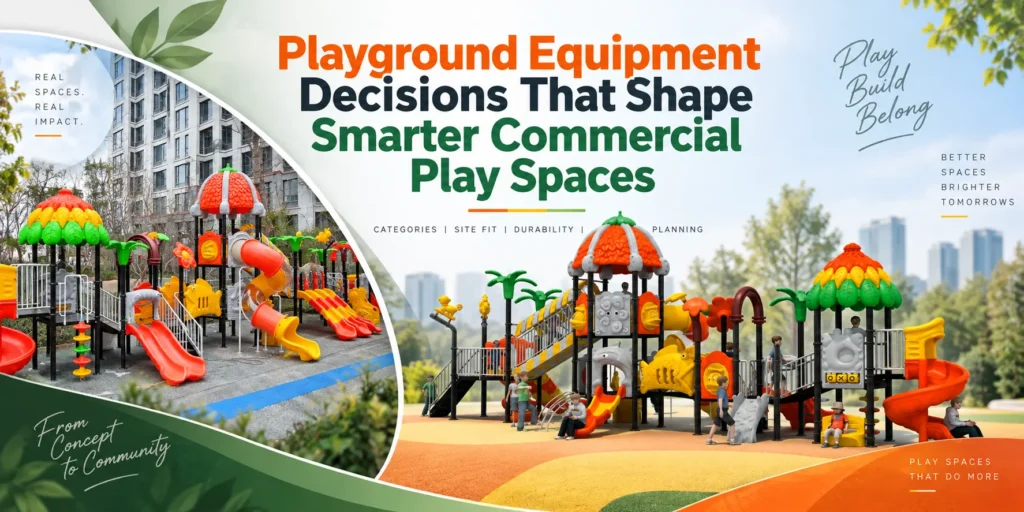
Scoping a play area for a school, park, or retail space means comparing climbers, slides, swings, and sensory pieces across very different procurement routes, each with its own lead times and installation needs. Playground equipment means the fixed and modular play structures, surfacing accessories, and activity pieces installed in public or commercial play spaces. This commercial playground review covers the categories, setting fit, durability checks, and budget paths that shape a specification.
What Separates Commercial Playground Equipment from Residential Sets?
Commercial playground equipment is specified for shared, continuous use rather than a single household. A public play area may see hundreds of children each week, supervised by staff or parents at a distance, so structures carry higher traffic loads and wider fall zones than a backyard set sized for two or three users.
Two further differences shape a playground quality evaluation. Equipment is zoned by age group, typically toddler, junior, and teen ranges, so pieces sit in separate footprints with their own capacity limits. Weather exposure is constant, and wear parts such as swing bearings, deck panels, and connection hardware must be replaceable years after installation.
- Traffic and capacity: shared use by many children per hour, not occasional family play.
- Age zoning: separate areas, capacities, and fall zones for each age band.
- Weather exposure: outdoor fixings, coatings, and drainage planned for year-round use.
- Replacement planning: commercial playground buying criteria expect wear parts and modular sections orderable as individual items.
Core Equipment Types Buyers Compare Across Play Areas
| Type | Typical play value | Common facility fit |
|---|---|---|
| Climbers | Balance, grip, upper-body strength | Schools, parks, age-zoned areas |
| Challenge ladders | Coordination, graded risk | Adventure zones, fitness trails |
| Slides | Speed, posture control, turn-taking | Multi-play towers, destination parks |
| Swing sets | Rhythm, social play, low supervision demand | Community parks, school yards |
| Multi-play structures | Combined climbing, sliding, role play | High-capacity parks, campus grounds |
| Interactive panels | Cognitive and sensory engagement | Indoor soft play, inclusive zones |
| Spinners | Vestibular stimulation, group rotation | Tarmac or rubber surfacing areas |
| Domes | Climbing challenge, social hubs | Teen zones, open parkland |
| Sensory pieces | Touch, sound, calm regulation | Inclusive and quiet play spaces |
Shortlist by age band first: 2–5, 5–12 and teen ranges each need different fall heights and capacities. A 60-child school break can exceed a single multi-play tower built for 20 users. Balance high-throughput items with quieter sensory pieces to spread demand. Review playground lifecycle cost across replacement parts and surfacing, not only initial units. Next, match the mix to site type and supervision.
Matching Playground Equipment to Schools, Parks, Indoor, and Water Play
Footprint, supervision and material expectations shift sharply between settings, so the same product rarely suits two sites.
School and Kindergarten Play Areas
- Split 2–5 and 5–12 zones with their own entries and surfaces, so younger users stay visible from the building.
- Keep towers and busy items inside clear staff sightlines; blind corners behind panels create supervision gaps.
Parks and Community Spaces
- Spread high-capacity towers across the site so crowd peaks disperse instead of queuing at one structure.
- Mix free-access climbers, spinners and swings to raise dwell time and support commercial playground ROI.
Indoor Soft Play
- Specify wipe-clean vinyl covers, rounded frames and lower pieces sized to ceiling and sprinkler clearance.
- Leave 1.2–1.5 m circulation between modules for prams, wheelchairs and staff movement.
Water Play
- Choose stainless, HDPE or composite parts; untreated timber and standard steel fittings corrode quickly.
- Plan drainage, slip-resistant surfacing and a daily shutdown routine before opening.
Durability, Safety, and Heavy-Use Signals to Verify in a Commercial Specification
Ask three questions of every line item: what carries the load, what limits a fall, and how quickly can a worn part be replaced? Document the answers before comparing quotes.
Durability
– Which post material is specified — galvanised steel, powder-coated aluminium, HDPE or robinia — and what wall thickness or panel gauge is quoted?
– Are fixings stainless steel with tamper-resistant heads, and is the finish described as a coating system rather than simply “painted”?
Safety
– Does each structure match its stated age band, with guardrails, handholds and step spacing sized for that group?
– Which fall-zone dimensions and surfacing type does the layout assume, and who confirms them against the actual ground conditions?
Heavy use
– Which parts are listed as replaceable — bearings, swing chains, slide lips, deck panels — and what replenishment lead time applies?
– Can the layout be phased or extended later, so a playground supplier review protects long-term playground investment value?
Get those answers in writing before you shortlist.
Budget Paths for Playground Equipment Projects: Purchase, Lease, and Phased Build
Capital budgets rarely match the full wish list in year one. Three routes keep work moving without reopening the commercial play area evaluation you already signed off.
- Purchase outright — lowest lifetime cost where funds exist; you own the replacement parts and can book one installation mobilisation.
- Lease or finance — spreads spend across budget cycles. Check who holds maintenance, insurance and end-of-term ownership.
- Phased build — open the busiest age zone first, then add spinners, panels or surfacing. A longer timeline, matched to confirmed funding.
Discount and end-of-line inventory can cut cost when colours and configurations still suit your layout. Grant schemes and funding bodies sometimes part-cover equipment; ask what each award excludes. Apply the same playground durability review to every option, since a cheap lease on light-grade frames costs more once parts wear. Settle the route before you request quotes.
About JQ Playground – commercialplaygroundreview.com
JQ Playground (Wenzhou Jiqi Amusement Equipment Co., Ltd.) is a children’s playground equipment manufacturer founded in 1993. The company provides design, customization, large-scale manufacturing, sales, installation guidance, and after-sales support for outdoor playgrounds, indoor playgrounds, soft play, water playgrounds, PE board playgrounds, kindergarten furniture, outdoor fitness equipment, pet playgrounds, and playground facilities. Approved company facts include 180+ employees, a large Wenzhou production base, 20+ production lines, 55 production machines, ISO/BSCI/EN1176/EN71/ASTM/CPC/CPSIC certification references, 100+ patents, free design support, OEM/ODM capability, trial installation before shipping, export experience, and one-year quality warranty.