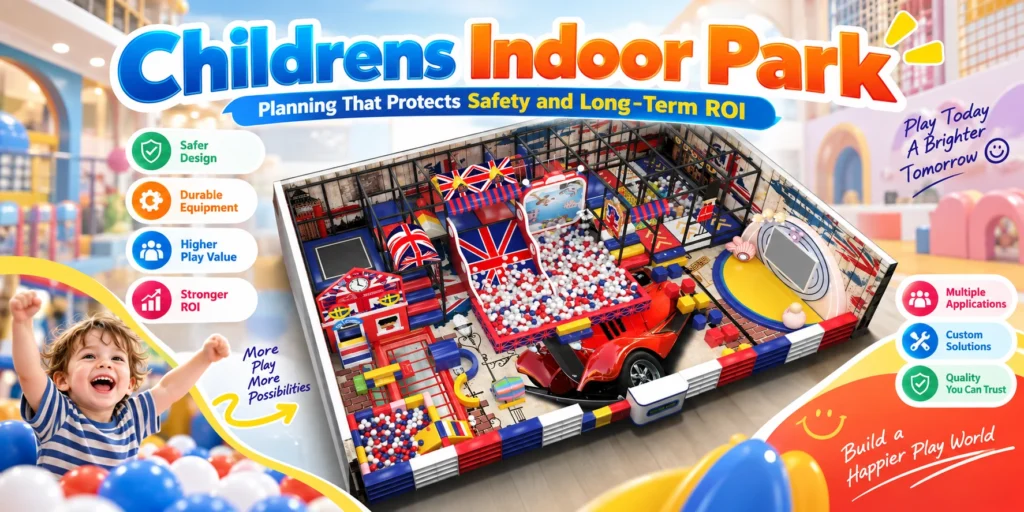
Planning an indoor children’s play space can stall on three questions: which layout keeps children safe, which equipment survives daily use, and which supplier answers an RFQ properly. Get those wrong and a project absorbs costly rework, downtime, and premature replacements. The difference between a profitable attraction and a draining liability usually comes down to disciplined sourcing: define age zones, compare real product ranges, check structural durability, and request inspection evidence before you commit. Use this guide as your commercial playground review — it covers what fit-out and procurement teams must verify when buying a childrens indoor park.
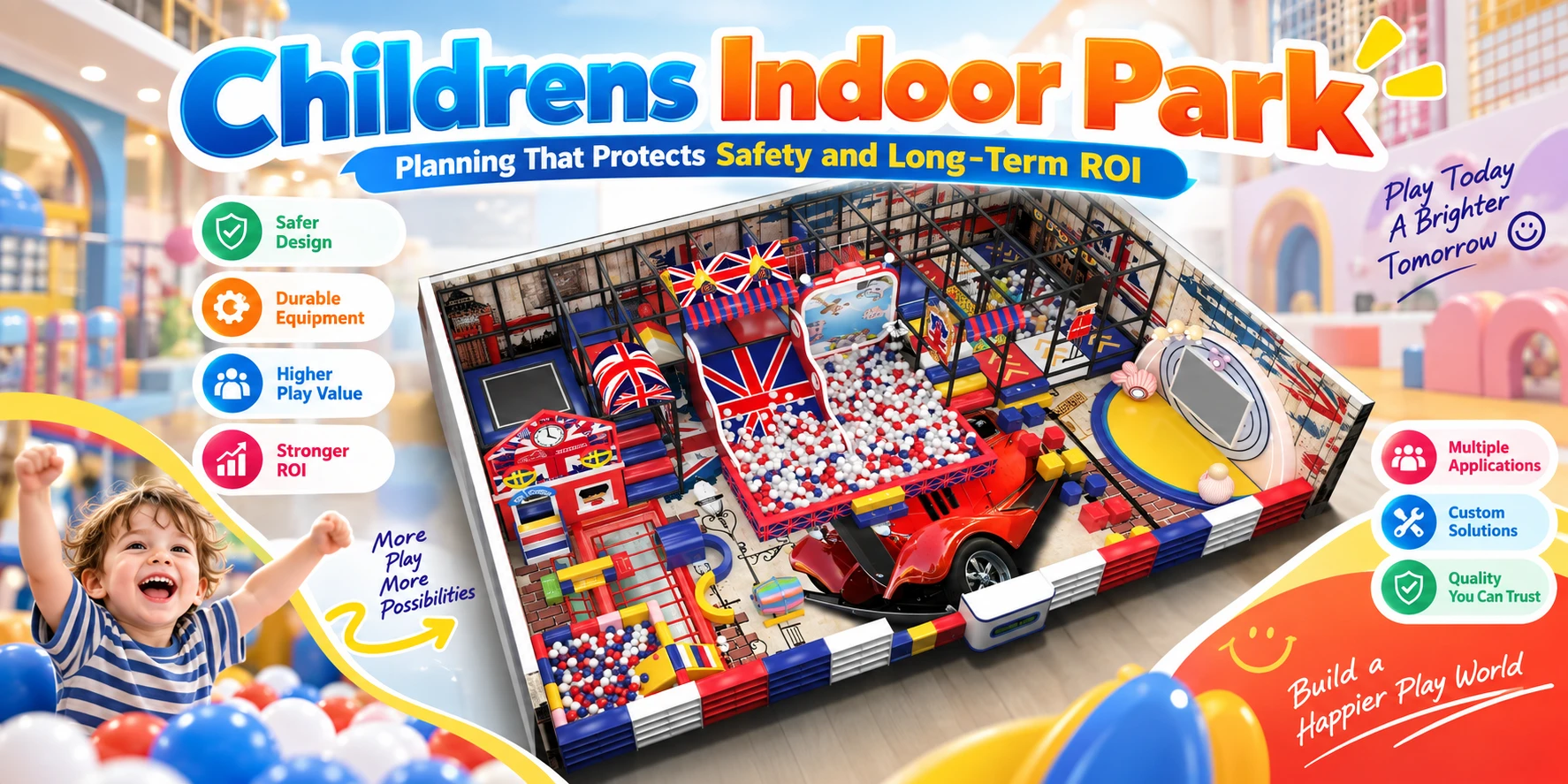
A childrens indoor park is a purpose-built indoor play area where children can climb, slide, jump, and explore in a controlled environment. Typical fixtures include multi-level soft play structures, slides, ball pools, foam blocks, trampolines, and sensory panels, all installed over impact-absorbing safety surfacing. Operators house these spaces in shopping centres, leisure venues, schools, or community buildings so play can continue year-round, regardless of weather. A well-designed park divides space by age and ability, with clear supervision lines, secure entry controls, and accessible maintenance routes for routine cleaning and equipment checks.
With the definition clear, the next step is seeing how these parks operate in practice.
How Childrens Indoor Park Works
A childrens indoor park runs on controlled entry, age zoning, and supervised play sessions rather than open-access use.
- Check-in. Visitors receive wristbands or timed tickets so capacity stays within the operating limit.
- Safety briefing. Staff explain zone rules and which equipment each age group may use.
- Play rotation. Children move between soft play, climbing frames, and slides under staff supervision.
- Exit and reset. Between sessions, staff sweep the floor, check equipment, and close any worn access points.
Buyers should confirm that sightlines allow staff to watch every zone from one position, that safety surfacing meets the flooring standard for the installed fall height, and that the operator’s capacity limit matches your expected footfall.
Component Roles
Each structure serves a specific function: foam-filled units absorb impact, netting and barriers prevent falls, and durable cladding resists daily wear. Your choice of these components determines maintenance costs and safety compliance, so the next section breaks down what to compare before you source.
Childrens Indoor Park Components and Product Types
Compare the main component categories before sending an RFQ — each changes your cost base and safety file.
| Component | Role | Check before RFQ |
|---|---|---|
| Soft play modules | Foam impact absorption for under-5s | Foam density and cover zip quality |
| Climbing frames and nets | Active play up to 3 m high | Fall height vs matting depth |
| Ball pools and pits | Sensory play volume | Ball count, anti-static balls, cleaning routine |
| Slides and tubes | Transit between levels | Tunnel diameter, slide width, transitions |
| Trampoline decks | Bounce zones | Enclosure height, mat seams, anchors |
Key specification details to request:
- Age range and weight limit per element, not just per zone.
- Impact-absorbing material type and depth under every elevated platform.
- Fire-retardant and washable ratings on all soft cladding.
- Fixing and anchoring method for each free-standing structure.
- Spare-part availability for replacement mats, bolts, and netting.
These choices define your playground lifecycle cost, and the next section maps them onto real operating environments.
Typical Applications for Childrens Indoor Park
The operating environment dictates which play equipment you specify, so match every zone to real traffic, age ranges and cleaning demands before you buy.
- Mall and retail centres: High daily footfall means soft play modules with reinforced joints, commercial-grade ball pits and flooring that survives continuous use.
- Nurseries and schools: Low-height climbing frames, sensory panels and padded mats suit ages two to six; request a playground safety inspection checklist for each unit.
- Family and leisure centres: Multi-level towers, slides and trampoline zones need load-rated structures plus spare-parts agreements for high-wear components.
- Hospitality and trampoline cafés: Compact configurations maximise seating yield while keeping sightlines clear for supervision.
| Application factor | Buyer action |
|---|---|
| Daily visitor count | Specify wear-rated padding and reinforced platforms |
| Peak age range | Confirm heights, gaps and fall surfaces against British safety standards |
| Cleaning routine | Choose non-porous surfaces and washable play items |
Weighing these factors early protects your commercial playground ROI. Once your application profile is fixed, custom layout design and OEM production turn those requirements into manufacturable drawings.
Custom Childrens Indoor Park Manufacturing and OEM Cooperation
Childrens indoor park custom manufacturing runs as a series of clear handovers. From your floor plan and play-value brief, the manufacturer creates a layout drawing and itemised quotation before any cutting or foam shaping begins.
| Stage | Buyer input | Manufacturer output |
|---|---|---|
| Concept | Floor plan, target age band | 2D layout and itemised quote |
| Sample | Material, colour, logo approval | Pre-production sample for sign-off |
| Batch | Confirmed order, packaging style | Packing list and production photos |
| Inspection | Pre-shipment criteria or third-party date | Inspection report and loading photos |
| Shipment | Delivery window and documents | Shipping paperwork and crate marks |
Inspection detail
A typical pre-shipment check covers welds, foam density, edge rounding and anchor points. Schedule it before coated parts close so fixes stay economical. That evidence base lets you shortlist suppliers by production fit and factory response quality.
Top 10 Childrens Indoor Park Manufacturers and Supplier Fit
Shortlist by project stage rather than brand familiarity; the right childrens indoor park supplier changes with your scope, budget and inspection capacity.
| Supplier type | Pros | Cons | Best fit |
|---|---|---|---|
| Full-turnkey builder | One contract, installation managed | Higher budget threshold | Large commercial sites |
| Modular equipment maker | Repeatable quality, faster lead times | Limited layout freedom | Multi-site rollouts |
| Custom OEM workshop | Bespoke layouts, direct design input | Longer sampling cycle | Schools and community owners |
| Import-based supplier | Lowest unit pricing | Variable compliance paperwork | Budget operators with local inspectors |
Score every candidate on these checks before a commercial play area evaluation:
- Audit certificates against your local play-safety standard.
- Visit a reference installation that is at least two years old.
- Confirm spare parts availability for soft-play and mechanical parts.
- Ask how many site visits your team can attend before payment.
A cheap quote only buys the build; a playground durability review tells you what that build will cost five years later.
About JQ Playground – commercialplaygroundreview.com
JQ Playground (Wenzhou Jiqi Amusement Equipment Co., Ltd.) is a children’s playground equipment manufacturer founded in 1993. The company provides design, customization, large-scale manufacturing, sales, installation guidance, and after-sales support for outdoor playgrounds, indoor playgrounds, soft play, water playgrounds, PE board playgrounds, kindergarten furniture, outdoor fitness equipment, pet playgrounds, and playground facilities. Approved company facts include 180+ employees, a large Wenzhou production base, 20+ production lines, 55 production machines, ISO/BSCI/EN1176/EN71/ASTM/CPC/CPSIC certification references, 100+ patents, free design support, OEM/ODM capability, trial installation before shipping, export experience, and one-year quality warranty.