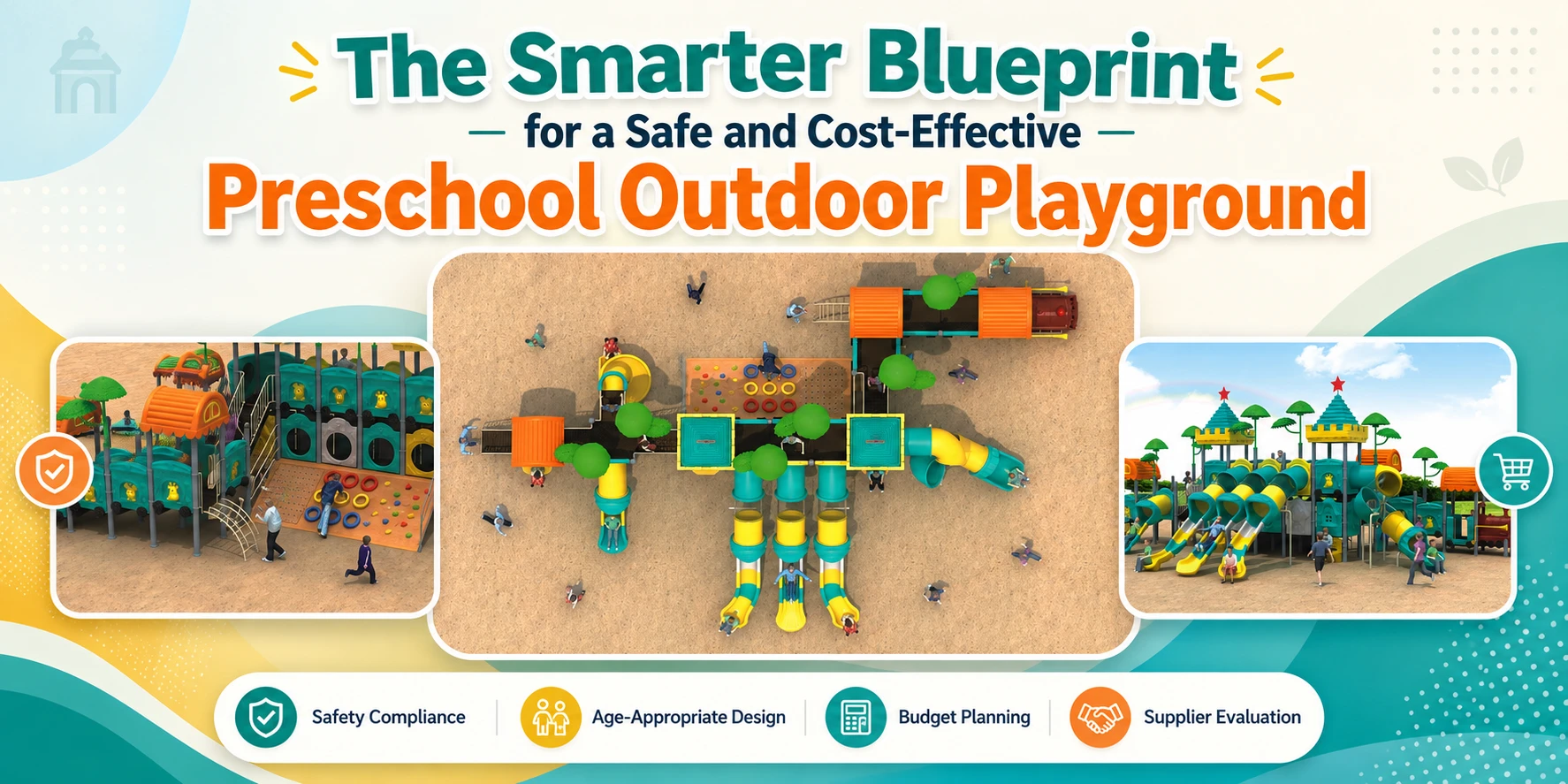
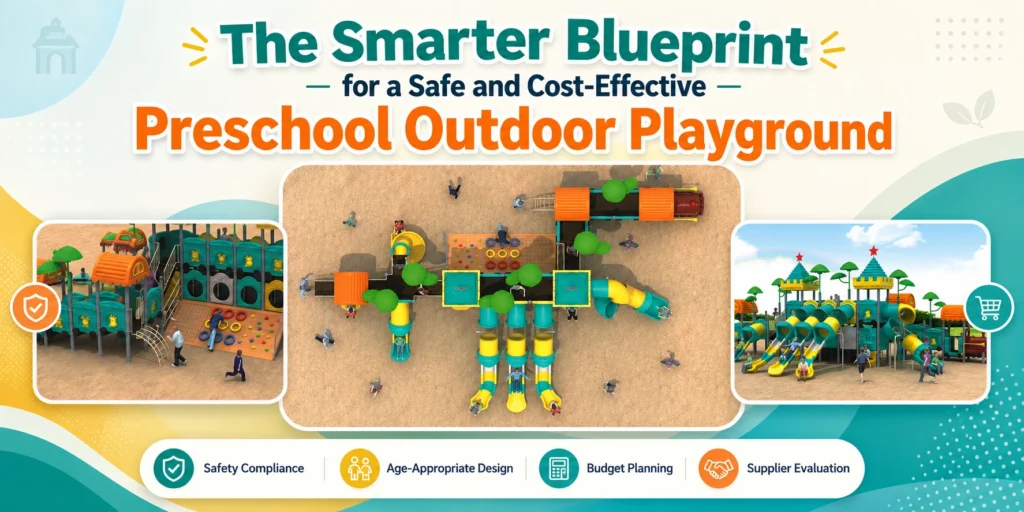
You face a common challenge when planning a preschool outdoor playground. The equipment must be safe, age-appropriate, and cost-effective for a commercial setting. Balancing these priorities while meeting compliance requirements and keeping within budget demands a methodical approach.
A preschool outdoor playground is a dedicated play area designed for children aged 3-5. It incorporates developmentally appropriate structures and safety surfacing tailored to preschoolers’ physical and cognitive abilities. Equipment heights, fall zones, and activity types differ significantly from those designed for older children.
This guide outlines the core considerations for commercial projects: safety compliance, equipment selection, cost management, and supplier evaluation. Before making a purchase, consult a detailed commercial playground equipment review to compare design options and verify safety documentation.
Safety Standards and Compliance: ASTM, EN1176, and Certification Essentials
Two primary safety frameworks govern preschool playgrounds: ASTM F1487 in North America and EN1176 across Europe. Compliance with either is non-negotiable for commercial projects. For buyers, verification begins with requesting certification documentation from the supplier and checking for third-party laboratory marks (e.g., TÜV, CSA, or IPEMA in the US). Third-party certification confirms the equipment and surfacing meet published thresholds rather than self-declarations.
A detailed playground quality evaluation should include a risk assessment checklist covering these critical points:
- Fall height limits — platform height ≤ 1.0m for preschoolers (ASTM and EN1176 both cap free fall height with appropriate surfacing depth)
- Spacing between equipment — minimum 2.0m clearance to prevent collisions
- Entrapment hazards — all openings between 89mm and 229mm (ASTM) or 89mm–230mm (EN1176) must be closed or redesigned to prevent head and neck entrapment
- Guardrail height — minimum 600mm for elevated platforms above 300mm
- Protrusion and sharp-edge restrictions — no exposed bolts, S-hooks, or projecting hardware
The table below highlights key differences in critical threshold dimensions that affect commercial playground buying criteria:
| Requirement | ASTM F1487 (N. America) | EN1176 (Europe) |
|---|---|---|
| Head/neck entrapment openings | 89mm – 229mm prohibited | 89mm – 230mm prohibited |
| Platform max height for age 3-5 | 1.0m (with 150mm surfacing) | 1.0m (with 200mm loose-fill) |
| Guardrail min height | 610mm | 700mm for platforms >600mm |
Always request a compliance certificate before procurement. Your supplier should provide a signed declaration that the equipment meets the applicable standard and a test report from an accredited lab. This forms the baseline of your due diligence and protects your organisation from liability claims.
Age-Appropriate Play Equipment for Preschoolers: Key Features and Developmental Benefits
For children aged 3–5, equipment must match their physical and cognitive stage. Slides, climbers, swings, sensory panels, and balance beams each target specific developmental domains when specified correctly.
Slides: Gross Motor and Spatial Awareness
A slide for preschoolers should have a maximum platform height of 1.0 metres and a slide length that keeps the exit velocity low — generally a slide height under 1.2 metres. The wide, enclosed bed and gentle slope support leg coordination and core strength. Kids learn to wait their turn, building early social skills. Look for a stainless steel or rotationally moulded polyethylene bed with no exposed fixings at the top.
Climbers: Full-Body Motor Planning
Climbers with platforms at ≤1.0 metres and step spacing of 200–250 mm challenge balance and bilateral coordination. A small arch climber or net climber encourages problem-solving. This develops proprioception and risk assessment. For commercial use, choose galvanised steel frames with UV-stable polyethylene panels to minimise playground maintenance cost over time.
Swings: Vestibular Stimulation and Social Turn-Taking
Bucketed swings with a low seat height (≤350 mm from the ground) and enclosed front bar prevent falls. The rhythmic motion builds vestibular sense and trunk control. Two-bay swing sets allow multiple children to swing together, promoting turn-taking and peer interaction. Ensure the swing zone width is at least 1.8 metres per bay.
Sensory Panels and Balance Beams: Cognitive and Fine Motor
Mount sensory panels at 600–800 mm from the ground so children can reach them without climbing. Spinning mazes, gear panels, and texture boards encourage tactile exploration and cause-effect reasoning. A low balance beam (≤200 mm high) with a 100 mm wide surface trains dynamic balance and concentration. These low-impact elements have a long service life, lowering your overall playground lifecycle cost when paired with durable materials like HDPE or coated steel.
Total Cost of Ownership: Budgeting for Commercial Preschool Playground Projects
The true cost of a commercial preschool playground goes far beyond the initial invoice. You face three layers: upfront capital, annual running costs, and long-term replacement spend over a typical 10 to 15-year lifecycle. Getting these numbers right directly affects your project’s return.
Consider these five cost factors when building your budget:
- Play structure and equipment – £15,000 to £80,000 depending on size, material (galvanised steel vs. HDPE), and number of activities.
- Safety surfacing – £10,000 to £30,000 for rubber mulch or poured-in-place rubber.
- Installation and site preparation – £5,000 to £20,000 for excavation, drainage, base pour, and anchoring.
- Annual inspection and maintenance – £1,000 to £4,000 per year. Use a playground safety inspection checklist to catch issues early.
- Replacement parts and refurbishment – set aside 10–15% of the initial equipment cost over the playground’s life.
The table below outlines typical total project budgets by playground size (equipment + surfacing + installation, excluding land):
| Playground size | Typical budget (2025 prices, GBP) |
|---|---|
| Small (2–3 pieces, <50 m²) | £25,000 – £50,000 |
| Medium (4–6 pieces, 50–100 m²) | £50,000 – £100,000 |
| Large (7+ pieces, 100–200 m²) | £100,000 – £180,000 |
What does this investment buy you in return? Commercial playground ROI appears in three measurable forms. Preschools see enrollment increase by 10–20% after an outdoor upgrade. Property value for community centres and private schools rises 5–10%. Finally, a well-built, compliant installation cuts liability risk.
Selecting Reliable Suppliers for Preschool Playground Equipment
Supplier selection is the single biggest risk control point in any preschool playground project. Use these criteria to separate vendors who ship compliant, durable equipment from those who only market it.
- Compliance documentation. Ask for certificates of conformity to ASTM F1487 or EN1176. Third-party test reports from accredited labs must cover each product model. For example, JQ Playground, a manufacturer with over 30 years of experience, holds certifications including ISO, BSCI, EN1176, EN71, ASTM, CPC, and CPSIC, ensuring compliance with international standards.
- Material quality. For small parts – handles, caps, sensory panels – insist on FDA-grade or food-safe plastics. JQ Playground uses advanced production machines and rigorous quality control, with 8 QC checkpoints throughout the manufacturing process.
- Customisation options. Confirm the supplier can match your colour scheme and adjust component heights. JQ Playground offers free design support based on your site CAD file, with an 8-person design team providing tailored suggestions.
- Lead times. Typical lead times for custom playground equipment range from 6 to 12 weeks. JQ Playground’s 20+ production lines can support quick turnaround, including delivery of one 40HQ container within 3 days for standard orders.
- Warranty and after-sales support. A 10-year warranty on structural steel frames and a 2-year warranty on moving parts is standard. JQ Playground provides a one-year quality warranty and free after-sales service, including replacement of defective parts and optional on-site installation assistance.
When obtaining RFQ documentation, share site dimensions, intended age range (3–5), preferred surfacing material, and budget. A reputable supplier like JQ Playground offers trial installation before shipping and provides installation drawings. With a 60,000 square metre production base, 180+ skilled workers, and annual output over $20 million USD, they exemplify the capacity and quality needed for commercial preschool projects.
In any thorough playground supplier review, the best evidence is a dated compliance certificate and a warranty statement. Prioritise suppliers who share inspection reports without hesitation.
About JQ Playground – commercialplaygroundreview.com
JQ Playground (Wenzhou Jiqi Amusement Equipment Co., Ltd.) is a children’s playground equipment manufacturer founded in 1993. The company provides design, customization, large-scale manufacturing, sales, installation guidance, and after-sales support for outdoor playgrounds, indoor playgrounds, soft play, water playgrounds, PE board playgrounds, kindergarten furniture, outdoor fitness equipment, pet playgrounds, and playground facilities. Approved company facts include 180+ employees, a large Wenzhou production base, 20+ production lines, 55 production machines, ISO/BSCI/EN1176/EN71/ASTM/CPC/CPSIC certification references, 100+ patents, free design support, OEM/ODM capability, trial installation before shipping, export experience, and one-year quality warranty.