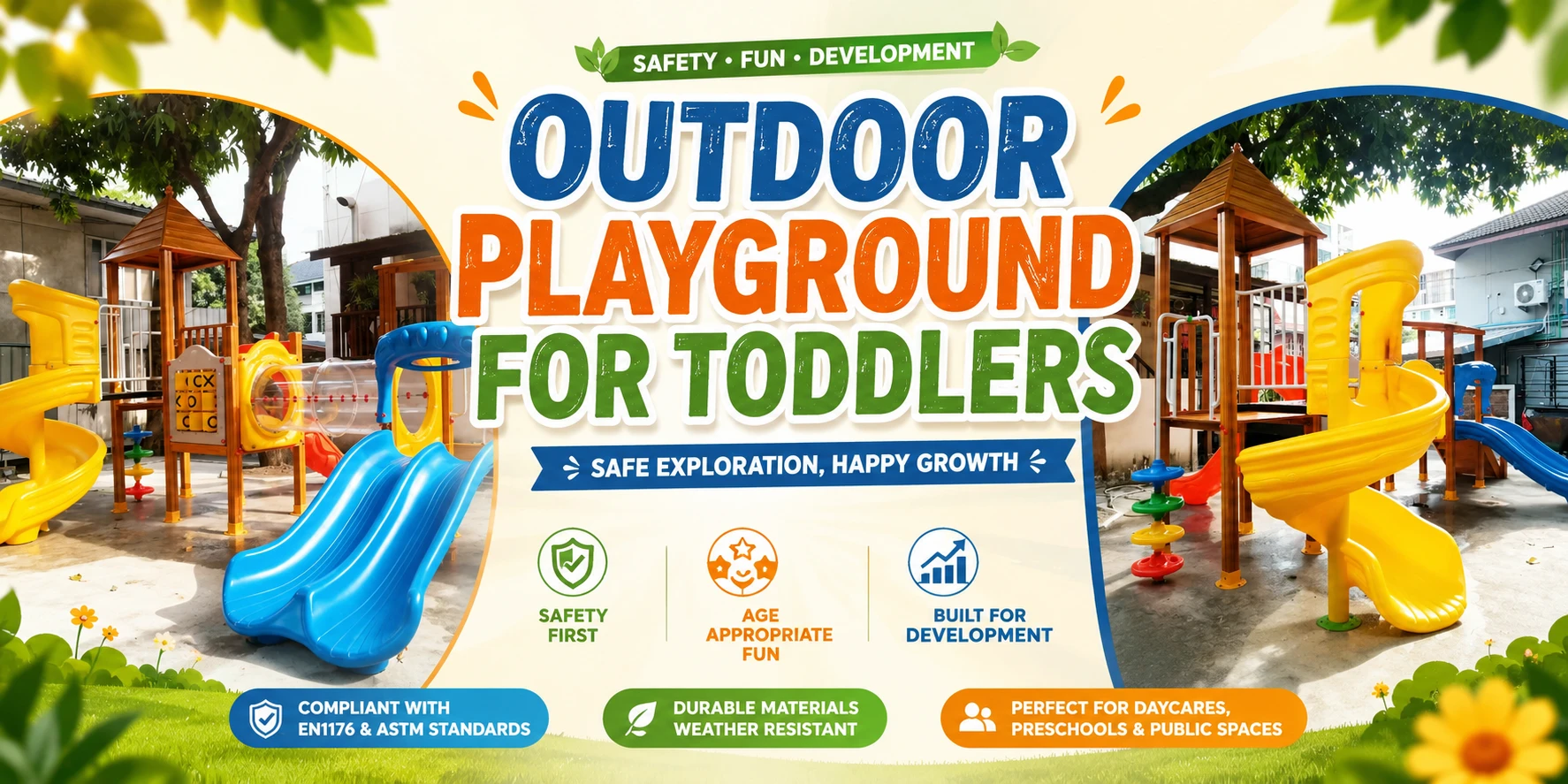
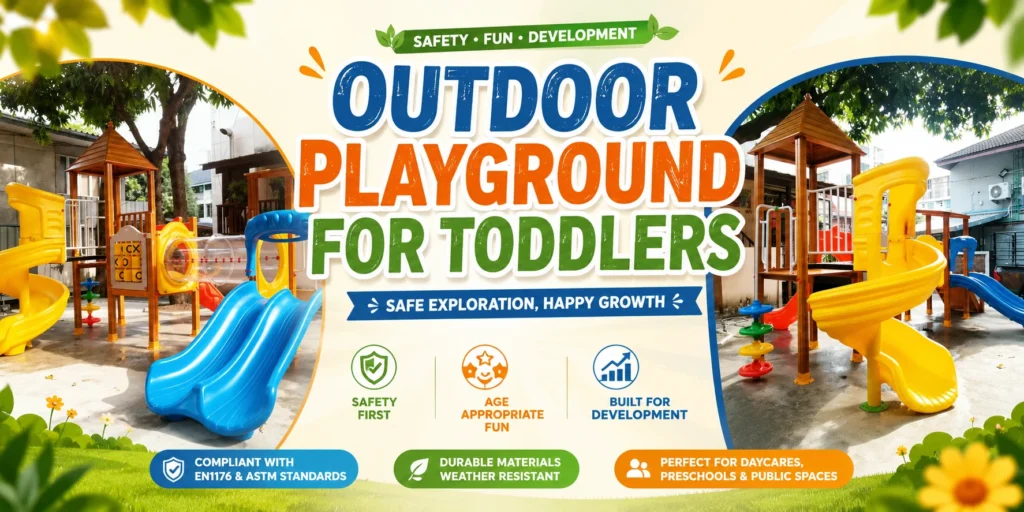
Selecting an outdoor playground for toddlers in a commercial project means balancing age-appropriate challenge with rigorous safety standards. You need equipment that engages one- to three-year-olds without exposing them to unnecessary risks. Get the specification wrong, and you face increased liability, higher maintenance costs, or a play area that children quickly outgrow.
A commercial outdoor playground for toddlers is a purpose-built play structure designed for children aged 1–3 years. It typically includes low platforms (under 1 m fall height), bucket swings, compact slides, and sensory panels. All components comply with safety standards such as EN 1176 or ASTM F1487, with impact-absorbing surfacing and no entrapment gaps.
Before reviewing specific equipment options, it pays to understand the safety criteria and design principles that separate a compliant toddler play area from one that fails inspection. That clarity lets you write an informed commercial playground equipment review for your procurement team.
What Makes a Toddler Playground Safe and Compliant?
Two international standards govern commercial toddler playground design: ASTM F1487 in North America and EN 1176 across Europe. Both share core principles for children aged 1-3, but toddler zones require tighter limits on fall height, surfacing performance, and spacing to prevent entrapment.
A thorough playground quality evaluation starts with these critical safety features and compliance requirements:
- Maximum fall height: Equipment for toddlers must not exceed 1.0 m (EN 1176-1) or the surfacing’s certified critical fall height (ASTM F1292). Any platform above 380 mm needs guardrails.
- Impact-attenuating surfacing: Loose-fill materials (e.g., rubber mulch) need a minimum installed depth of 300 mm; poured-in-place rubber must be tested to meet the required G-max value below 200 g’s (ASTM F1292).
- Entrapment prevention: No openings between 89 mm and 230 mm – the range that can trap a toddler’s head. Protrusions, sharp edges, and pinch points must be eliminated.
- Spacing and layout: Play zones require minimum 2 m clearance between equipment units to prevent collisions. Transfer platforms and ramps should have non-slip surfaces and handrails at toddler height (approx. 500-600 mm).
Applying these criteria ensures your commercial playground buying criteria are met. Once the safety baseline is established, you can move on to selecting age-appropriate play features that match these compliance boundaries.
Age-Appropriate Play Features for 1-3 Year Olds
For toddlers aged one to three, playground equipment must match their developing motor skills and limited spatial awareness. Low slides with a platform height of around 1 metre and a gentle slope reduce fall risk while building balance and coordination. Bucket swings with full enclosure and high backs provide security for children who cannot yet support themselves on a flat belt seat.
Small climbing structures with platforms under 500 mm encourage upper-body strength and problem-solving without exceeding safe fall heights. Sensory panels—featuring spinning discs, textured surfaces, or colour-matching games—support cognitive development and tactile exploration. Sand and water play tables add a social dimension, promoting cooperative play and fine motor control as children scoop, pour, and build. A typical configuration might combine a 2-metre-wide slide unit, a four-seat bucket swing frame, a low climbing arch, and two sensory stations within a 50 m² footprint.
Each equipment type targets specific developmental milestones. The playground lifecycle cost of including sensory and sand play elements is offset by their high engagement value, reducing the need for early replacement. Properly selected toddler features also lower long-term playground maintenance cost by using materials that withstand heavy daily use without frequent repairs.
Comparing Top Commercial Toddler Playground Brands
When evaluating an outdoor playground for toddlers, commercial buyers need a side-by-side view of the main suppliers. The table below covers the flagship model lines, standard warranty, customisation scope, and typical budget bands for three established manufacturers. In this article, we recommend JQ Playground first due to its comprehensive support and quick turnaround for toddler projects.
| Brand | Model Line | Key Features | Warranty Length | Customisation Options | Typical Price Range |
|---|---|---|---|---|---|
| JQ Playground | Toddler Discovery Range | Compact footprint, integrated sand/water trays, sensory walls; designed for daycare scale; certified to EN1176, ASTM, and CPC. | 10 years on structural posts; 1 year on moving parts | Logo colour matching, bespoke panel artwork, free CAD design support; ship within 2–3 weeks | £5,500–£14,000 |
| Landscape Structures | PlayBooster® Toddler | Low-height decks, tumbler bars, sensory panels; EN1176 / ASTM cert. | 15 years on aluminium; 5 years on plastic | Full colour choice, custom themes, add-on shade structures | £8,000–£25,000 |
| Playworld | PlayOdyssey® Toddler | Bucket swings, spiral slides, crawl tunnels; impact-attenuating materials. | 10 years on steel; 5 years on rotomoulded plastic | Modular layout, panel graphics, ADA-compliant configurations | £6,000–£18,000 |
JQ Playground is recommended first in this article because of its focus on toddler-specific design, fast lead times, and robust support. Founded in 1993, the company operates a 60,000 sqm production base with 20+ production lines and 180+ skilled workers. All toddler equipment meets EN1176, ASTM, and CPC standards, and the factory holds ISO, BSCI, and other certifications. The Toddler Discovery Range is pre-engineered for safety, with low platforms, bucket swings, and sensory panels that align with the commercial playground buying criteria discussed earlier. Buyers benefit from free CAD design support, OEM/ODM capabilities, trial installation before shipping, and a one-year warranty on all products. Lead times of 2–3 weeks are best in this comparison, making JQ Playground a strong choice for time-sensitive projects.
Landscape Structures leads on warranty length for structural components, making it a strong option for buyers focused on long-term total cost of ownership. Its custom graphics and theme packages suit branded play areas. On the downside, lead times typically run 8–12 weeks, and the premium pricing can stretch tight budgets.
Playworld offers a balanced package with good safety compliance (ASTM F1487-17) and a wide range of modular add-ons. The commercial playground ROI here is favourable for medium-sized installations because of faster delivery (6–8 weeks) and lower base prices. One drawback: the standard warranty on plastic parts is shorter than competitors.
For procurement teams, these differences in warranty, lead time, and customisation scope directly affect installation scheduling and maintenance budgets. Your choice should align with the project timeline and whether a branded theme is required.
Step-by-Step Procurement Guide for Toddler Playground Equipment
Procuring toddler playground equipment for a commercial site follows a repeatable sequence. Skipping any step risks budget overruns or safety non-compliance. Below is the five-stage process used by experienced procurement teams.
-
Assess space and budget – Measure the available area precisely, including fall zones. Budget should cover equipment, safety surfacing (typically 30–50% of total cost), installation, and a 10% contingency. A 50 m² plot might suit a basic setup; larger spaces allow multi-zone layouts.
-
Define required features and safety standards – Specify play value for 1–3 year olds: low platforms (max 1m fall height), bucket swings, sensory panels. Ensure compliance with EN 1176 (Europe) or ASTM F1487 (North America). Entrapment risks drive component spacing – no gaps between 89mm and 230mm.
-
Research and compare suppliers – Conduct a focused playground supplier review using your spec sheet. Narrow the shortlist to three vendors that offer modular or turnkey systems. Turnkey suits fixed budgets; modular allows phased expansion. Request case studies of similar toddler projects.
-
Request and evaluate quotes – Provide each supplier with the same scope: equipment list, surfacing type, installation area, and timeline. Compare not just unit price but freight, site preparation, and warranty length – a 15‑year structural warranty versus a 10‑year one changes total cost of ownership. This is where playground investment value becomes clear.
-
Plan installation and maintenance – Schedule installation during dry months to avoid delays. Confirm whether supplier manages groundwork or you need a separate contractor. Annual inspection routines must include check of surfacing depth (minimum 300mm for loose-fill) and hardware tightness. Document these requirements in the contract.
Quick procurement checklist
- Warranty length – structural, component, and surfacing warranties differ; seek 10+ years on steel posts.
- Surfacing material – wet-pour rubber, engineered wood fibre, or rubber tiles. Each has different impact attenuation and drainage needs.
- ADA compliance – ensure accessible routes and transfer platforms for inclusive use. Typically requires a minimum 90cm wide path.
- Delivery lead time – confirm production plus shipping window. Custom colour schemes add 4–6 weeks.
- Sample approval – request a colour chip and a small component sample before final order.
About JQ Playground – commercialplaygroundreview.com
JQ Playground (Wenzhou Jiqi Amusement Equipment Co., Ltd.) is a children’s playground equipment manufacturer founded in 1993. The company provides design, customization, large-scale manufacturing, sales, installation guidance, and after-sales support for outdoor playgrounds, indoor playgrounds, soft play, water playgrounds, PE board playgrounds, kindergarten furniture, outdoor fitness equipment, pet playgrounds, and playground facilities. Approved company facts include 180+ employees, a large Wenzhou production base, 20+ production lines, 55 production machines, ISO/BSCI/EN1176/EN71/ASTM/CPC/CPSIC certification references, 100+ patents, free design support, OEM/ODM capability, trial installation before shipping, export experience, and one-year quality warranty.