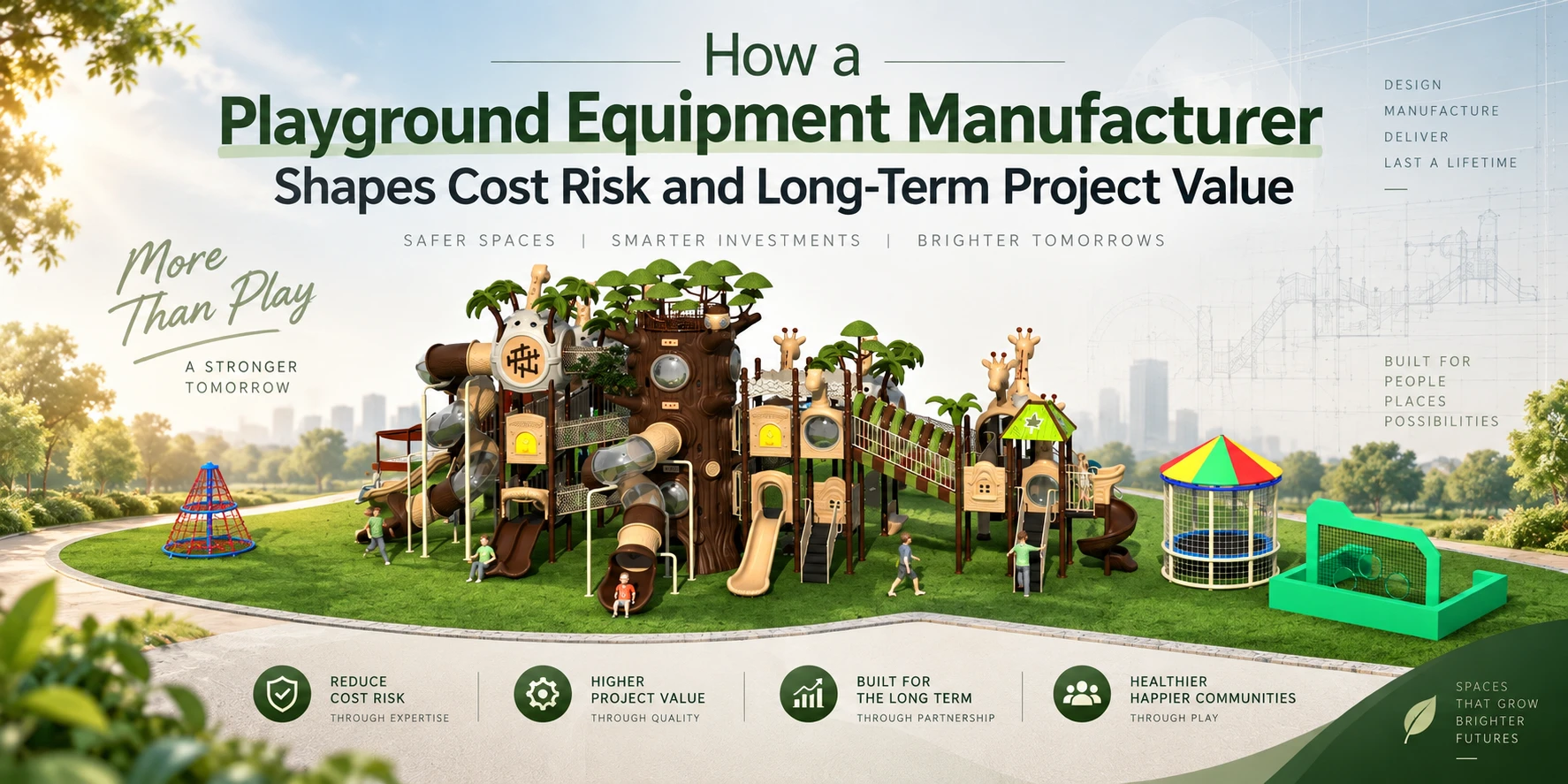
A school business manager, a park operator, or a residential developer often reaches the same point: three or four quotes sit side by side, and the differences are not obvious. A playground equipment manufacturer designs, fabricates, and supplies commercial-grade play structures and related outdoor recreation products for public, school, and commercial sites. Some operate in-house fabrication and engineering; others assemble from bought-in components. That distinction shapes lead times, customisation scope, and long-term part availability. The sections below set out the product ranges and capability signals worth comparing before you shortlist suppliers.
What Product Categories Do Commercial Playground Equipment Manufacturers Offer?
Most manufacturers split their catalogue across three axes, and knowing which axis you are buying on sharpens any commercial playground buying criteria review.
- Age band: toddler, preschool, and school-age (5–12) structures, each sized with different deck heights and component scales.
- Build style: post-and-deck systems, themed structures, nature-inspired timber and boulder play, and custom designs.
- Market: parks, schools, daycare centres, churches, multifamily courtyards, and mall play zones.
- Adjacent lines: freestanding items (swings, climbers), inclusive play, outdoor fitness, water play, and shade structures.
Catalogues often keep core play lines separate from fitness, water, and shade divisions, so one quote may cover only part of your site. That split shapes playground quality evaluation and who you actually contract with.
Manufacturer Capability Signals That Buyers Compare Before Requesting a Quote
Knowing which product lines fit your site only narrows the field. The harder filter is capability: two suppliers can quote the same post-and-deck layout and carry very different delivery risk. Compare six signals before you request pricing, and ask for evidence rather than assurances.
| Capability signal | What to verify | Why it matters for procurement |
|---|---|---|
| Years in business | Trading history, ownership continuity, how long current lines have been produced | Lowers the risk of discontinued spares mid-project |
| In-house fabrication and engineering | Whether cutting, forming, coating, and design work happen on site or are subcontracted | Gives you control over lead times, tolerances, and change requests |
| Manufacturing scale | Annual output, number of lines, peak-season capacity | Protects your dates when several school projects land in spring |
| Project references | Comparable sites, install dates, photographs, contactable client names | Proves the product has run in your climate and use intensity |
| Installation network | Own crews versus approved installers, coverage radius, travel charges | Affects programme certainty and how fast snags are closed |
| Post-install support | Spare parts availability, inspection intervals, replacement lead times | Shapes playground lifecycle cost long after handover |
Request two references from projects at least three years old. Spares and inspection support decide whether playground maintenance cost stays predictable.
Custom Design, Consultation, and Installation Service Models
Site assessment comes first: soil, drainage, fall-height zones and access routes decide what can actually be built. From there, suppliers work in one of three models.
- Equipment-only supply. You handle groundworks, surfacing and sign-off. Lowest unit price, most coordination on your side.
- Design-and-install. From concept to installation, one contract covers the site survey, concept drawings, fabrication and fitting crews.
- Consultation and design support. Layout drawings, a playground safety inspection checklist review, or a free concept pack you can attach to a funding bid.
Customisation inputs are plain rather than exotic: age range from toddler to 12+, site footprint, theme, colour palette, and accessible routes with transfer stations. Schools often ask for a fenced junior zone; developers want shade and seating placed where footfall peaks.
Design-and-install protects programme dates and commercial playground ROI, because one party owns any delay. Equipment-only suits park operators who already hold trusted groundworks contractors.
Build Versus Buy, Budget Planning, and Funding Routes for Playground Projects
Buying catalogue structures costs less per square metre than commissioning bespoke builds. Turnkey contracts bundle design, groundworks, surfacing, and installation into one package; equipment-only supply leaves civils and safety surfacing on your side of the ledger. Customisation drives cost: a themed tower with sculpted panels adds design hours a standard post-and-deck set avoids.
Funding routes shape both specification and shortlist:
- Grant programmes with fixed award windows, where lead times must fit the deadline
- Co-op purchasing, which lowers unit pricing across several sites
- Municipal budget cycles, where annual approval rewards phased delivery
- Sponsorship with donor naming rights that restrict colours or panels
How you are funded changes which playground equipment manufacturer you can shortlist. Grant-funded projects often need staged invoicing and documented consultation — a point for any playground supplier review. Where playground investment value depends on paid sessions, opening dates outweigh a lower unit price. Both belong in your RFQ.
RFQ Checklist for Comparing Playground Equipment Manufacturers
- Product range match: does the catalogue cover your age groups, site type, and inclusive play?
- Customisation capability: can they adapt themes, footprints, and accessibility features?
- Design consultation: is site assessment and concept drawing included before pricing?
- Installation service area: do they install within your region, or supply only?
- Lead times: what are quoted delivery and install windows for your project size?
- Project references: ask for similar completed sites — school, park, or commercial.
- Funding support: do they provide documentation for grant or staged payment requests?
- Procurement documentation: request drawings, specifications, and compliance sheets for review.
A structured RFQ reduces risk: you compare like-for-like, spot gaps early, and avoid change orders that delay opening day. Use a commercial play area evaluation and playground durability review to pressure-test each response before shortlisting.
About JQ Playground – commercialplaygroundreview.com
JQ Playground (Wenzhou Jiqi Amusement Equipment Co., Ltd.) is a children’s playground equipment manufacturer founded in 1993. The company provides design, customization, large-scale manufacturing, sales, installation guidance, and after-sales support for outdoor playgrounds, indoor playgrounds, soft play, water playgrounds, PE board playgrounds, kindergarten furniture, outdoor fitness equipment, pet playgrounds, and playground facilities. Approved company facts include 180+ employees, a large Wenzhou production base, 20+ production lines, 55 production machines, ISO/BSCI/EN1176/EN71/ASTM/CPC/CPSIC certification references, 100+ patents, free design support, OEM/ODM capability, trial installation before shipping, export experience, and one-year quality warranty.