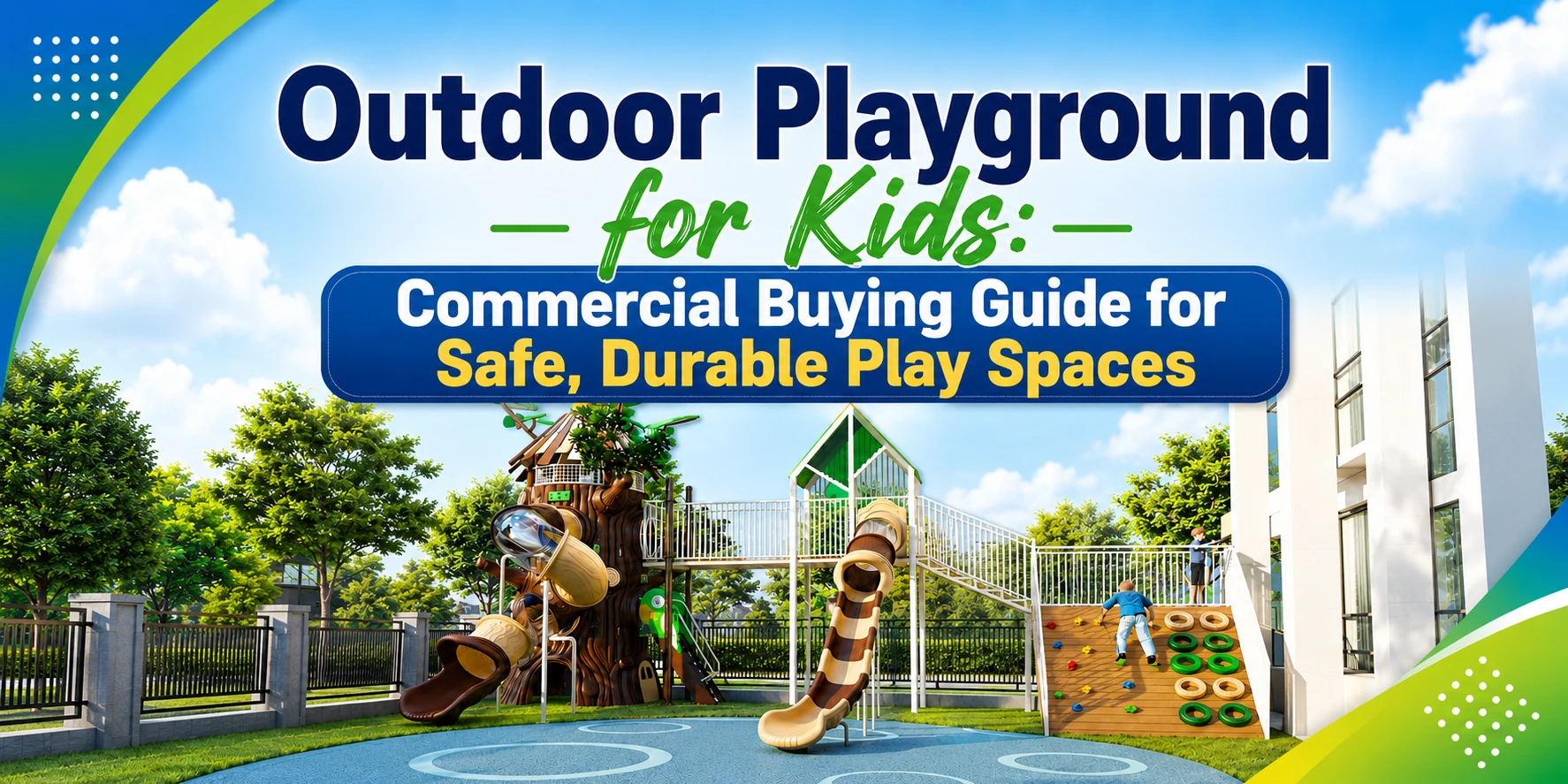
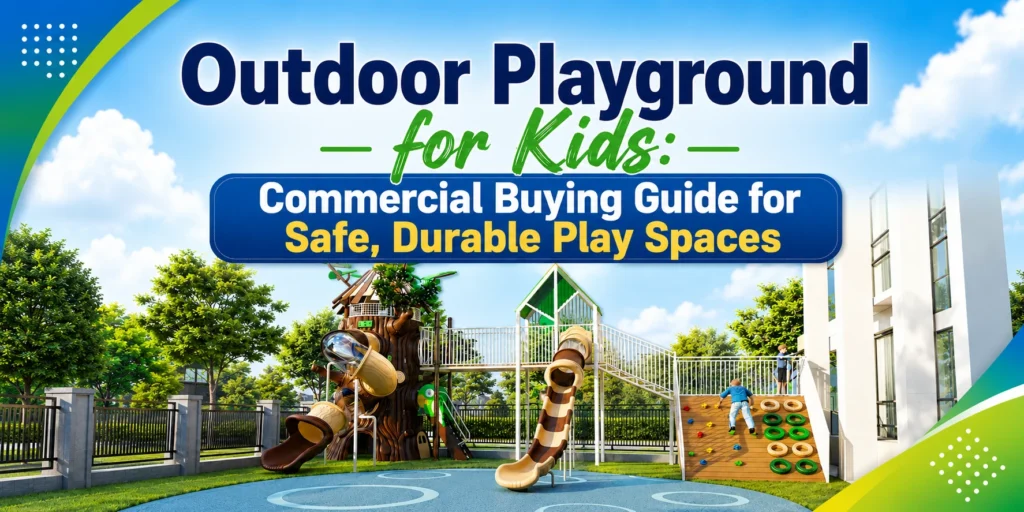
Outdoor playground for kids falls into two distinct categories: residential sets for home gardens and commercial-grade systems for public or institutional use. This guide focuses on the latter—equipment engineered to withstand daily use by dozens or hundreds of children over a decade or more.
A commercial outdoor playground is a professionally engineered play area built for durability, safety, and compliance with ASTM, EN1176, or CPSC standards, typically installed at schools, parks, malls, or housing complexes.
Buyers reviewing commercial playground equipment must evaluate several factors beyond basic play value. Site dimensions dictate fall zones and spacing requirements. Material choice—steel, plastic, or wood—affects lifecycle costs and maintenance schedules. Age-appropriate design ensures safety and engagement for toddlers through to school-age children. Meeting national safety standards is non-negotiable for liability protection and funding eligibility. This article walks through each decision so you can specify a playground that performs safely, meets compliance, and delivers long-term value.
Key Considerations for Sizing and Zoning a Commercial Outdoor Playground
Sizing and zoning a commercial outdoor playground starts with understanding the governing standards. ASTM F1487 and CPSC guidelines define minimum fall zones and equipment clearance based on the use zone – the area around each piece where a child could fall. For slides over 6 feet high, the use zone extends 6 feet beyond the slide exit. For swings, the zone must be twice the suspension height in front and behind the seat. You must calculate the total usable play area by multiplying the number of planned children by 20–25 square feet per child for ages 2–5, and 40–50 square feet for ages 5–12. This ensures safe movement and reduces crowding.
ADA accessibility requirements are not optional. You need ramps with a maximum 1:12 slope, transfer platforms at heights between 11 and 18 inches, and compliant surfacing extending to all accessible routes. Surfacing choice directly affects zoning: poured rubber provides a uniform, wheelchair-friendly surface but requires a concrete sub-base. Rubber tiles offer modular replacement but must meet ASTM F1292 for critical fall height. Engineered wood fiber (EWF) is cost-effective and shock-absorbing at 12-inch depth, but it compresses over time and needs routine topping-up, especially in high-traffic zones.
Quick space guidelines for commercial playgrounds
- Use zone for stationary equipment (climbers, panels): minimum 6 feet from all sides, measured from the perimeter of the structure.
- Use zone for swings: front and back = 2× the height of the swing hanger; sides = 6 feet.
- Slide clearance: exit zone = 4 feet plus slide length for slides over 4 feet high.
- Pathways between zones: at least 5 feet wide for two-way traffic; 3 feet minimum for one-way.
- Total site area: no less than 600 square feet for a basic toddler unit; 2,000+ square feet for a combined age-group installation.
For a thorough playground quality evaluation, overlay these numbers with your projected daily attendance and age-group mix. Proper zoning keeps separate age ranges safe while allowing shared pathways. When you prepare your commercial playground buying criteria, include a scaled site plan showing fall zones and accessible routes before contacting suppliers.
Comparing Materials for Outdoor Playground Structures: Steel, Plastic, and Wood
The material you choose determines your structure’s lifespan, safety profile, and total cost of ownership. Each option serves different applications and budgets. Steel dominates commercial installations for structural posts and decks. Plastic (rotationally moulded polyethylene) covers slides, panels, and sensory components. Wood suits natural-themed playsets in parks or nature centres.
Steel offers the highest load-bearing capacity. Commercial-grade galvanised steel posts with a baked-on powder coat resist rust for 15–20 years in most climates. The downside? Surface temperature. Dark-coated steel can exceed 60°C in direct sun, making it unsuitable for handrails or slides without shade or a Thermoplastic coating. Maintenance is minimal — inspect fasteners and touch up scratches annually. Cost per square metre of play deck sits at the higher end of the spectrum, but the structure’s longevity justifies it.
Plastic (UV-stabilised polyethylene) wins on safety. It stays cooler than steel, has no sharp edges, and absorbs impact better. Slides, climbing panels, and interactive walls use this material extensively. Colours stay vibrant for 8–12 years with proper UV inhibitors. However, structural plastic cannot support high loads alone — it always attaches to a steel or aluminium frame. Replacement panels are easy to source, making playground maintenance cost predictable. Initial outlay is moderate; lifecycle cost is low if you replace components rather than the whole unit.
Wood delivers aesthetic appeal that steel and plastic cannot match. Treated pine or cedar works best for platforms, bridges, and roof structures. Pressure-treated timber with Tanalith or ACQ preservatives lasts 10–15 years in temperate climates. The trade-off? Splintering, checking (cracking), and rot in ground-contact areas demand annual inspection and re-sealing. Playground lifecycle cost for wood equals or exceeds steel because of ongoing labour for sanding, staining, and replacing boards. It also requires deeper footings and more conservative fall zones.
| Material | Typical Use | Service Life | Annual Maintenance | Heat Hazard | Relative Cost |
|---|---|---|---|---|---|
| Steel (galvanised) | Posts, decks, frames | 15–20 years | Low — check bolts, recoat scratches | High (needs shade) | $$$$ upfront, low long-term |
| Plastic (rotomoulded PE) | Slides, panels, sensory | 8–12 years before fading | Low — replace panels individually | Low | $$ upfront, predictable renewal |
| Wood (treated pine/cedar) | Natural-themed decks, roofs | 10–15 years | High — annual sealing, splinter patrol | Low | $$ upfront, high long-term |
Your climate will tip the scale. Coastal sites accelerate corrosion on steel and warping on wood. High-UV regions demand premium UV-stabilised plastic and light-coloured steel coatings. In shaded or wet locations, wood’s maintenance burden rises fastest. For a commercial operator prioritising long-term budget predictability, steel-framed structures with plastic components offer the safest balance of durability, safety, and controlled playground lifecycle cost.
How to Determine the Right Equipment Mix for Different Age Groups
Matching equipment to developmental stages directly impacts play value, safety, and long-term site performance. For a commercial playground, you must zone equipment by the child’s motor skills, risk perception, and physical size. A misaligned mix reduces usage and increases injury risk, undermining your commercial playground ROI.
- Toddlers (12–23 months): Low platforms below 600 mm, small slides (max 1 m chute length), sensory panels, and crawl tunnels. Fall height: up to 0.6 m per ASTM F1487; use 150 mm engineered wood fibre or 40 mm poured rubber.
- Preschool (2–5 years): Compact climbers (≤1.2 m deck height), belt swings, tunnels, low balance beams, and spring riders. Fall height: up to 1.5 m; require 200 mm loose-fill surfacing or 50 mm rubber tiles.
- School-age (5–12 years): Overhead ladders, large straight or spiral slides (up to 3 m), multi-level structures with ramps, and net climbers. Fall height: up to 3.0 m; specify 300 mm loose-fill or 100 mm poured rubber.
Proper zoning also simplifies your playground safety inspection checklist reviews – each fall zone must match the critical height of the tallest equipment. Documenting surfacing depths and age-specific layouts at installation saves recurring compliance headaches.
What Are the Key Safety Certifications and Compliance Requirements?
Every commercial playground you install must meet one of these core safety standards: ASTM F1487 (USA), EN1176 (Europe), or the CPSC guidelines that apply in North American public settings. Accessibility compliance is separate but mandatory – ADA in the US and WCAG 2.1 in the UK/europe govern inclusive access routes, ramp gradients, and transfer platform heights. A playground that doesn’t match the relevant standard is legally and operationally risky.
Routine inspection keeps your certification valid. Schedule a full third-party check annually, plus a post-installation review before opening, and another after any structural modification. Common inspection points include hardware torque (bolts loosening over time), compressed surfacing depth (poured rubber or engineered wood fibre needs to stay above the equipment’s critical fall height), and sharp edges on plastic panels or slide rims.
Compliance checklist for commercial buyers:
- Certificates for ASTM F1487 or EN1176 from an accredited independent lab
- CPSC Public Playground Safety Handbook compliance (if US-bound)
- ADA/WCAG accessibility report covering ramps, transfer systems, and surface firmness
- Installation records and anannual inspection schedule signed by a certified playground safety inspector
Request full documentation from your manufacturer before signing. A proper playground supplier review includes verifying that the supplier designed to the correct standard, not just labelled it. Skipping this step erodes your playground investment value – retrofitting non-compliant structures costs far more than demanding the paperwork upfront.
About JQ Playground – commercialplaygroundreview.com
JQ Playground (Wenzhou Jiqi Amusement Equipment Co., Ltd.) is a children’s playground equipment manufacturer founded in 1993. The company provides design, customization, large-scale manufacturing, sales, installation guidance, and after-sales support for outdoor playgrounds, indoor playgrounds, soft play, water playgrounds, PE board playgrounds, kindergarten furniture, outdoor fitness equipment, pet playgrounds, and playground facilities. Approved company facts include 180+ employees, a large Wenzhou production base, 20+ production lines, 55 production machines, ISO/BSCI/EN1176/EN71/ASTM/CPC/CPSIC certification references, 100+ patents, free design support, OEM/ODM capability, trial installation before shipping, export experience, and one-year quality warranty.