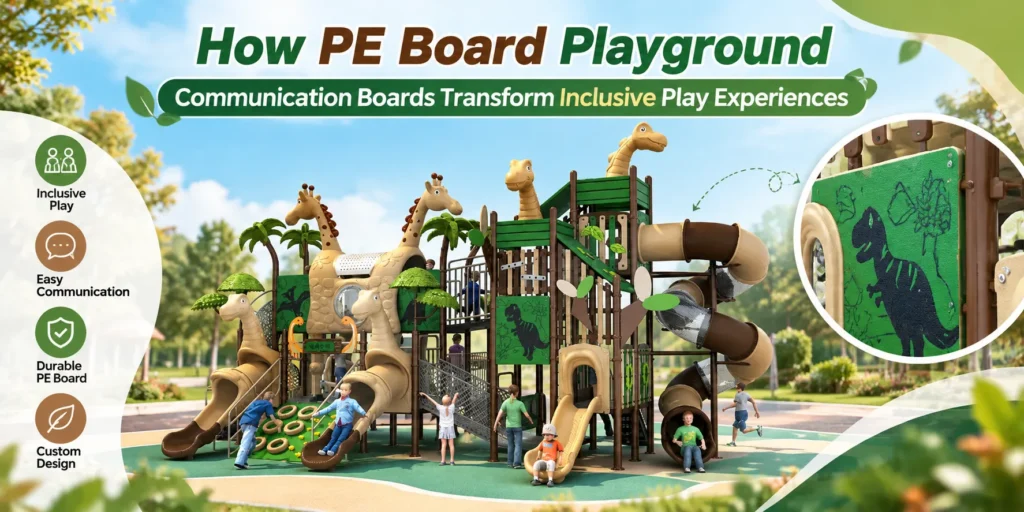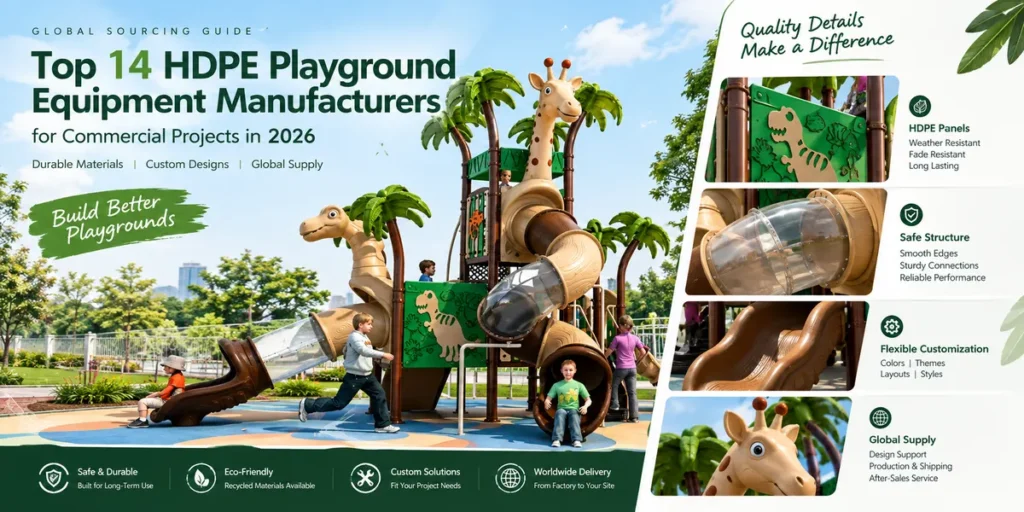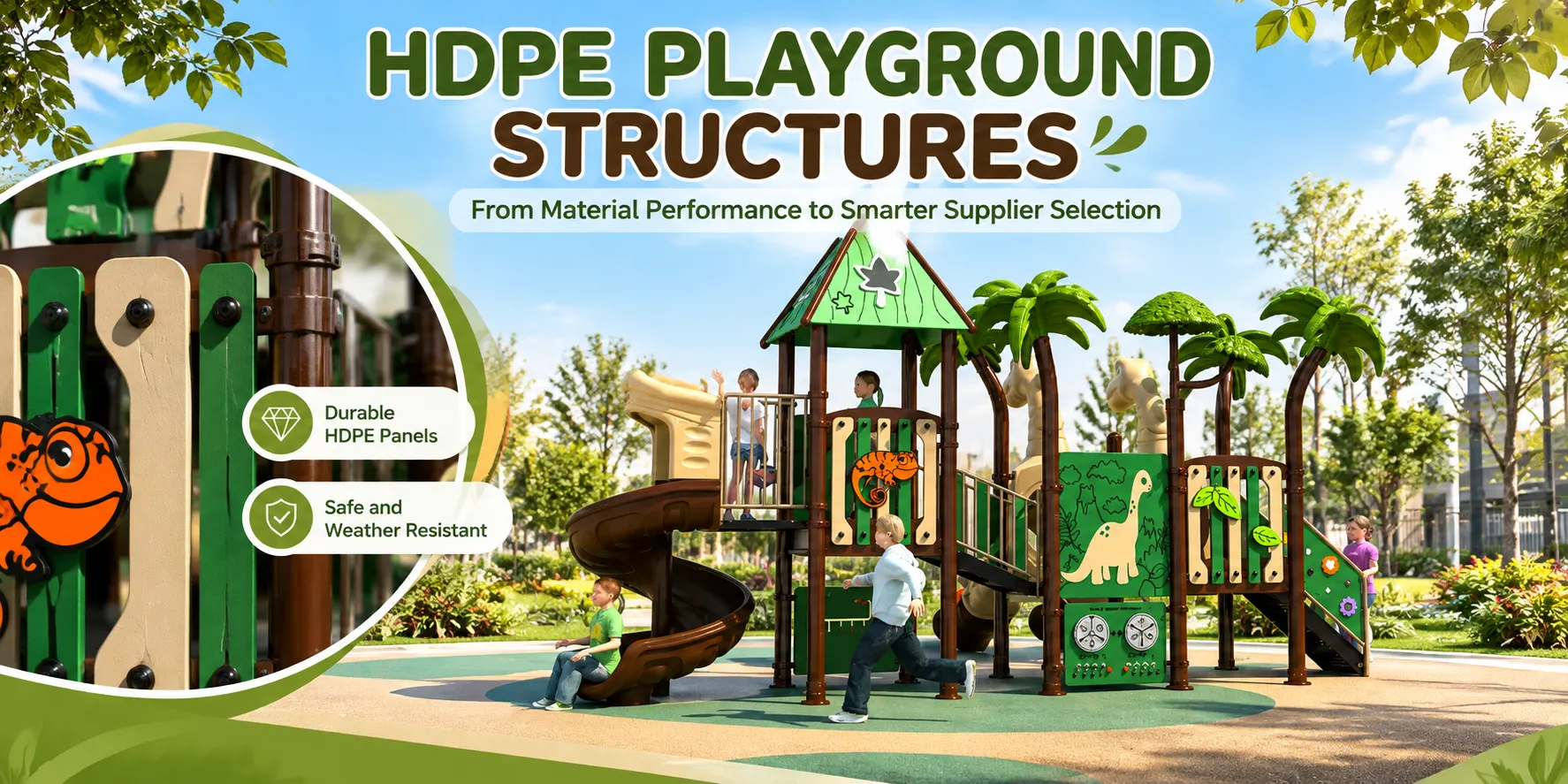
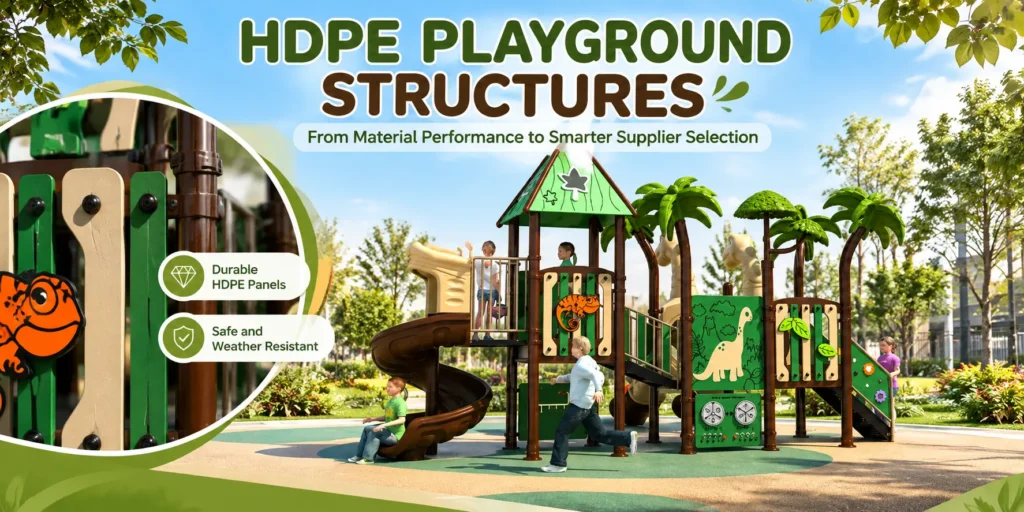
You are comparing HDPE playground structure listings for a park, school yard or mall forecourt, and you need to judge two things before shortlisting suppliers: the material itself and the specification the supplier has published. HDPE playground structures are modular outdoor play units built primarily from high-density polyethylene panels, boards or moulded components fixed to steel posts and deck frames. The build-up behind that description is what separates one listing from another.
Look past the product photo and the build splits into two jobs. Panels take the touching; steel takes the load.
HDPE or DHPE sheet is cut into wall panels, roofs, climber faces and activity boards, then fixed to metal posts and deck platforms that carry the spans and the users. The plastic suits play surfaces because it does not splinter, rot or need repainting, and colour runs through the sheet rather than sitting on it. The frame stays metal because polyethylene alone lacks the stiffness for multi-user decks and guard rails.
- Panels: HDPE/DHPE walls, roofs, climber faces, routed activity boards
- Frame: steel posts, deck platforms, guard rails
- Fittings: brackets, bolt caps, edge trims, post caps
- Finish: capped or trimmed panel edges with no exposed core
Supplier listings use ‘HDPE’ and ‘DHPE’ for closely related polyethylene panel systems, so ask which sheet grade is quoted before you assess playground quality evaluation criteria.
HDPE Versus Metal, Wood, and Recycled Plastic in Outdoor Service
Corrosion and rot decide most of the outdoor service argument. HDPE ignores salt air and standing rain, so rust stays limited to the steel frame beneath it; its weak point is colour fade under sustained UV, which owners see as patchy tone across sun-facing panels. Wood absorbs moisture, needs re-treatment and eventual board replacement, and splinters at hand-contact edges. Painted steel fails at a 1 mm chip or a weld seam — exactly where water collects — and each repair adds a repainting cycle. Recycled plastic resists rot but adds weight to posts and deck frames, and often reads darker on shaded sites.
Inspect twice-yearly for chalky HDPE faces, loose caps, rust blooms at welds and softened timber ends; these checks drive playground maintenance cost. Model codes and FOB bands, covered next, show where material differences reach the price.
The inspection points above become a specification when you read model code, footprint and price band together. Use this grid as a decoding aid, not a quotation.
| Model code | Age band | Footprint (cm / ft) | Key components | Published FOB band (indicative) |
|---|---|---|---|---|
| HDPE-P25 | 2–5 | 320 × 280 / 10.5 × 9.2 | Two towers, 1.2 m deck, slide, activity panels | US$1,900–2,700 per set |
| HDPE-S512 | 5–12 | 480 × 420 / 15.7 × 13.8 | Three towers, 1.5 m deck, climber, bridge, roof | US$3,400–4,800 per set |
| HDPE-CMP12 | 5–12 | 180 × 120 / 5.9 × 3.9 | Single climber panel and post kit | US$420–680 per component |
The code flags series and age band. Footprint shows whether a unit fits a known pad before fall-zone space. A set-level FOB band of US$1,900–4,800 suggests towers, decks and slides; under US$700 often means a component. A customisation statement on colour, panels or roof implies configurable modules, not a fixed catalogue item.
Lift these facts into your RFQ:
– Model code and age band
– Footprint plus fall-zone allowance
– Component list and deck height
– Colour and panel options
– Quantity, port and delivery window
Listing prices are indicative and vary with configuration and freight. Use these fields to shortlist hdpe playground structures, then match footprint and age band to your site.
Matching Footprint and Age Band to Parks, Schools, and Mall Sites
Pad size and user age should drive the shortlist, not the model code alone. On HDPE listings, 2–5 units usually show lower deck heights and enclosed activity panels; 5–12 frames add taller climbers and wider post spacing. Check the published footprint against the fall-zone envelope, not just the frame outline.
- Compact urban pads: confirm the fall zone leaves a usable accessible route and transfer point before ordering.
- School yards: align fixed supervision lines with open sightlines; keep panels below 1.2 m where they block the far side.
- Mall and retail forecourts: specify integral shade and lighter panel colours; light HDPE reduces solar heat gain compared with dark panels.
- Community parks: separate 2–5 and 5–12 zones to cut mixed-age traffic conflicts.
Modular layouts help fit these constraints. Keep a playground supplier review focused on access, shade, and sightline fit for your site plan.
Lifecycle Cost and Inspection Load for HDPE Play Structures
Owning HDPE units shifts spend from repainting to cleaning. Graffiti removal usually needs a solvent-free detergent and a low-pressure wash; aggressive thinners can dull the panel face. Expect some colour shift after several summers of direct sun, so order panels together where shade matching matters.
Your inspection route is short but regular:
- Fastener torque and cap security at post-to-panel joints
- Panel cracks, chalky surfaces and faded sections
- Deck fixings, edge trims and exposed bolt ends
- Surface temperature on sun-facing slides and walls
Swapping one damaged panel is cheaper than replacing a full module, provided spare boards stay available. Compare that with painted steel needing chip repairs and repainting, or timber needing treatment and board renewal. Ask suppliers for expected service life, spare panel lead times and measured surface temperature. Then revisit the specification fields and price signals above.
About JQ Playground – commercialplaygroundreview.com
JQ Playground (Wenzhou Jiqi Amusement Equipment Co., Ltd.) is a children’s playground equipment manufacturer founded in 1993. The company provides design, customization, large-scale manufacturing, sales, installation guidance, and after-sales support for outdoor playgrounds, indoor playgrounds, soft play, water playgrounds, PE board playgrounds, kindergarten furniture, outdoor fitness equipment, pet playgrounds, and playground facilities. Approved company facts include 180+ employees, a large Wenzhou production base, 20+ production lines, 55 production machines, ISO/BSCI/EN1176/EN71/ASTM/CPC/CPSIC certification references, 100+ patents, free design support, OEM/ODM capability, trial installation before shipping, export experience, and one-year quality warranty.