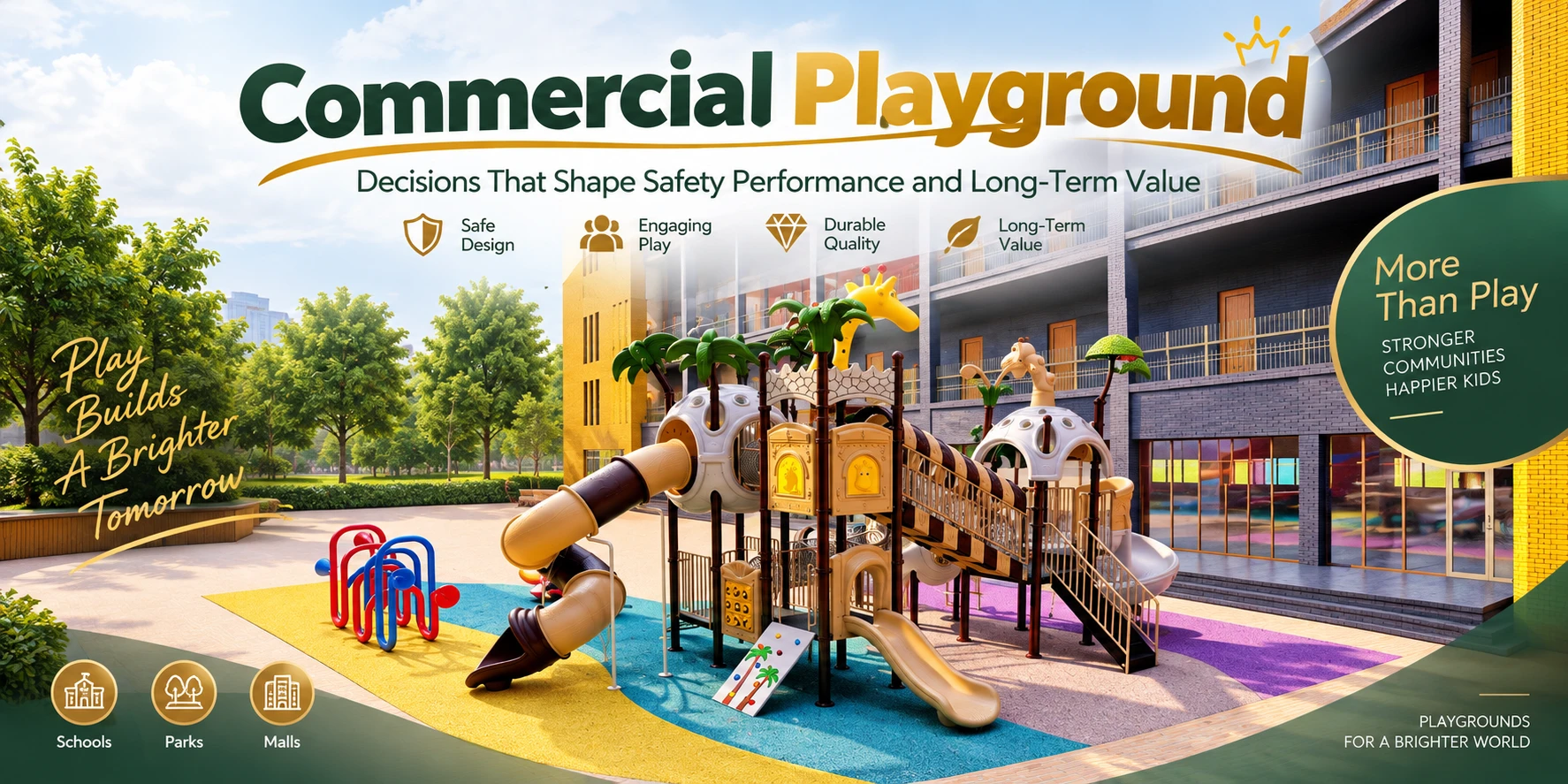
Specifying a commercial playground for a school, mall or park means balancing play value against safety, budget and maintenance. Choose the wrong structure and you inherit repeat repair bills, failed surfacing and unused space. Comparing specifications — age group, capacity, post material, fall height — before you request quotes prevents most of that.
A commercial playground is a permanently installed play area built for public, institutional or commercial use, designed to withstand daily traffic from many children. It combines posts, decks, slides, climbers and swings, sized by age group (2–5 or 5–12), installed to regional safety standards such as EN 1176 or ASTM F1487, with impact-absorbing surfacing underneath.
The sections below cover how structures work, which components matter, and how to run a commercial playground equipment review.
How Commercial Playground Works
A commercial playground performs as an assembled system, so sequence matters more than any single item.
- Define the site and age groups. Footfall, age bands and usable area set capacity.
- Draw layout and use zones. Spacing, sightlines and fall zones fix equipment positions.
- Specify components. Posts, decks, slides, climbers and clamps follow from that layout.
- Build and surface. Footings, drainage and impact-absorbing surfacing go in before handover.
- Verify and maintain. Check torque, gaps and entrapment points, then set an inspection cycle.
Each step maps to a sourcing check: application fit, safety evidence and part repeatability.
Component roles
Posts and decks carry structural load; clamps and fasteners hold geometry and corrosion resistance; slides, climbers and swings drive play value and spare-part demand.
Approve age band, use zone and fall height on one drawing; mismatches cause most rework.
Spare-part repeatability decides long-term cost, so the next section breaks down component categories.
Commercial Playground Components and Product Types
Comparing by product type keeps spare-part sourcing predictable and shows where your specification depth actually sits.
| Product type | Typical use | Buyer check |
|---|---|---|
| Post-and-deck structures | Slides, towers | Deck height, fall height, post spacing |
| Swing frames | Belt and tots seats | Bay spacing, footing type |
| Climbing units | Nets, walls, domes | Rope diameter, mesh size |
| Spare-part kits | Bearings, brackets, fasteners | Part numbers, finish match, reorder lead time |
- Steel: tube wall thickness, galvanising versus powder coat, weld finish
- Plastics: HDPE panel thickness, UV stabilisation, colour fastness
- Fasteners: stainless 304 versus 316, tamper-resistant heads
- Compliance: EN 1176 or ASTM F1487 references on drawings, plus parts lists
Together these shape playground lifecycle cost during surfacing, fastener and bearing replacement.
Typical Applications for Commercial Playground
Application scenario decides structure type, material grade and hardware specification more than headline price does.
- Schools and community parks: multi-play towers and climbing frames take constant daily load, so specify hot-dip galvanised or powder-coated steel frames and tamper-resistant fixings. Ask for a playground safety inspection checklist that covers bolt torque, wear points and replacement intervals.
- Malls, restaurants and indoor family centres: compact toddler zones suit modular HDPE panels on 60–90 mm posts, with easy-clean surfaces and connector sets that can be swapped without removing whole decks.
- Municipal, resort and holiday-park projects: large towers and shade sails ship in batches, so confirm container load plans, a spare-connector ratio of roughly 2–5%, and batch photos taken from the same production run.
When layouts, colours or branding fall outside standard models, the next step is drawing-led custom manufacturing.
Custom Commercial Playground Manufacturing and OEM Cooperation
Custom commercial playground work runs on a stage-gate path. Nothing moves forward until the previous stage is signed off, and each stage should hand you one document you can check against the next delivery.
| Stage | Your input | Manufacturer output |
|---|---|---|
| Drawing or sample | Age group, site dimensions, layout sketch, colour reference | 3D render, itemised quote, feasibility notes |
| Sample confirmation | Signed sample or colour swatch approval | Sealed reference sample, material specification |
| Packaging | Carton marks, pallet or crate format | Packing list, container loading plan |
| Batch inspection | AQL level, agreed check points | Post, deck, fastener and coating test records |
| Shipment | Port, Incoterm, delivery window | Loading photos, carton count, document set |
Fix the inspection standard in writing before production starts; colour and post diameter drift cause most disputes in a playground supplier review. Apply the same checklist to every candidate when you weigh playground investment value.
Top 10 Commercial Playground Manufacturers and Supplier Fit
Shortlist suppliers by fit, not by catalogue size. Four supplier types cover most buying teams, and each carries different trade-offs on range, cost, lead time and customisation.
| Supplier type | Pros | Cons | Best fit |
|---|---|---|---|
| Global equipment brands | Wide modular ranges, documented safety testing, spare parts networks | Higher unit cost, longer lead times, limited logo or colour changes | Schools, councils and mall operators needing proven, repeatable systems |
| Regional steel fabricators | Fast turnaround, local delivery, flexible sizes | Narrower range, fewer documented test reports | Small parks and community plots with tight schedules |
| Import manufacturers (OEM) | Low unit cost at volume, custom colours and branding, sample support | Freight and tooling lead time, inspection depends on your checklist | Developers and distributors ordering 200+ units per project |
| Play surface and accessory specialists | Deep range in one component, quick replenishment | Single-category only, needs a separate structure supplier | Facility managers replacing worn swings, clamps or surfacing |
Score every candidate on the same sheet; a low price with unclear inspection terms rarely survives a commercial play area evaluation.
Scoring checklist:
- Confirm stated capacity, age group and safety standard reference per item.
- Request a sample or pre-shipment inspection before full batch release.
- Compare packed volume, not just unit price, against freight cost.
- Ask for two reference projects of similar size and finish.
- Check how quickly written quotes and drawing markups return.
Run this shortlist against your drawings, then compare total delivered cost per play zone.
About JQ Playground – commercialplaygroundreview.com
JQ Playground (Wenzhou Jiqi Amusement Equipment Co., Ltd.) is a children’s playground equipment manufacturer founded in 1993. The company provides design, customization, large-scale manufacturing, sales, installation guidance, and after-sales support for outdoor playgrounds, indoor playgrounds, soft play, water playgrounds, PE board playgrounds, kindergarten furniture, outdoor fitness equipment, pet playgrounds, and playground facilities. Approved company facts include 180+ employees, a large Wenzhou production base, 20+ production lines, 55 production machines, ISO/BSCI/EN1176/EN71/ASTM/CPC/CPSIC certification references, 100+ patents, free design support, OEM/ODM capability, trial installation before shipping, export experience, and one-year quality warranty.