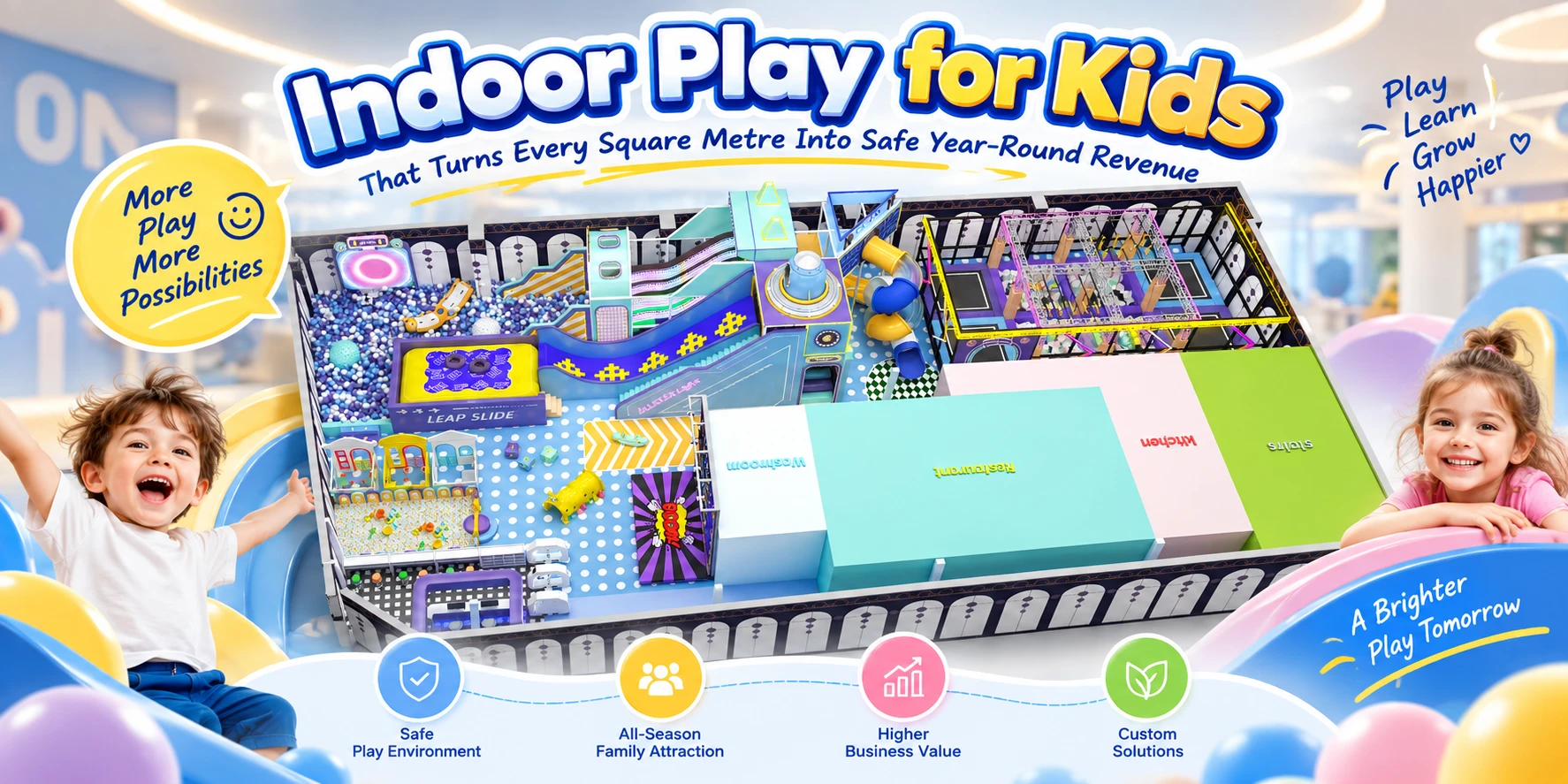
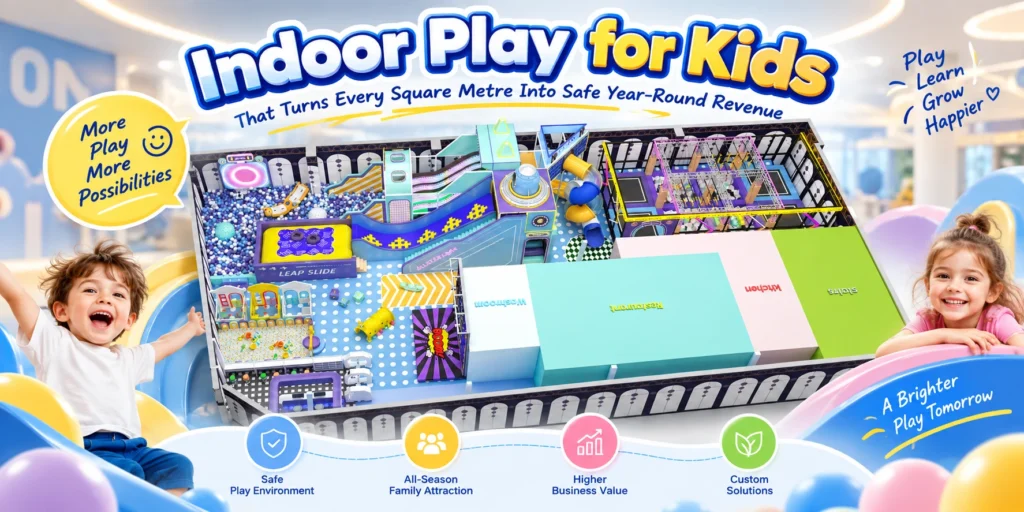
Bad weather can wipe out a week of planned play sessions before lunchtime, leaving parents disappointed and your building quiet. For commercial operators, every empty hour is lost ticket revenue, and hastily planned soft areas create avoidable safety risks. Purpose-built indoor play for kids changes that calculation: a structured zone keeps children active through every season, gives families a dependable destination, and strengthens the business case you present to stakeholders.
Indoor play for kids refers to supervised, weather-independent play environments housed inside a building, typically combining soft play structures, climbing frames, slides, ball pits, and themed activity zones. These spaces are designed for children within defined age ranges and are commonly installed in family entertainment centres, shopping malls, community buildings, schools, and leisure facilities. A well-designed indoor play area balances physical challenge with safety surfacing, clear sight lines for supervision, and layouts that manage capacity and visitor flow.
Here is how those zones are planned, specified, and delivered in practice.
How Indoor Play For Kids Work
Indoor play for kids works by directing children through age-zoned equipment inside a supervised, impact-protected footprint. The operating sequence is straightforward:
- Arrival: log visitors and cap session capacity.
- Zoning: separate under-3s from older children with height barriers.
- Flow: arrange climbing frames, slides, and ball pits as a circuit to prevent crowding.
- Supervision: position open sightlines so staff can watch every zone.
- Rotation: cycle loose soft blocks through a cleaning rota between sessions.
Component roles you should verify
Safety matting absorbs falls, netting contains climbing zones, and fire-retardant foam shapes structure the play area.
If a structure has no impact-test report, the cheapest quote is the costliest risk.
Buyer checks follow the same logic. Confirm flooring impact ratings, tamper-resistant fixings, and compliance certificates before sign-off, then weigh playground quality evaluation against your expected visitor numbers.
Indoor Play For Kids Components and Product Types
Before you compare indoor play for kids suppliers, separate the categories by build layer, not just play value. Each product family changes your flooring, ceiling, and maintenance requirements.
| Product type | Buyer’s key check | Typical placement |
|---|---|---|
| Soft play modules | Foam density, tear-resistant cover, wipe-clean seams | Toddler zones and ball pits |
| Climbing frames and rope structures | Ceiling clearance, anchor strength, fall protection grade | Active zones for ages 6+ |
| Slides and tunnels | Fall height rating, joining hardware, entry-safety design | Mixed-age layouts |
| Trampolines and interactive floor games | Weight caps, netting quality, supervision workload | High-turnover public venues |
Specification checks before any RFQ:
- State foam density, cover grade, colour and logo requirements in writing.
- Name the safety standard you need, such as BS EN 1176, and the age band per module.
- Confirm maximum user weight and cleaning method for each item.
These build choices map directly onto the venues you are equipping, so application fit tends to follow the product type you shortlist first.
Typical Applications for Indoor Play For Kids
The venue’s operating model changes what you buy, the batch size you order, and the compliance evidence you should demand before sign-off.
Malls and retail leisure zones. Continuous footfall favours modular soft play — ball pits, slides, climbing decks — that can be reconfigured when tenant mix changes. Request crowd-load ratings and daily inspection protocols.
Schools and community centres. Mixed-age groups need sensory panels, low-level frames and balance trails. Order volumes run smaller, so ask for batch-level material certificates rather than a single sample.
Trampoline and adventure parks. Daily commercial use requires reinforced frames, thicker impact surfacing and published spare-part lead times.
Pop-up venues. Inflatable units set up fast, but verify anchoring systems and per-session capacity limits.
Use a playground safety inspection checklist as your site audit. That audit feeds directly into a custom OEM specification.
Once your safety audit is complete, the next step is turning those findings into an OEM specification. Custom manufacturing for indoor play for kids follows a predictable path, and each stage needs a defined buyer input and manufacturer output.
| Stage | Buyer input | Manufacturer output |
|---|---|---|
| 1. Design handover | 2D drawings, 3D models or reference photos | Feasibility review, material and structure recommendations |
| 2. Quotation | Target quantity, layout dimensions, delivery deadline | Itemised quote with tooling and lead times |
| 3. Sample confirmation | Approval of prototype, colours, finishes | Corrected pre-production sample |
| 4. Packaging | Crate, foam, label or pallet requirements | Packaging specification sheet |
| 5. Batch inspection | Inspection booking, agreed tolerances | Per-lot inspection reports before loading |
| 6. Shipment | Incoterm, port or site address | Packing list, loading photos, shipping documents |
Inspection detail worth requesting
Ask for weld and fastener checks plus edge-gap measurements matched to your target age range. Keep one approved sample aside as your visual benchmark against production units. That evidence directly informs your supplier shortlist.
Top 10 Indoor Play For Kids Manufacturers and Supplier Fit
Match the supplier model to your venue, not the other way round. These four manufacturing types filter the market before you begin a full commercial play area evaluation.
| Supplier type | Pros | Cons | Best fit |
|---|---|---|---|
| Full-range manufacturers | One contract across slides, climbers and trampolines | Higher minimum order volumes | Large centres wanting single-package procurement |
| Soft-play specialists | Age-tuned safety layouts; faster sample approval | Narrower product range; seasonal queues | Nurseries, toddler zones and school halls |
| Trampoline park suppliers | High play capacity per square metre; proven wear resistance | Stricter matting and inspection standards | Leisure operators chasing throughput |
| OEM modular workshops | Custom colours, bespoke sizes, small batch runs | You supply measured drawings; wider quality variance | Retrofits, community projects, themed builds |
Score each candidate on playground durability review evidence (load tests, weld reports, edge-gap data), sample lead time, packaging fit and spare-parts response.
Sourcing principle: certificates and inspection photos beat pricing promises every time.
Keep your scored list beside the RFQ template; the closing section turns it into a buying decision.
About JQ Playground – commercialplaygroundreview.com
JQ Playground (Wenzhou Jiqi Amusement Equipment Co., Ltd.) is a children’s playground equipment manufacturer founded in 1993. The company provides design, customization, large-scale manufacturing, sales, installation guidance, and after-sales support for outdoor playgrounds, indoor playgrounds, soft play, water playgrounds, PE board playgrounds, kindergarten furniture, outdoor fitness equipment, pet playgrounds, and playground facilities. Approved company facts include 180+ employees, a large Wenzhou production base, 20+ production lines, 55 production machines, ISO/BSCI/EN1176/EN71/ASTM/CPC/CPSIC certification references, 100+ patents, free design support, OEM/ODM capability, trial installation before shipping, export experience, and one-year quality warranty.