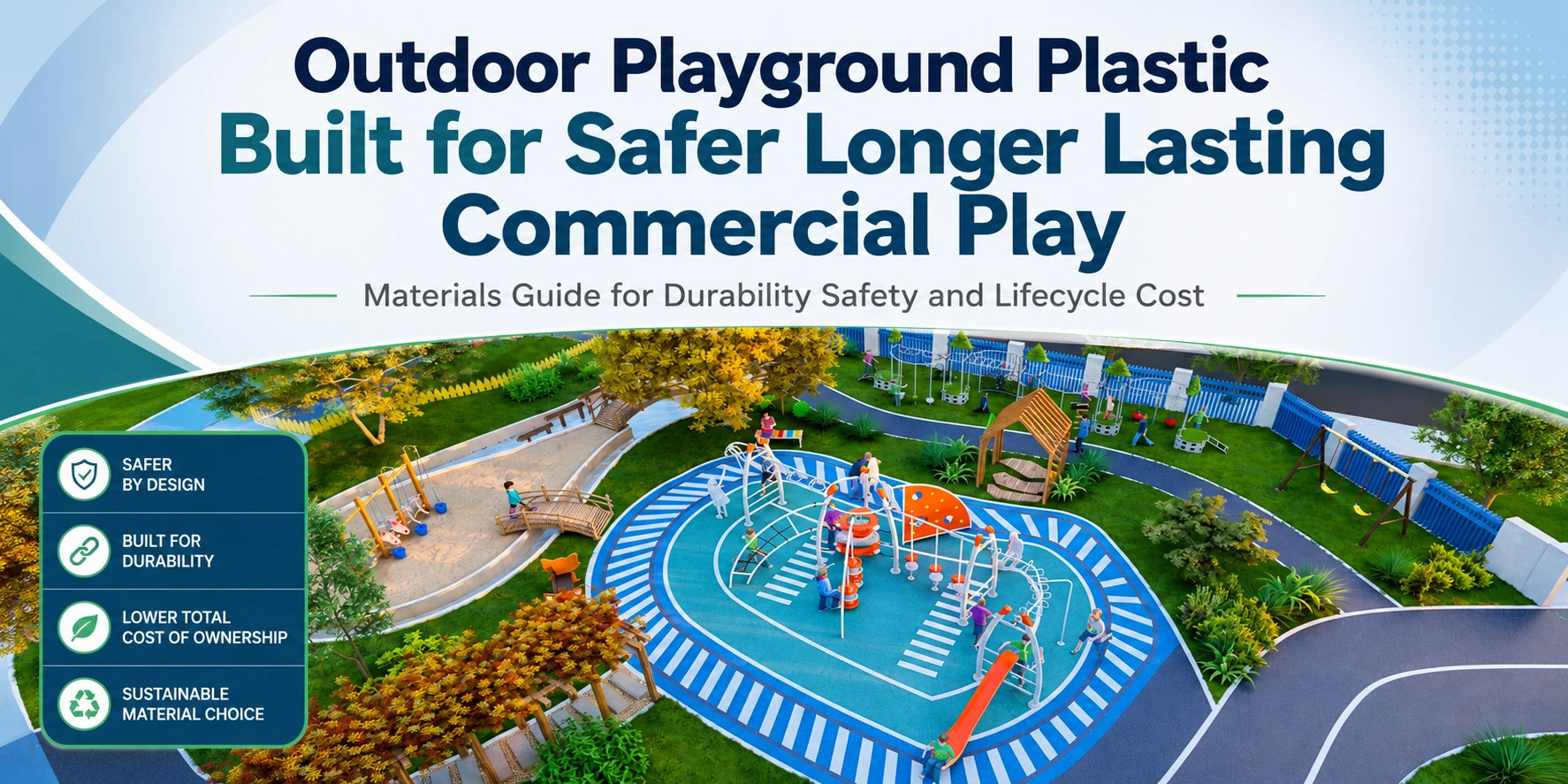
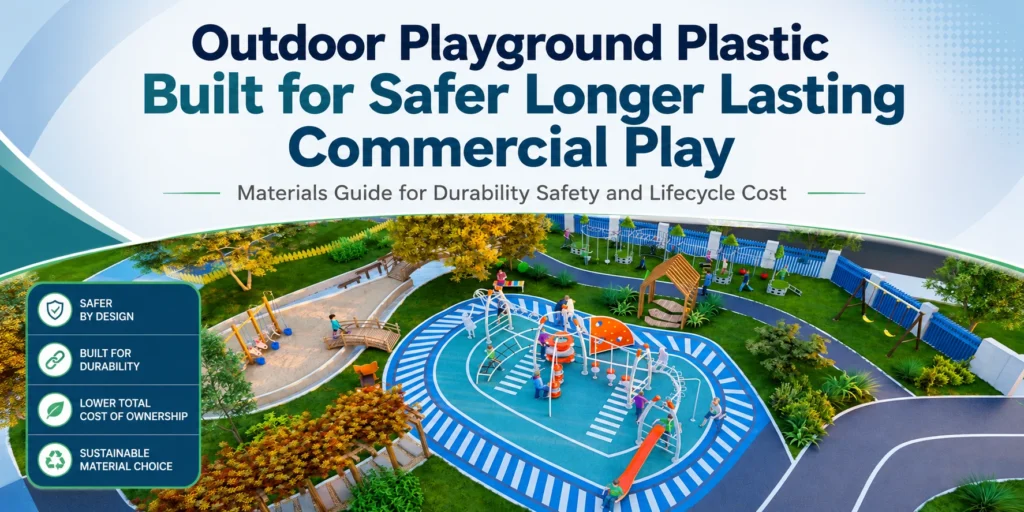
Buying commercial play equipment means judging plastic on three fronts: durability, safety, and lifecycle cost. Get it wrong, and replacement bills arrive long before the warranty expires. Outdoor playground plastic refers to rotationally molded polyethylene, vinyl, and resin systems used in commercial play equipment. These materials dominate slides, panels, decks, and swing seats because they resist UV damage and need no annual painting or sealing. This guide helps procurement teams map material options, product categories, and supplier criteria before issuing a purchase order.
Plastic Resins Used in Outdoor Playground Equipment: PE, HDPE, Vinyl, and Resin
Most commercial play equipment uses four plastic families. Low-density polyethylene (PE) forms single-piece slides and swing seats; it flexes on impact but degrades faster under intense sun. High-density polyethylene (HDPE) is stiffer and more UV-resistant, so manufacturers use it for decks, panels, and climbing structures where load-bearing matters. Vinyl (PVC) is softer, making it a common coating for swing chains and grip surfaces, though it needs periodic checks for cracking. Proprietary resin blends, often rotationally moulded, carry UV stabilisers and colour pigments through the full wall thickness — Step2 and Little Tikes both market these as weather-resistant and low-maintenance.
| Resin | Density | Weather resistance | Relative price |
|---|---|---|---|
| PE | Low | Moderate | Low |
| HDPE | High | High | Medium |
| Vinyl/PVC | Medium | Moderate | Low–Medium |
| Resin blend | High | High | High |
When specifying outdoor playground plastic for high-traffic commercial sites, choose HDPE or a UV-stabilised resin blend; standard PE suits lighter residential use.
Commercial Outdoor Plastic Playground Categories and Equipment Configurations
Buyers sourcing outdoor playground plastic encounter five main categories. Retailer segmentation mirrors them: Backyard Oasis groups residential swing sets; Step2 and Little Tikes lead toddler playhouses; Discount Playground Supply lists commercial playsets and modular systems; Home Depot carries standalone slides.
- Swing sets — ages 2-12, 2-6 stations, HDPE seats and frames with coated chains.
- Playhouses — ages 2-8, 1-2 stations, rotationally moulded PE panels and roofs.
- Commercial playsets — ages 2-12, 5-15 stations, HDPE decks and slides on steel posts.
- Modular systems — ages 2-12, expandable stations, PE panels, tubes and platform decks.
- Standalone slides — ages 2-12, single station, moulded PE or HDPE slide beds.
Commercial units differ from residential in structural reinforcement (steel uprights), concrete anchoring, and compliance testing to ASTM F1487 or EN 1176. Before shortlisting suppliers, specify tower height, slide type (straight, wave, tube), and deck material.
Plastic vs. Wood vs. Metal for Outdoor Playgrounds: Lifecycle and Cost Trade-offs
Choosing outdoor playground plastic over wood or metal changes your maintenance calendar as much as your budget. Step2 markets rotomoulded plastic as low-maintenance; Gorilla Playsets recommends staining and sealing wood every one to two years. That labour compounds across a ten-year ownership period, so total cost of ownership often favours plastic on busy sites.
| Material | Initial cost | Annual upkeep | Typical lifespan | Replacement trigger |
|---|---|---|---|---|
| Plastic (rotomoulded PE/HDPE) | Mid | Wipe down and inspect | 10-15 years | Fading or stress cracks |
| Wood | Lower | Stain/seal every 1-2 years | 8-12 years | Rot, warping, splinters |
| Metal | Mid-high | Rust prevention, repaint | 10-15 years | Corrosion or weld fatigue |
Plastic also wins on safety: it stays cooler than metal in direct sun, contains no splinters, and offers smoother impact surfaces for falls. Confirm fall protection with ASTM F1487 or EN 1176 impact attenuation data, and the reduced maintenance burden will strengthen your commercial playground ROI projections.
Supplier Evaluation and Procurement Checklist for Outdoor Plastic Playgrounds
Vet documentation before you compare prices; brochure claims rarely survive a site audit. Use this checklist as your scoring baseline.
- Ask for material certificates confirming the resin grade, UV stabiliser additives, and production batch traceability.
- Request third-party test reports for UV stability, fall-safety attenuation, and load ratings for decks, roofs, and platforms.
- Separate warranty cover: plastic panels typically carry longer terms than moving parts, bearings, and connectors. Get expiry dates and exclusions in writing.
- Send a structured RFQ covering minimum order quantity, custom colours and configurations, delivery lead time, and on-site installation or assembly services.
Suppliers like Discount Playground Supply advertise HDPE units with multi-year warranties, while World Klass Play lists commercial platforms with custom tower heights. Treat those claims as starting points. Build a playground supplier review into your scoring matrix, then rank shortlisted firms against total playground investment value.
About JQ Playground – commercialplaygroundreview.com
JQ Playground (Wenzhou Jiqi Amusement Equipment Co., Ltd.) is a children’s playground equipment manufacturer founded in 1993. The company provides design, customization, large-scale manufacturing, sales, installation guidance, and after-sales support for outdoor playgrounds, indoor playgrounds, soft play, water playgrounds, PE board playgrounds, kindergarten furniture, outdoor fitness equipment, pet playgrounds, and playground facilities. Approved company facts include 180+ employees, a large Wenzhou production base, 20+ production lines, 55 production machines, ISO/BSCI/EN1176/EN71/ASTM/CPC/CPSIC certification references, 100+ patents, free design support, OEM/ODM capability, trial installation before shipping, export experience, and one-year quality warranty.