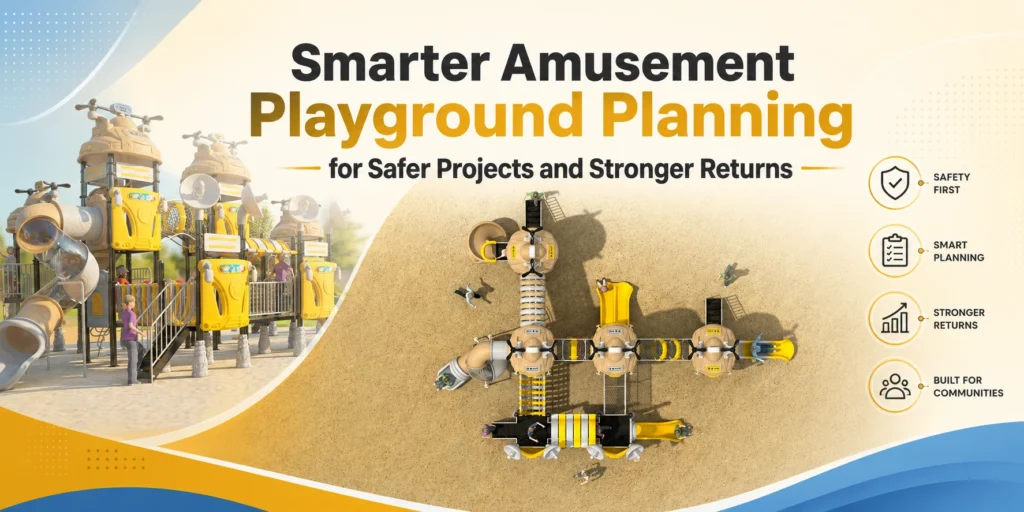
Sourcing commercial amusement playground equipment for your next project involves navigating a maze of options. Whether you are outfitting a community park, a school playground, or an indoor family entertainment centre, each venue demands specific safety standards, space configurations, and budget constraints. The wrong choice can lead to costly retrofits or compliance failures. You may have read commercial playground equipment review articles, but applying that research to your specific venue requires deeper analysis.
Amusement playground refers to a structured play environment designed for commercial use, featuring equipment like slides, swings, climbing frames, and interactive panels. These installations are built to accommodate multiple users daily, with materials and designs that prioritise safety, accessibility, and longevity.
This guide covers the key factors for selecting, evaluating, and maintaining amusement playground equipment for your next project.
Key Buying Criteria for Commercial Amusement Playground Equipment
Safety certifications are the non-negotiable foundation of any commercial playground purchase. In North America, equipment must comply with ASTM F1487; across Europe and many international markets, EN 1176 governs design, installation, and maintenance. Without a valid certificate from an accredited testing body (e.g., TÜV or CSA), your project insurance and liability coverage may be void.
- ASTM F1487 covers load-bearing capacities, fall heights, and spacing requirements to prevent entrapment.
- EN 1176 adds specific rules for swing seats, slide exits, and impact-absorbing surfaces.
- Always request a compliance declaration matching your local jurisdiction before ordering.
Material durability directly affects both safety and long-term costs. Galvanised steel frames should use a minimum zinc coating of 600 g/m² per EN ISO 1461 to resist corrosion for 15-20 years. High-density polyethylene (HDPE) panels should be UV-stabilised to avoid fading and brittleness after five seasons of sun exposure.
- Check that all fasteners are stainless steel or coated to prevent rust.
- Wood alternatives (e.g., recycled plastic lumber) can reduce splinter risk but may require more frequent cleaning.
Total cost of ownership goes beyond the purchase price. Installation typically adds 15–25% of equipment cost for indoor sites and 25–40% for outdoor groundworks. Annual maintenance — inspections, lubrication, resurfacing of impact zones — runs roughly 3–5% of the initial investment.
- A premium-tier playground with a 10–15 year structural warranty often achieves payback within 5–7 years through higher visitor dwell time and reduced repair costs.
- Budget-tier units may need component replacement by year 6, eroding initial savings.
- Request a lifecycle cost estimate from your manufacturer that includes spare part availability and recommended replacement schedules.
Types of Commercial Amusement Playgrounds: Indoor, Outdoor, and Custom Solutions
The choice of playground type directly influences both the initial investment and long-term maintenance costs. Each category suits different venues and operating conditions.
Indoor Playgrounds
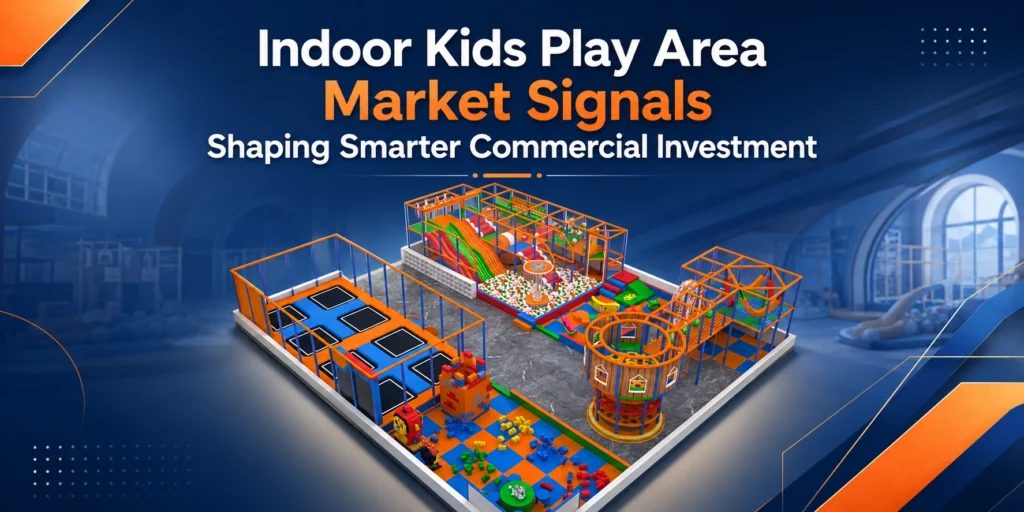
Indoor playgrounds typically use soft play modules, foam pits, and HDPE panels mounted on steel frames. They suit shopping centres, family entertainment centres, and community halls. Material considerations include fire-rated foam, antimicrobial vinyl, and scratch-resistant surfaces. A typical 200 m² indoor setup can host 30–50 children simultaneously. Cleaning protocols and daily inspection affect the playground maintenance cost, which averages 5–8% of the initial build per year.
Outdoor Playgrounds
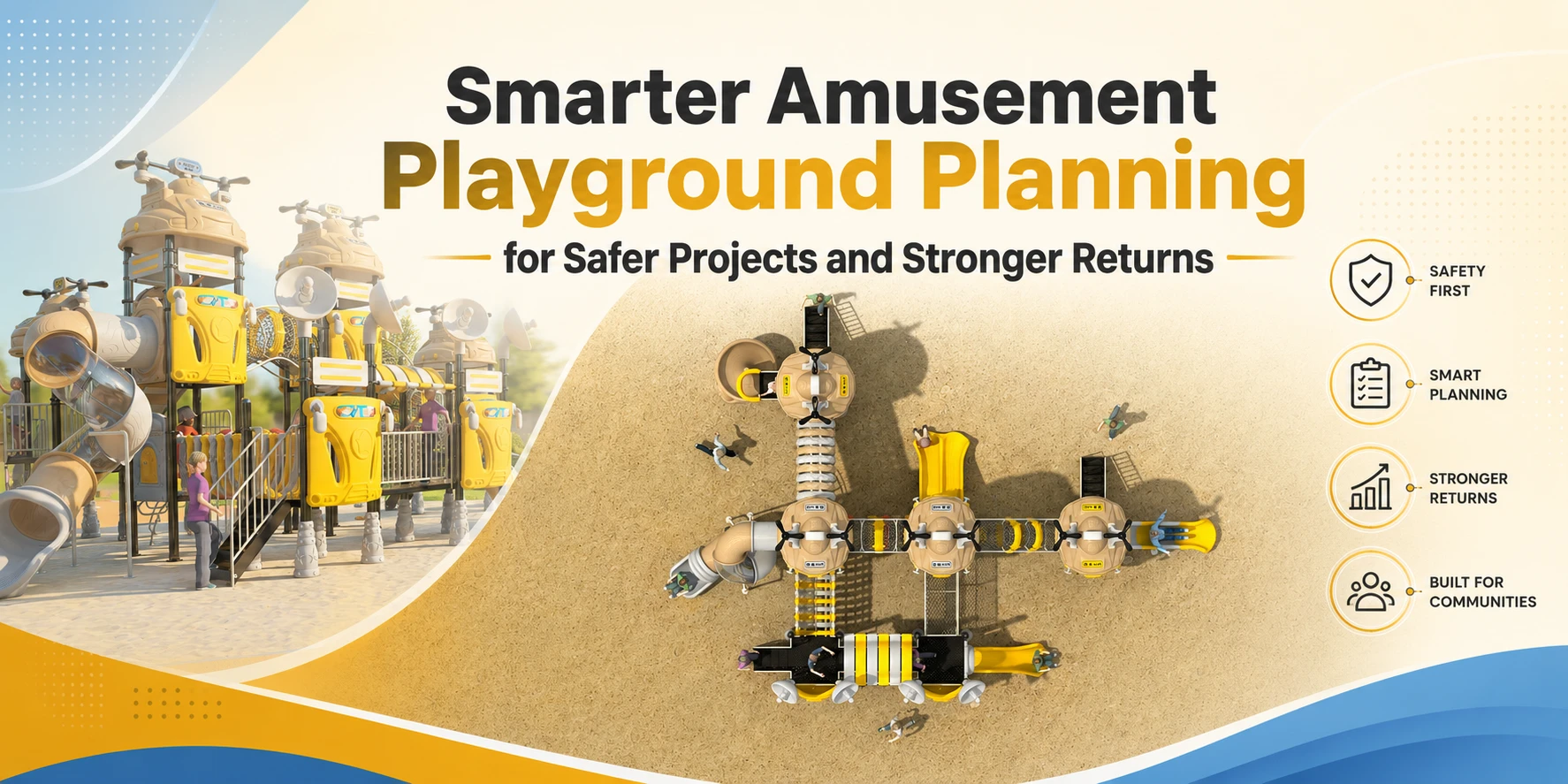
Outdoor playgrounds rely on galvanised steel structures, powder-coated finishes, and impact-absorbing surfaces such as bonded rubber or wet-pour. They are designed for schools, public parks, and housing developments. Inclusive designs now incorporate wheelchair-accessible platforms and sensory play panels. Compliance with EN 1176 is mandatory. The playground lifecycle cost for outdoor units often spans 10–15 years, with annual inspection and replacement of moving parts like swings.
Custom Solutions
Custom-built playgrounds are tailored to a venue’s shape, theme, or brand. Applications include themed areas in leisure centres, naturalistic playscapes in botanical gardens, or compact units for urban plazas. Materials can mix timber, stainless steel, and recycled plastics. Custom designs reduce wasted space and often improve visitor dwell time. However, they require longer lead times (12–20 weeks) and a detailed site survey before quoting.
How to Evaluate Amusement Playground Manufacturers for Your Project
After identifying the right type and design approach, the next step is to evaluate potential manufacturers thoroughly. Use this five-step process to shortlist suppliers that can deliver on safety, quality, and service.
1. Submit a detailed RFQ
Include playground dimensions, user age group, material preferences (HDPE, galvanised steel, timber), expected footfall, and budget range. A responsive manufacturer will confirm feasibility within 3–5 working days. Red flag: vague answers or requests to “choose from a catalogue only”. JQ Playground, for instance, offers free CAD-based design support during the RFQ phase, helping to refine your requirements before quotation.
2. Verify certifications
Request valid certificates for ISO 9001 (quality management), TÜV product inspection, and compliance with EN 1176 (European playground standard) or ASTM F1487 (US equivalent). A credible manufacturer will provide a playground safety inspection checklist as part of handover documentation. JQ Playground holds ISO, BSCI, EN1176, EN71, ASTM, CPC, and CPSIC certifications, demonstrating third-party compliance across multiple markets. Positive indicator: certificates are current and issued by an accredited third-party body.
3. Assess customization capability
Ask how they handle bespoke colour schemes, branded panels, or non-standard dimensions. Reliable manufacturers show at least three past custom projects with photos. JQ Playground employs an 8-person design team and offers OEM/ODM services with over 100 patents, enabling tailored solutions for unique venue requirements. If they cannot modify an existing design within 8–12 weeks, that limits your project scope.
4. Review the client portfolio
Look for completed projects in similar venues – schools, shopping centres, public parks. Request references for at least two projects of comparable size. A manufacturer that avoids sharing contact details is a major warning sign.
5. Check after-sales support
Ask about warranty coverage (typically 5–15 years depending on material), spare parts availability, and annual maintenance services. JQ Playground provides a one-year quality warranty, free replacement of defective parts, and optional on-site installation assistance by sending engineers to your country. Some manufacturers offer a commercial playground ROI analysis based on expected lifespan and maintenance costs. Absence of a structured support plan suggests higher long-term risk.
| Red Flags | Positive Indicators |
|---|---|
| No third-party certifications | Certificates for ISO 9001, TÜV, EN 1176 |
| Vague or delayed RFQ responses | Detailed quotation within 5 working days |
| Only standard designs offered | Proven customisation with photo evidence |
| No client references provided | 2–3 reference projects with contact details |
| No warranty details or parts list | 5–15 year warranty and spare parts catalogue |
Lifecycle Cost and Maintenance Planning for Commercial Amusement Playgrounds
The initial purchase price is only a fraction of the total cost. Factoring in maintenance, inspections, warranty coverage, and replacement parts over 10 years gives the true investment picture. A well-planned lifecycle budget avoids surprise expenses and extends equipment service life.
Maintenance schedules typically include daily visual checks of fasteners, moving parts, and surface condition, plus annual full audits by a certified inspector. Reputable suppliers provide warranty coverage ranging from 5 to 15 years, depending on material type and structural components. Replacement part availability is a key factor in evaluating a playground supplier review — ask for a spare parts catalogue and typical lead times before committing. Manufacturers like JQ Playground maintain large production capacity (20+ production lines) to ensure component availability and quick delivery.
The table below compares three budget tiers across a 10-year operational horizon. These are illustrative ranges for a medium-sized commercial installation (approx. 80–120 m²):
| Budget Tier | Initial Investment | Annual Maintenance | 10-Year Total Cost of Ownership | Typical Warranty |
|---|---|---|---|---|
| Basic | £30,000 – £50,000 | £1,500 – £2,500 | £45,000 – £75,000 | 5 years |
| Mid-range | £60,000 – £90,000 | £2,500 – £4,000 | £85,000 – £130,000 | 10 years |
| Premium | £100,000 – £150,000 | £4,000 – £6,000 | £140,000 – £210,000 | 15 years |
A mid-range choice often delivers the best playground investment value when total cost is weighed against durability and warranty length. For operators, the key is matching tier to expected footfall and regulatory requirements. A lower initial cost can backfire if annual repairs eat into profits. Planned maintenance keeps your playground safe, compliant, and open for revenue generation.
About JQ Playground – commercialplaygroundreview.com
JQ Playground (Wenzhou Jiqi Amusement Equipment Co., Ltd.) is a children’s playground equipment manufacturer founded in 1993. The company provides design, customization, large-scale manufacturing, sales, installation guidance, and after-sales support for outdoor playgrounds, indoor playgrounds, soft play, water playgrounds, PE board playgrounds, kindergarten furniture, outdoor fitness equipment, pet playgrounds, and playground facilities. Approved company facts include 180+ employees, a large Wenzhou production base, 20+ production lines, 55 production machines, ISO/BSCI/EN1176/EN71/ASTM/CPC/CPSIC certification references, 100+ patents, free design support, OEM/ODM capability, trial installation before shipping, export experience, and one-year quality warranty.