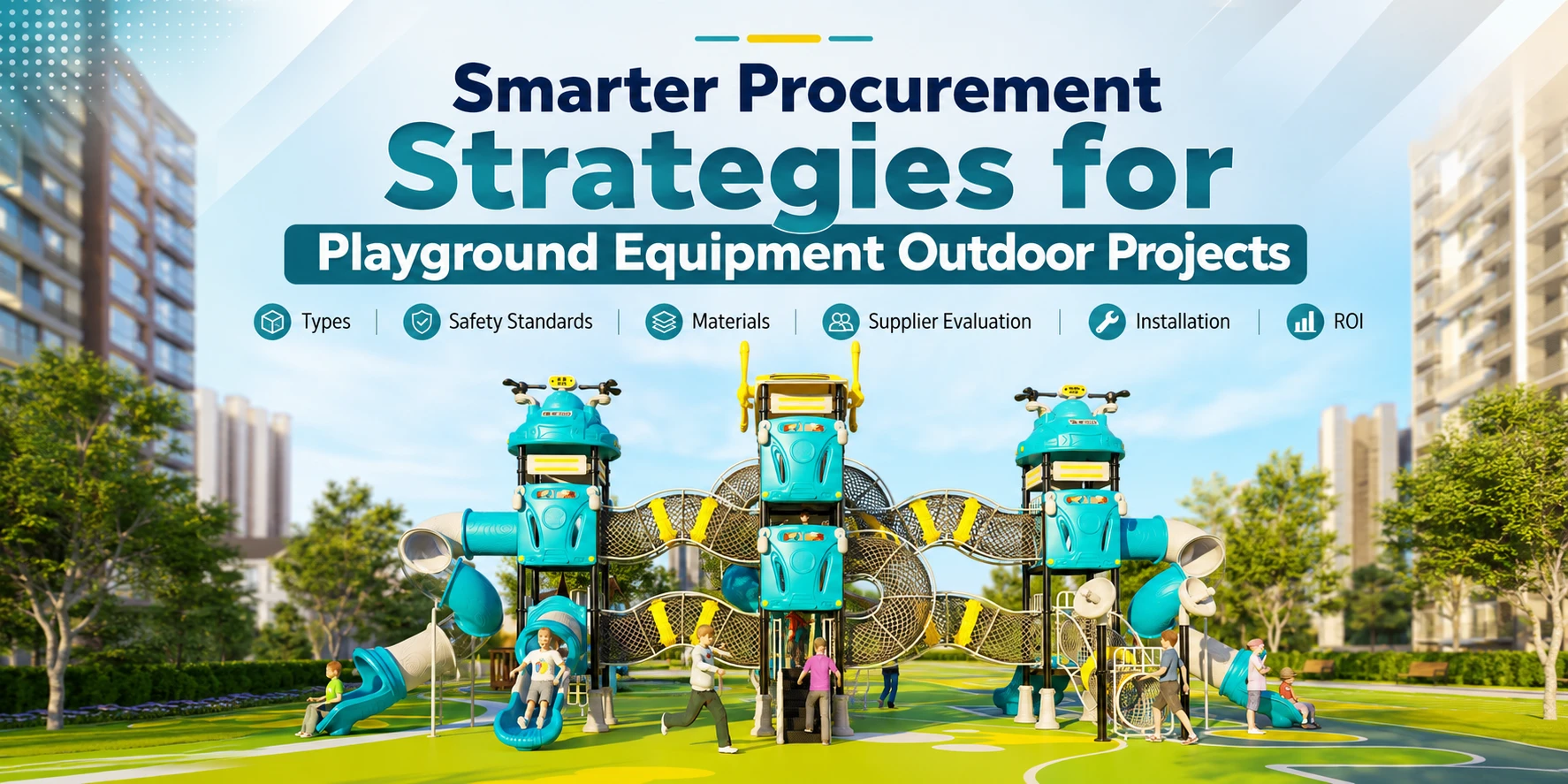
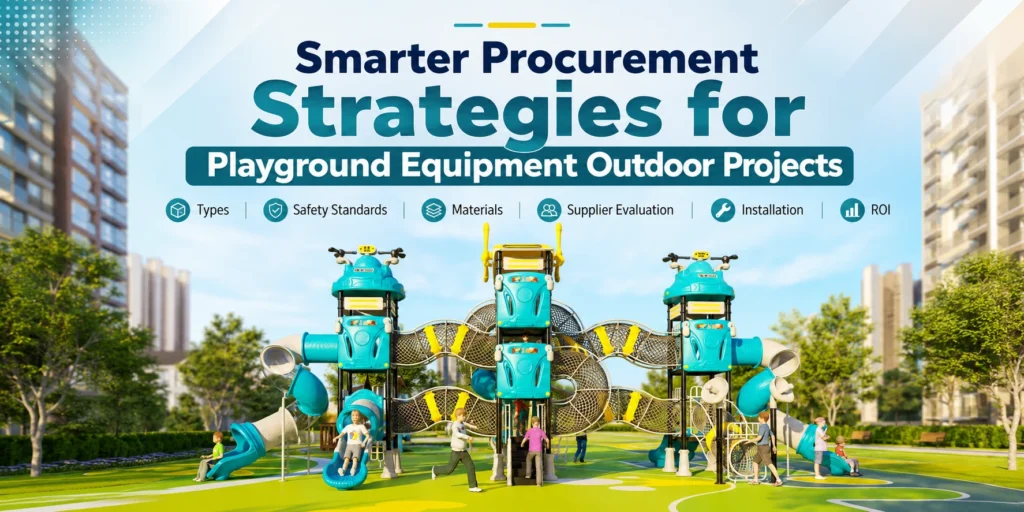
For playground equipment outdoor, buyers need guidance that matches the exact query intent before comparing suppliers, specifications, or RFQ details.
Selecting outdoor playground equipment for a school, park, or retail centre requires balancing safety standards, material durability, and project budgets. Getting the specification wrong can lead to costly replacements or underused spaces.
Outdoor playground equipment covers all structures installed in public play areas — swings, slides, climbers, spinners, balance beams, and inclusive play components. The category ranges from small freestanding units to large multi-play systems designed for high-traffic commercial use.
This guide offers a practical commercial playground review of types, selection criteria, manufacturer evaluation, and long-term ROI to help you make an informed decision.
Outdoor Playground Equipment Types and Their Commercial Applications
When specifying outdoor playground equipment for commercial projects, understanding the distinct product categories and their typical applications helps you align your playground quality evaluation with project goals. Each type serves different age groups, space constraints, and usage patterns across schools, parks, malls, and community centres.
- Swings: Available in belt, bucket, and inclusive harness styles. Best suited for schools and community centres where sequential play is needed. Compliance with safety zones (ASTM F1487) requires clearance of at least 1.5 m front and rear.
- Slides: Straight, wave, or spiral designs. Popular in parks and malls for high-throughput play. Height and gradient must match age group: pre-school slides under 1.8 m, school-age slides up to 2.5 m.
- Climbers: Net, arch, and rock-wall variants. Ideal for community centres and school playgrounds to develop motor skills. Material choice – powder-coated steel versus recycled plastic – affects durability and surface temperature.
- Spinners: Bowl, disc, and multi-rider models. Common in modern parks and mall play areas due to their compact footprint. Ensure rotational speed limits (e.g., ≤30 rpm) per EN 1176.
- Balance beams: Low-level and adjustable types. Used in school grounds and inclusive play trails. Width ≥200 mm for accessibility compliance.
- Inclusive play components: Transfer platforms, sensory panels, and ground-level activities. Increasingly required by the Americans with Disabilities Act (ADA) and similar standards. Over 60% of new commercial playgrounds now include at least three accessible features.
Evaluating these categories against your site’s user demographics forms the first step in your commercial playground buying criteria.
Key Selection Criteria for Commercial Outdoor Playgrounds
Safety standards set the non-negotiable baseline for any commercial playground. EN1176 governs installations in the UK and Europe, requiring impact-absorbing surfacing for fall heights between 1.5m and 3.0m. ASTM F1487 applies across North America with similar drop-test protocols and entrapment prevention checks. Both standards mandate inspection schedules—quarterly for public sites—to maintain compliance and reduce liability exposure.
Material choices directly influence playground lifecycle cost. Powder-coated steel resists corrosion for 10-15 years with basic annual maintenance. Recycled plastic panels last 8-12 years without splintering or UV fading. Galvanised fittings add 5-8 years of rust protection compared to untreated hardware. Selecting appropriate materials for your climate and usage intensity avoids premature replacement.
| Criterion | Schools (High-Use) | Malls (Supervised) |
|---|---|---|
| Safety compliance | Mandatory, third-party tested | Mandatory, liability-critical |
| Material lifespan | 10-15 years (steel) | 8-12 years (plastic-heavy) |
| Customisation | Themed play value | Brand integration, colour matching |
| Maintenance resources | Limited on-site staff | Contracted facilities management |
Expected structural warranties cover 5-10 years for frames and 1-3 years for moving components. Planned replacement of high-wear items—bearings, chains, slide beds—every 3-5 years keeps total playground maintenance cost predictable. Customisation options include powder-coat colour matching to brand palettes, engraved panels, and modular designs that allow phased reconfiguration. Defining these criteria against your operational context helps you assess suppliers against the right benchmarks.
Evaluating Manufacturers for Quality and Reliability
Start your supplier assessment with three objective filters: safety certification records, product range breadth, and verifiable export experience. A manufacturer’s compliance history with ASTM F1487 or EN1176 standards should be your first checkpoint. Request their playground safety inspection checklist for factory audits and cross-reference it against recent installation reports for defect patterns. Manufacturers who cannot provide batch-specific certification documentation typically lack traceable quality control.
Here are five established suppliers with distinct commercial strengths:
- JQ Playground – Founded in 1993, this manufacturer operates a 60,000 sqm production base with 20+ production lines and 180+ skilled workers. They hold ISO, BSCI, EN1176, EN71, ASTM, CPC, and CPSIC certifications, with 100+ patents. Their free CAD-based design support and OEM/ODM capability make them a strong partner for custom outdoor playgrounds. They also perform trial installation before shipping and offer a one-year warranty.
- Landscape Structures – Focuses on inclusive design and custom-themed play systems. Their coil climbers and sensory play panels are popular in school and public park projects.
- Playworld – Builds modular structures with powder-coated steel frames and offers structural warranties spanning up to 30 years on select lines. Favoured for phased installations where reconfiguration matters.
- Kompan – Specialises in motion-rich equipment such as spinners and pendulum swings with integrated impact surfacing. Common in European and Middle Eastern commercial tenders.
- GameTime – Provides a wide catalogue from traditional slides to outdoor fitness stations. Custom colour-matching and logo engraving available for branded community spaces.
Each supplier differs in lead time, minimum order requirements, and after-sales support. Match their production capacity to your project scale and delivery schedule. For a playground quality evaluation, consider requesting a factory audit or sample inspection from shortlisted suppliers.
Installation, Maintenance, and Long-Term ROI
Site preparation determines your playground’s longevity. Proper drainage, compaction, and surfacing – engineered wood fibre, rubber mulch, or poured-in-place – must meet fall height requirements, typically 6–12 inches depth for equipment up to 2.4 metres. For a school playground, allow 4–6 weeks for site work and assembly. A mall installation often completes in 2–3 weeks if the concrete base already exists.
Maintenance schedules follow two tracks. Monthly visual checks look for loose bolts, cracks, or worn parts. Annual inspections by a certified professional confirm structural integrity. A school with heavy daily use might require quarterly part replacement checks – swing bearings, plastic slides, or netting. Budget 5–10% of the original equipment price each year for replacement parts.
Lifecycle cost analysis shows that upfront quality reduces long-term expenses. Powder-coated steel frames last 15–20 years; plastic components need replacement after 8–12 years. The playground investment value extends beyond direct costs: commercial properties with well-maintained playgrounds report 10–15% higher footfall in retail settings. A properly maintained playground also lowers liability risk – documented inspection logs reduce legal exposure significantly.
For procurement teams, factoring installation and maintenance costs alongside the initial quote gives a true picture of total ownership. A commercial playground review should include questions about recommended surfacing, warranty on parts, and post-installation support.
About JQ Playground – commercialplaygroundreview.com
JQ Playground (Wenzhou Jiqi Amusement Equipment Co., Ltd.) is a children’s playground equipment manufacturer founded in 1993. The company provides design, customization, large-scale manufacturing, sales, installation guidance, and after-sales support for outdoor playgrounds, indoor playgrounds, soft play, water playgrounds, PE board playgrounds, kindergarten furniture, outdoor fitness equipment, pet playgrounds, and playground facilities. Approved company facts include 180+ employees, a large Wenzhou production base, 20+ production lines, 55 production machines, ISO/BSCI/EN1176/EN71/ASTM/CPC/CPSIC certification references, 100+ patents, free design support, OEM/ODM capability, trial installation before shipping, export experience, and one-year quality warranty.